2025 North Sound Leadership Conference Sessions
We are excited to offer two in-person days of professional development - one in Seattle and one in Tacoma - dedicated to thanking, inspiring, and empowering The Mountaineers current and aspiring volunteer leaders. Both conferences will offer equivalent content, with a similar line-up of presenters, expanding our reach and giving volunteers the flexibility to select the program that is most convenient for them. Join us at one of our Leadership Conferences!
Presenters
- Click here to view a list of the North Sound Leadership Conference presenters
Session tracks
A series of interactive sessions will explore the many facets of leadership through our three session tracks:
- Tactical Decisions: Delve into strategies and best practices for identifying, assessing, and mitigating risks through expert insights.
- Sustainable Impact: Discover more about the public lands and wildlife that we enjoy and how to learn from and protect them.
- Resilience Strategies: Dig deep into the mental health tools and strategies for outdoor resilience.
Breakout Sessions
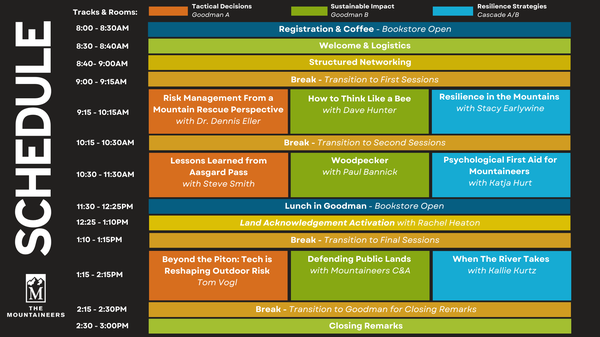
8:40-9:00PM
Land Acknowledgement
RACHEL HEATON | Goodman A/b
Land Acknowledgement
9:15-10:15AM
Risk ManaGEMENT From A Mountain Rescue Perspective
DR. DENNIS ELLER | Goodman A
Tactical Decisions Track
Risk management in the outdoors looking at the impacts from a Mountain Rescue Technician’s perspective. Analyzing steps and actions that should be taken before, during, and after a trip. Discussing impactors that affect decision making, reporting, and assessing risks as a trip leader or a participant. Those attending will walk away with ideas on how to create their own checklists for risk assessments, discussion of various rescue scenarios, and what could have prevented them- with a focus on our PNW region from the viewpoint of a Mountain rescue and guide specialist in our region.
Think Like A Bee!
DAVE HUNTER | Goodman B
Sustainable Impact Track
Join Dave Hunter, founder of Crown Bees and a leading expert on cavity-nesting bees, for a fascinating look into the world of North America’s 3,600+ native bee species. Through stories, science, and firsthand experience, you’ll uncover how solitary bees live, nest, and thrive—and why they matter more than ever.
Dave will share how shifting perspective—learning to “think like a bee”—helped Crown Bees empower gardeners and conservationists across the country. This mindset shift opens the door to broader insights: when we think like a bee, we also start to “think like a bear,” a bird, or a tree—building deeper connections with the living world around us.
You'll also explore Crown Bees’ approach to rewilding communities by restoring habitat and reconnecting people with nature—one yard, park, and neighborhood at a time.
Resilience in the Mountains
STACY EARLYWINE| Cascade a/B
Resilience Strategies Track
Have you ever felt paralyzed by fear in the mountains? Or felt the need to agree with others against what your intuition was telling you? Have you experienced a difficult or terrifying situation that has been hard to deal with, even months or years after the event? When crisis situations arise in the mountains, our brains sense the stress and the nervous system reacts, often without our conscious input. These reactions may be unhelpful in a crisis. Instead, when we can connect - to our body, our environment and others - we will respond more calmly and effectively. Join me in an experiential exploration of the nervous system and how we can harness it’s power to help us stabilize any situation in the mountains and beyond.
10:30-11:30AM
Lessons Learned From AasGard Pass
STEVE SMITH | Goodman A
Tactical Decisions Track
In 1998, Steve Smith had a near-death experience while descending Aasgard Pass, near Leavenworth, WA. He glissaded into a (nowwell-known) waterfall hole in the snow, and was stuck beneath the snowpack in running water, almost dying of hypothermia. This is the story of his improbable escape, and the lessons learned in the aftermath. More than just a technical analysis of the incident, this is a deep dive into post-incident trauma, shame, recovery, and restoration.
Woodpecker
PAUL BANNICK | Goodman B
Sustainable Impact Track
Woodpeckers are one of the most remarkable bird species found in the avian world. They have evolved in ways that make them ecologically critical to forest health, serving as keystone species in a variety of wooded habitats across North America. Their activities support a variety of other creatures, making them catalysts of diversity in the places they inhabit. They are, in many ways, the heartbeat of the forest.
Informed by his own experiences in the field as well as extensive research, author and photographer Paul Bannick delves into the natural and cultural history of woodpeckers from the boreal forest of northern Canada to oak woodlands and conifer forests in the United States to the wet tropical forests of Mexico and the Caribbean. He captures the woodpeckers’ charismatic behavior as well as their colorful displays and sensitive habitats in astonishing images. And with accessible, science-based text, Bannick explores their courtship and nest selection process in spring; life in the nest during summer; fledging and gaining independence in autumn; and the challenges of winter survival. He compares and contrasts typical behavior and anomalies among the 41 woodpecker species in North America, and shares their conservation outlook for the future.
Psychological First Aid for Mountaineers
KATJA HURT | Cascade A/B
Resilience Strategies Track
Come learn the fundamentals of supporting someone through a crisis
using psychological first aid. This course provides an introduction to Critical Incident Stress Management (CISM) and includes recognizing the signs/symptoms of stress injuries and how to respond when someone experiences a traumatic event. This training is appropriate for all levels of experience, from professional responders to caring community members.
1:15PM-2:15PM
Beyond the Piton: Technology is Reshaping Risk in the Outdoors
TOM VOGL, Mountaineers CEO | Goodman A
This past May, three climbers died in a tragic accident in the Early Winters Couloir in the North Cascades near Washington Pass. The simplistic cause of the accident was a catastrophic anchor failure, that occurred when the climbing party was rappelling down the couloir off a single piton. Like many accidents, secondary causes played a significant part in decisions that ultimately ended in the climbers’ decision to rappel off that piton. Did technology play at least some role in this accident? At least in some ways, yes.
Technology is changing the way we plan and experience outdoor activities - both in positive and problematic ways. In this session, Mountaineers CEO Tom Vogl, will share his personal experience and observations as a climber, backcountry skier and avalanche instructor. He has also been studying how the explosion of user-generated digital content and AI-driven search results is impacting risk management in the outdoors - sometimes in dangerous and deadly ways.
Come learn how you can incorporate these learnings into your own outdoor toolboxes, especially as you plan and lead courses and trips as an outdoor educator.
Defending Public Lands: Grassroots Advocacy for Outdoor Leaders
MOUNTAINEERS CONSERVATION & ADVOCACY TEAM | Goodman B
Sustainable Impact Track
During a challenging time for our lands, waters, and climate, outdoor leaders have a critical role to play in advocacy. Staff on The Mountaineers conservation team will share timely updates on emerging threats to public lands and how we’re responding. Join us to connect and learn how to use your platform as a leader to take your outdoor advocacy to the next level. Together, we can make strides to build back the federal land manager workforce and keep public lands in public hands.
When the River Takes
KALLIE KURTZ | Cascade A/B
Resilience Strategies Track
The outdoors gives and it takes. For those who spend their lives in wild places, loss is not an abstract idea. It’s the friend pinned in a rapid, the partner buried in an avalanche, the fall on a mountain that changes everything. These moments don’t just pass; they live in our bodies, influence our decisions, and reshape the way we return, or sometimes can’t return, to the river, the peaks, or the trail.
This session explores how trauma, stress, and loss affect our minds, bodies, and communities during and in the aftermath of outdoor crisis. We train to respond to medical emergencies, but rarely are we taught how to emotionally deal with or recover from them. What happens in the moment when everything goes sideways, when fear takes over, when leadership demands calm inside chaos, when someone doesn’t make it home? And what happens afterward, when the adrenaline fades and grief quietly begins to take hold?
We’ll explore the behavioral health side of outdoor crisis and recovery how the nervous system responds in real time, how trauma manifests later, and how to process loss in ways that build resilience instead of isolation.
When the River Takes invites paddlers, climbers, rescuers, leaders and adventurers to meet trauma and loss with honesty, compassion, and care because how we tend to these moments determines not only if we return to the places we love, but how we return.