 Thomas Bancroft
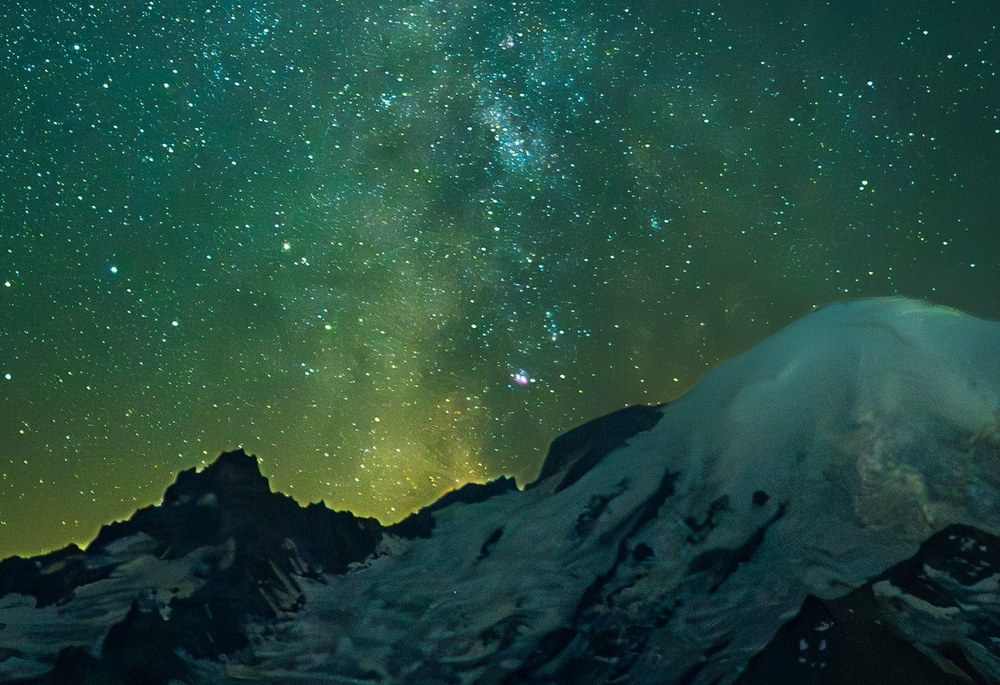
The wind whistled through whitebark pines and subalpine firs. This August Friday had been hot at Mount Rainier, but with the sun beginning to set behind the volcano, temperatures cooled rapidly at these elevations. The meadows along Sourdough Ridge glowed in the warm afternoon light.
Cascade asters still bloomed, and the seed pods of western pasqueflowers dotted the open areas. Several juncos flitted between bushes, and a chipmunk scurried across the trail. My goal was to find a piece of the trail along the ridge where I might be protected from the wind as well as the glare from all the headlamps of nighttime hikers. Friday was the first night of the Black Moon, (also known as the New Moon, when the moon appears invisible from Earth) and the stars were expected to shine brightly.
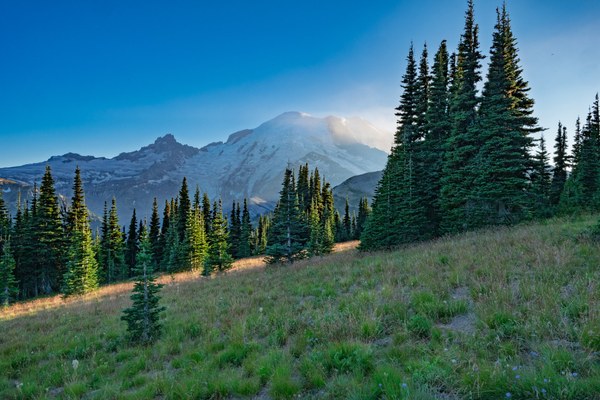
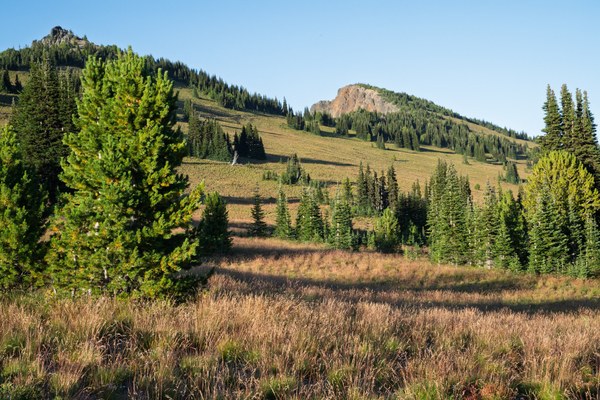
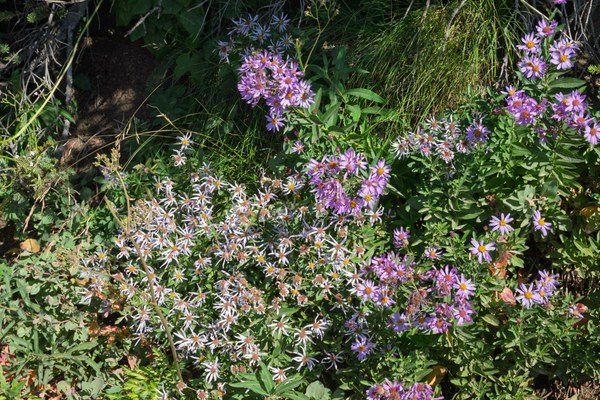

Back in 2013, I had hiked to Sourdough Ridge on a July evening. Two couples were on the crest when I arrived at about 10:30pm and stayed until midnight, never turning on a light. In 2022, I expected something similar when I brought a Mountaineers group to photograph the Milky Way. Instead, the place was overrun with stargazers. Those who had come to photograph the sky stayed on the trail and didn’t turn on their headlamps.
Over the previous decade, hiking to Fremont Lookout to watch the sunset had become popular. From dark until well after midnight, more than a hundred returned with headlamps blazing. But the real crowd was people who’d come to watch for meteors. Thousands jammed the parking lot; cars were parked on the fragile meadows; hundreds hiked the trails, and many ignored the etiquette to stay on the trails and off the fragile subalpine meadows. The disaster led the park service to increase the number of volunteers available on meteor-intense nights. The Mountaineers and outdoor community's efforts to educate people, especially those new to wild areas, remains paramount.
Friday
A side trail about a mile from the trailhead climbed above the main route. At an elevation of 6,900 feet, a wide spot provided a suitable place to set my tripod. From behind me, a Clark’s nutcracker called. Perhaps they had started harvesting whitebark pine seeds. No visible sighting, but it was fun to know they had joined me. The mutualistic relationship between pine and bird is astounding, complex, and a joy to think about.
The panorama, though, needed some attention. Cowlitz Chimneys rose to the south and left, shadowed by the volcano. Sunlight made the top of Goat Island Mountain glow. Little Tahoma and Disappointment Cleaver were left of the summit. A cloud over Willis Wall took on a reddish glow.
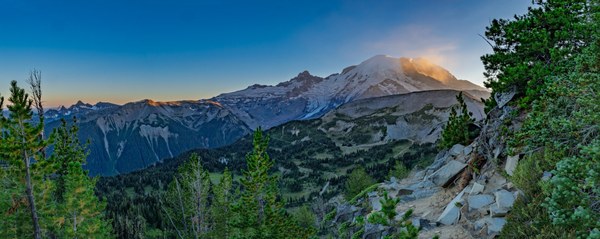

It was 8pm, and there were still 80 minutes until astronomical twilight. Burroughs, Shadow Lake, and the western side of Yakima Park all had the first hints of night. Over the previous ten days, I’d hiked these areas as well as the valley below the Emmons Glacier. For twenty minutes, I scanned every detail of the scene, thinking about all that had happened here.
Mount Rainier is only a little over half a million years old, and the rocks upon which I stood flowed as andesite lava about 504,000 years ago. That eruption was one of the first in this volcano’s existence. Others had grown, died and eroded away in this area before that. Goat Island Mountain, however, is composed of rocks that solidified much longer ago, during the late Eocene and Oligocene epochs. Mind-boggling!
At 9:30pm, the sky still had a hint of blue from the sun’s rays curling over the horizon. I started the intervalometer, setting it to take a 10-second exposure every 11 seconds, and sat cross-legged to watch. With my Mountaineers warm cap and a pair of gloves on, I huddled in between two rocks and ate a sandwich I’d made at camp.
The skies continued to darken for another ten minutes, allowing more stars to become visible. Scientists say it takes twenty minutes before one’s eyes become fully adjusted to the darkness. A bright light, even for just a second, resets that ability. Apparently, a red light allows one to maintain their night vision. I had bought a new headlamp this spring with a red mode. If everything went as planned, I wouldn't need to turn on any lights, not even a red one, until 2am.

By 9:40pm, the Milky Way was prominent, rising vertically from well left of Little Tahoma Peak. The Milky Way is the dense concentration of stars visible when looking through the center of our spiral galaxy, spanning its thickest extent. Astronomers refer to this as our galactic center, the rotational center of this massive spiral collection of stars. Somewhere along one edge of that dark space is the black hole that marks the central point of these galactic arms. The black hole, known as Sagittarius A, consists of a mass equivalent to 4 million suns.
My eyes ran up the streak of dense stars, and I leaned back to look straight over my head. The lower part of the Milky Way had a dark streak with few visible stars. According to astronomers, more stars are there, but a thick layer of cosmic dust blocks them from view.
The Milky Way became visible as astronomical twilight progressed toward night. It rose from the south and went over our heads. As the night progressed, the Milky Way moved across Little Tacoma and Rainier’s summit. 22 August 2025.
What is it about the night's stars that can turn one’s soul?
Streaks of light zipped across the sky, most coming right to left, many fast. A few that had blinking lights were clearly airplanes. Most, though, were satellites or space junk left by previous missions. For the first hour after sunset, many of these satellites catch the rays of the sun, sparkling as they rotate. I wished some might be meteors, but they generally lasted too long and lacked the tapered shape typical of a rock burning-up in the atmosphere. There seemed to be far more satellites than I’d ever seen before. At times, they looked like laser beams, maybe those phasers of Star Trek fame or photon torpedoes!
Back at my house, repeated playing of the time-lapse showed just how much stuff we humans have put into the sky. Even on a wilderness ridge, those objects still emphasize our capitalistic nature, but they also symbolize our quest for knowledge and understanding. I’d started my GPS unit at Sunrise, and some of those satellites allowed me to log a detailed track of this hike.
The first hint of a climbing party appeared on the mountain at 11:44pm when a red light began to glow. They were left of Disappointment Cleaver, possibly coming toward the rocks. Their lights turned white by 12:08pm. Other parties started to appear, and some moved along the edge of Disappointment Cleaver as my 2am stop point drew near.
I was surprised by how few climbing groups there were, and that none had started from Camp Schuman to climb the Emmons Glacier route. In 2013, one of the enjoyable aspects was watching the progress of several climbing parties as they moved up Emmons Glacier, while others came from Camp Muir, like a white snake weaving through the landscape. Possibly, Saturday, the next night, had more parties.
Only four people had come by me since it got dark. Four backpackers crested the ridge to head for Forest Lake Camp. It was after 10pm, and they rushed. They said they knew the trail down the north side of Sourdough Ridge was steep, for I had warned them to be careful.
For me, coming down from the crest of Huckleberry Trail was a slow process - I took it one cautious step at a time. Both my hiking poles were critical in maneuvering the numerous rocks and down steps. That section was the part I feared. My balance at 73 wasn’t what it had been. Disassembling my camera setup and repacking my backpack required that I sit on the ground. Twice, I almost lost my balance. During the previous ten days, I had done these tasks while standing numerous times, but the dark gave a new sense of reality.
The chatter of people along Sourdough Ridge was evident even before I reached it. The mile hike back to the Sunrise parking lot was crowded, although not as much as during the day. However, it seemed that many people were there, including numerous couples and groups of up to six. Often, there would be only one or two flashlights in a group. Of all the people I saw, only one person appeared to have a tripod for star photography. Car lights came and went along the Sunrise Road. At 3am, when I walked into the parking lot, I was shocked to find it almost half full of cars. Dozens of people hung about, chatting and getting ready for a hike. It seemed like a weekday with the crowd. I counted 54 cars coming up the hill before I reached the turnoff for the White River Campground. What might Saturday be like?
Saturday
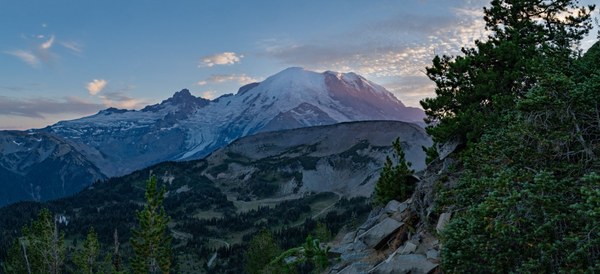
Scattered clouds moved across Mount Rainier and along the Cascades as my friend, Carla Conway, and I started up the trail from Sunrise. The New Moon would make it an ideal time to see the Milky Way. The clouds, though, made me nervous, but they could also add some dramatic texture to the changing scene. Perhaps they would only be scattered and not block out too many stars.
The parking lot seemed less crowded than the previous evening, and surprisingly fewer people seemed to be along the trail. The sky was predicted to be as dark as Friday, so where were the crowds? No one was at the site I’d picked, but four young men had climbed off the trail to be above us at a small peak on Sourdough Ridge. Hopefully, their headlamps wouldn’t cause us problems when they descended, and they wouldn’t damage this fragile ecosystem by being off trail.
We clicked on the intervalometers and began photographing at 9:26pm. The night would continue to darken for fifteen minutes. Already, one climbing party’s lights showed just left of Disappointment Cleaver, and as the night progressed, more appeared on the route from Camp Muir. I poured two small glasses of wine for us to toast the night, the stars, and us being in the wilds. How many stars might be visible, how many worlds like ours might be circling those burning gas masses?
At one point, I counted at least seven different climbing parties. What thoughts were running through the minds of the climbers? If two were close together, at our distance, they might appear as one, a light snake. Still, none appeared along the Emmons route.
The Milky Way became visible as astronomical twilight progressed toward night. It rose from the south and went over our heads. As the night progressed, the Milky Way moved across Little Tacoma and Rainier’s summit. 23 August 2025.
I’d texted a climbing friend, Danielle Graham, that I’d not seen any climbers on Emmons Glacier the previous night. She sent a link to a Park Service blog on climbing conditions, explaining that the Emmons Route - best done early in the season - had been mostly shut down by late July.
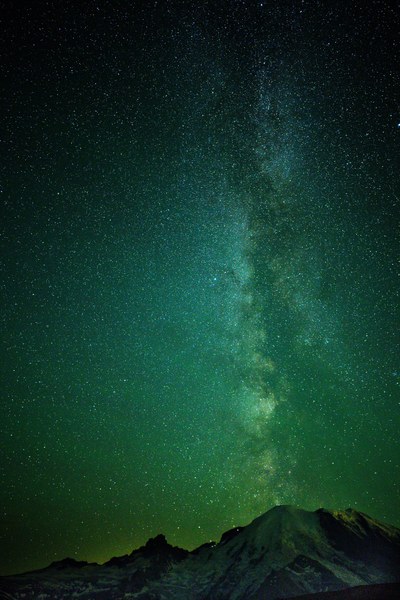
At 2am, as we shut down our cameras, the lead group from Camp Muir still had a way to go, probably another four hours, maybe more, to reach the summit. The time-lapse I put together later showed the groups working along the slope, gradually making progress. I was tired, stiff, cold, and ready to leave by 2am. But could I make it to 6am on a future trip and capture the climbers until they disappeared with dawn? The Milky Way had passed out of my frame by 2am, and would the climbers and stars be enough to maintain an engaging video? Maybe!
Leaning on my poles, with a backpack over my shoulders, I stared at the summit, wondering where my fascination arose. A New Moon on July 13, 2026, might be perfect for capturing climbers on both routes while the Milky Way passes over the mountain. Put it on the calendar, Tom, and order up clear weather and strong legs!
As we approached the main trail along Sourdough Ridge, a backpacker seemed to be waiting for us. He had a tripod on his back and a camera around his neck. He was headed to Second Burroughs to watch the night give way to daytime — another place and time I’d like to put on the agenda. Published photographs of the mountain with the sun starting at its peak and working down the eastern slope have been awe-inspiring. I’ve been told the summit lights up well before the sun rises above the horizon. Seven thousand more feet make a difference. It would also be a good location to photograph the Milky Way as it moves over Little Tahoma and across the summit. Could I be in two places at once?
Neither the trail nor the parking lot was as crowded as it had been the previous night. Still, there were many people, and we passed a dozen groups heading along Sourdough Ridge as we descended. Thirty-four cars came up to Sunrise as we drove back to White River Camp.
In camp, I sat in my chair, head leaned against the back so I could stare directly up through the canopy of Douglas firs, subalpine firs, western hemlocks, and red cedars. Stars twinkled in the infinite space.
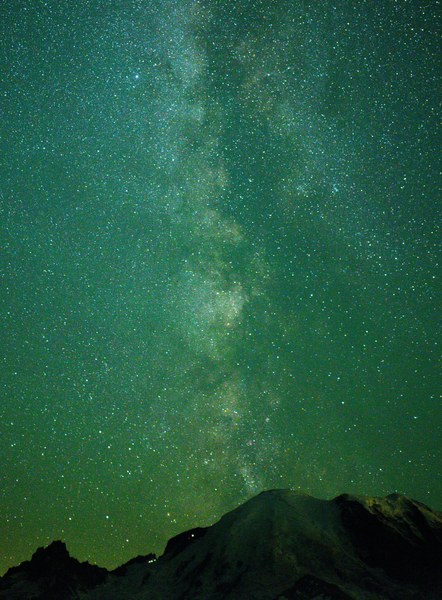 At 12:22PM, the Milky Way is about to reach the summit of Mount Rainier. The climbers, though, have a lot of up hill to go. May their legs hold out and they reach the summit with energy to enjoy the view. I've never had the strength or ability to achieve this goal. I envy the experience and view.
Being in the wilderness always gives me a sense of humility. Watching the Milky Way and contemplating the universe, our sun, and this planet makes me feel incredibly small and insignificant. The time frames of the objects in outer space are incomprehensible, and our time on Earth is so short. But we can still strive to understand, build empathy, and care. Six hours spent sitting in one wilderness spot was mystical, and my words are ineffable to describe the experience. It is an honor and a privilege to have these wild areas. We must continue to protect, fund, and support our public lands.
If you're interested in learning more about how you can support our public lands, consider joining me in attending An Evening of Advocacy on September 18, 2025.
Add a comment
Log in to add comments.
Since I like to be asleep long before the Milky Way appears, I am so appreciative of this blog and you taking us armchair traveling with you. The photos are stunning! See you on the 18th at the Evening of Advocacy.
