 Reine Abubakar
I was sitting in the third row of a large SUV, eyes wide as my sister passed an empty Oreo tray to the back of the car. My family had cracked open a window and gathered falling snow on the plastic lid, passing the snack tray from seat to seat excitedly as if they had captured a piece of magic. The mound of tiny ice crystals glittered under the car’s dome light. My first snowfall.
We didn’t have snow where I grew up, and it wasn’t until after we moved to the United States and traveled to Lake Tahoe that I finally pieced together how snowflakes look exactly like the paper cutouts if you look close enough. Staring at the flat blanket of white outside the car window, I wondered how such intricate patterns could so easily disappear in the vastness.
A new kind of wintering
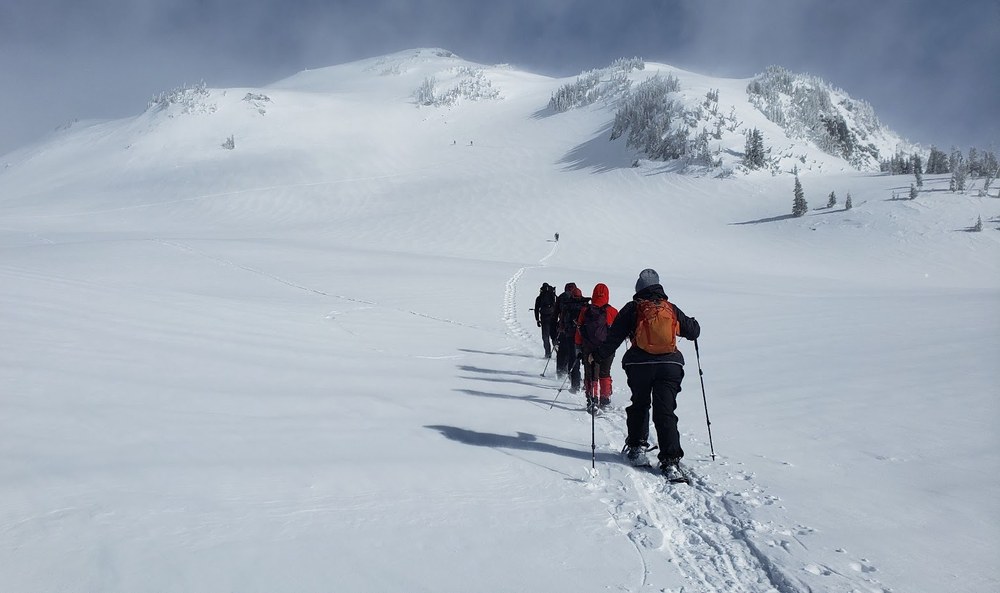
Nearly 20 years later, I am looking at an image of Panorama Point in Mount Rainier National Park and wondering the same thing. Only this time, the tiny patterns are people. “They look so small on that slope,” I cry into the phone, half in awe and half in fear. “And… the ground is practically vertical!” My stomach lurches at the thought of what I’ve (impulsively) signed up for.
Earlier that winter, my mom and I had registered for The Mountaineers Basic Snowshoeing course as a way to get outside after a summer full of hiking and backpacking. Since I had never participated in winter sports, snowshoeing felt like an approachable activity for people who spent most of their winters in snowless areas.
“Oo nga — Yes, indeed. But you’ll be fine,” my mom encourages me on the other end of the line. Panorama Point would be my first trip after taking the course. I feel woefully new to the business of walking in snow, but my mother’s words, coupled with the trip leader’s email promising the option to opt out of anything too uncomfortable, provide enough reassurance.
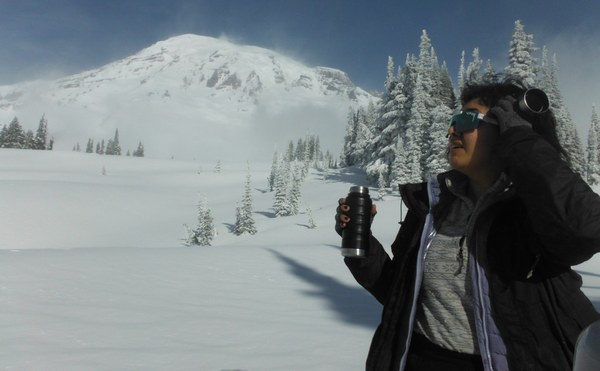 Snowshoeing participant, Michelle, looks out at Paradise. Photo by Mike McIntosh.
Tracing footsteps through snowy winds
A few days later, I am standing in the Paradise parking lot, squinting at the blue sky and praying the photos I’d seen online were an optical illusion. The trip leaders acknowledge they are aware a couple of us have limited snowshoeing experience, and reiterate that more moderate slopes are available for those who don’t want to ascend Panorama Point.
After discussing weather conditions, we realize our summit push might coincide with rather large gusts of wind (around 60 miles per hour). Mountain weather is unpredictable, but the wind isn’t too strong at the moment, so we decide to play it by ear and proceed on what is an otherwise clear day.
As soon as we exit the protection of trees, the wind picks up, whipping layers of snow from the ground and erasing the fresh footprints of the person two steps ahead. Fine particles of ice swirl in the air and brush against my face, forging sandpaper memories of watching participants pull balaclavas over their heads and sunglasses over their eyes. I had forgotten to bring a neck gaiter. With each focused step on the narrow switchbacks, I carefully angle my face away from the wind.
Every few switchbacks the leaders ask if we’re comfortable continuing. The snow particles dance across the surface below us, concealing how far we’ve climbed. I’m so focused on avoiding the wind that I completely forget how the angle of this very slope had loomed over me for the past week. We all press on.
After completing the bulk of our uphill climb, we reach a large, flat area where gusts of wind around 35 miles per hour almost knock me off balance. “I didn’t think I’d actually need these,” one leader yells as he puts on his ski goggles. He looks up at the summit and shakes his head. The rest of us shake our heads in solidarity, understanding that the wind will only get stronger the higher we go. Looking toward the parking lot, the distant smatterings of other snowshoers disappear from view with every strong breeze that passes, like little dots vanishing into the expanse.
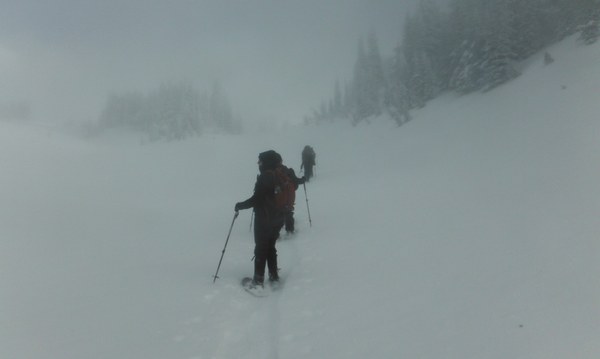 Taking a break amid the windy landscape. Photo by Mike McIntosh.
Rediscovering the magic
As we make our way back down the snowfield, soft powder blankets the shallow trail behind us. The wind makes me feel like just another dot ready to be erased, but every so often a nod or smile from someone in the group reminds me we are moving together.
I find it amusing how quickly we’re able to travel once we reach the flat area below. We run through Paradise’s playground like a game of “Freeze,” racing to see how far we get before the next gust of wind forces us to stop and cover our faces.
And… freeze! whispers the wind. We stop in our tracks and quickly do a 180, ducking swiftly and raising our arms for protection.
I can’t help but smile at the sight of it all. A trip leader catches me grinning from ear to ear and yells, “A smile! At least one of us is still having fun!” His ski goggles glint in the sun momentarily as the wind dies down again. We all laugh.
Despite the unfavorable weather, I am surrounded by people who are just as happy to skip around in snow, unbothered by whether we make it to the summit. Each smile confirms this: we are part of each other’s journeys, each person a piece of a community bigger than themselves.
Watching my new community make the most of an unpredictable day, I realize I have once again found a piece of magic in the snow.
This article originally appeared in our 2026: Issue 1 of Mountaineer magazine. To view the original article in magazine form and read more stories from our publication, visit our magazine archive.
Add a comment
Log in to add comments.
What a wonderful story. Thank you for sharing. I wish I could have been there, too. Sounds magical!
Thank you Tom! 😊
