 Alvaro Juarez
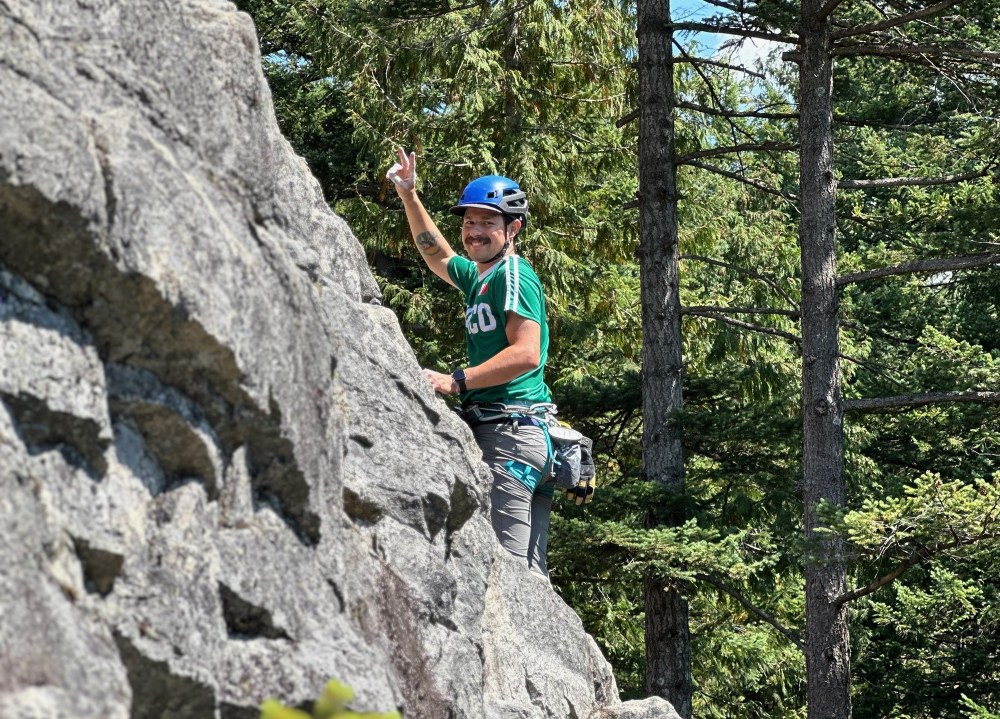
As the Seattle Youth Clubs manager, it’s not often that I have a free window of time to jump in and help our other youth programs. I am usually in the thick of planning and leading trips, coordinating with campground hosts, and supporting our team of instructors and volunteers. But when I was asked by my colleague Lauren (who oversees Partner Programs) to help belay a small class of students at the Seattle Program Center, I thought, Why not? My morning was open, and being outside beats sitting in front of a computer!
Partner Programs are a vital part of The Mountaineers youth program offerings. Unlike Camps and Youth Clubs, Partner Programs work with external groups, schools, and other various youth-serving organizations to curate a specialized program that meets their needs and goals. Whether it’s a school looking for a climbing progression to satisfy physical education requirements or a Scout troop looking for projects to repair or build at our program centers, we love inviting groups to our learning spaces.
The group on this crisp, October morning was a class of 13 middle schoolers visiting to climb for their PE class. Like every other program, we began by forming a circle to learn everyone’s name and favorite snacks – a classic ice breaker question. Most answers from the middle schoolers were predictable: pizza, ice cream, candy... but two students' answers were different. Not because they named a Latin American delicacy, and not because theirs was the healthiest food named by students. Their answers were different because they responded in Spanish.
Cultivating Belonging Through Shared Language
I am a fluent Spanish speaker (thanks, mom!) and up until this partner program, the intersection of Latin culture and climbing didn’t exist for me. If I did hear Spanish Speakers at a crag, it was often folks from Europe speaking a distinct dialect. (For example, folks from Spain speak a dialect called Seseo. Mexican Spanish speaks a dialect called Yeismo. Both dialects exhibit different pronunciations and cadences of speech). I am Mexican and my family’s dialect of Spanish is a bit drawn out, but very expressive and animated, especially if you’re speaking to someone who is muy alegre (very cheerful). While I’ve encountered climbers who speak Spanish, it is rare that I meet folks at the crag who speak a dialect that makes me feel at home.
Carlos and Valentina were the brother and sister duo who answered our ice breaker question in Spanish. Their favorite snack is arepas, especially ones stuffed with cheese and refried beans. Having spent almost a decade working in youth programs, I had a healthy amount of suspicion when I first heard them answer in Spanish while grinning ear to ear. The partner program hadn’t informed us there would be Spanish-speaking students, so I had assumed Carlos and Valentina had just learned a bit of Spanish and wanted to share it during our check in, or maybe they just discovered arepas and that was their fascination of the week.
After finishing the check-in, we geared up and started climbing. I didn’t think much about Carlos and Valentina’s arepa answer, but then I kept hearing them speak Spanish to their classmates. Meanwhile, none of the other students were replying in Spanish. I eventually asked Carlos and Valentina, ¿Solo hablan español? Do you only speak Spanish?
Sí. Yes. Carlos said with a hopeful look on his face.
Apenas llegamos! We just moved here! Valetina added as she budged in front of her brother to get her climbing harness safety checked.
Carlos and Valentina had just moved to Seattle from the beautiful city of Lara, Venezuela. We began sharing about our family’s heritage, where we come from and where our relatives live now. We became our own small team while climbing – me belaying while Carlos and Valentina traded turns on top rope. We chatted away in Spanish, learning we have similar tastes in music and a shared deep appreciation for Latin American professional baseball players.
Ni sabiamos que ibamos a escalar hoy! We didn’t even know we were coming here to climb! Carlos said. That’s how disconnected they were because of the language barrier. I have never seen a moment where being bilingual was so crucial and purposeful.
The Impact of Language
Having an opportunity to connect with people at the intersection of climbing and Latin culture was incredibly impactful for me. I have a hunch that Carlos and Valetina also felt a sense of belonging having someone who could not only speak to them but understand them, hear them, and make them feel welcomed. I will treasure that moment forever.
Speaking your native language while playing in the mountains is a feeling I can’t describe, but it’s palpable. It’s as if you're honoring ancestors while blazing your own path (especially if you’re a child of immigrants whose experiences spending time outside often meant working manual labor jobs). I hope Carlos and Valentina left that day feeling more connected to the climbing community of the Pacific Northwest, just as I did.
Language Resources
Language Matters! Let’s stop using slang for carabiners: Check out this blog authored by Don Sarver on the impact of language and why your Latin friends don’t appreciate you using slang.
Climbing Terms in Spanish: This list is a resource I made that provides Spanish translations for common climbing terms. Maybe you’re a Spanish speaker who has only been exposed to English climbing terms, or maybe this resource will come in handy for your next trip to El Potrero Chico or Patagonia – whatever your familiarity with Spanish and whatever the adventure, I hope this list is helpful!
Interested in volunteering with Partner Programs? Contact Lauren Glassbrenner.
