 Steve McClure
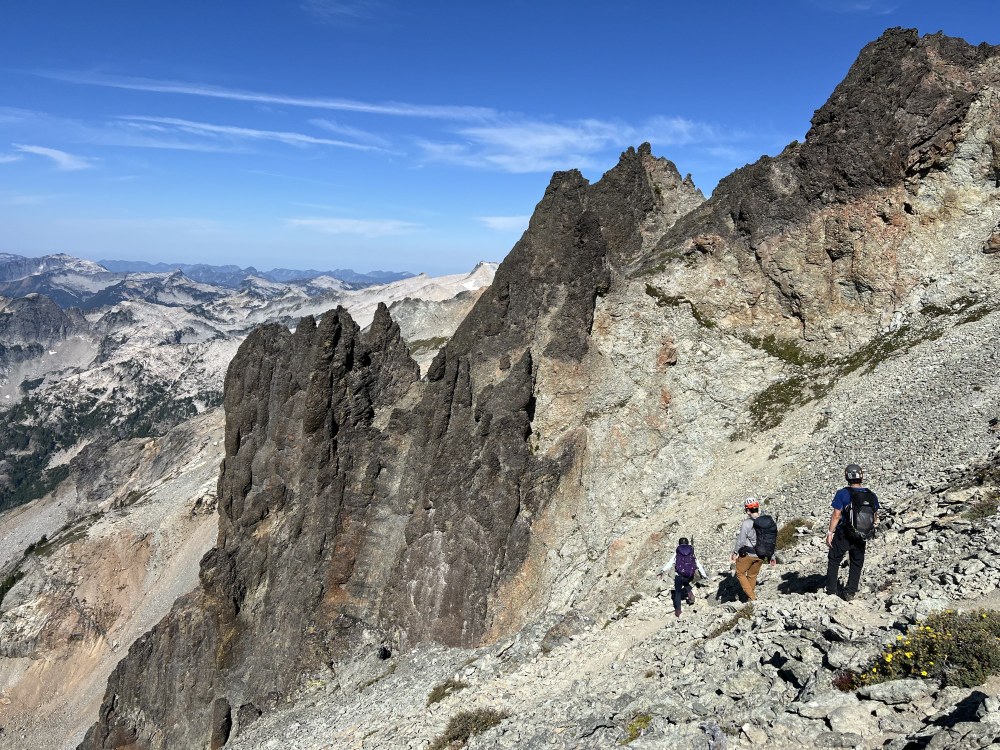
The "End of Maintained Trail" sign is a familiar sight for most Pacific Northwest hikers. For some, it’s a stopping point. For others, it’s a challenge. If you’ve ever looked at the untracked snowfields and high mountain meadows of the Cascades and felt like you were missing something, you’re ready for a scrambling class.
In the Seattle Branch, our regular, pod, and all-women’s courses are full, but this year’s Compressed Alpine Scrambling Courses (“CASC”) have plenty of room. CASC-A kicks off on April 14 and includes a three-day weekend from May 1 to May 3, 2026. CASC-B kicks off on April 16 and includes a three-day weekend from May 15 to May 17, 2026.
What is Alpine Scrambling?
Scrambling isn't just "hiking without a trail." It is a specific technical discipline designed to navigate the rugged 50% of Washington that isn't accessible by switchbacks. It is the art of moving safely over consolidated snow and finding the efficient "line" through the piles of loose rock that make up much of the Cascades.
While the goal of scrambling is often a summit, the core of scrambling is empowerment - having the skills to travel on steep snow, traverse rocky areas, navigate where every step requires navigation, and downclimb a rope when the landscape gets scary.
The "Basecamp" Advantage
What sets CASC apart from the regular scrambling course is its immersive nature of using The Mountaineers Stevens Pass Lodge as a high-altitude classroom. This course, founded by Tab Wilkens in 2011, is about equipping you with the experience you need to safely scramble countless mountains in the Pacific Northwest. Over the course of the weekend, you’ll be introduced to:
- Snow Skills: Using an ice axe for self-belay, self-arrest, and glissading, plus how to move safely in crampons.
- Rock Techniques: Learning three points of contact, friction movement, and protected downclimbing for emergency descents.
- Terrain Assessment: Developing a "mountain situational awareness" to find the safest route to the top.
We’ll have lectures on Friday and Saturday evenings. Saturday is our “Rock Day” where we’ll practice off-trail travel. On Sunday, we walk a few steps to the closed Stevens Pass ski area, where we work on snow skills. This is all done with a high ratio of experienced instructors to students. You will spend the two lodge evenings sharing meals and stories with fellow Mountaineers and experienced volunteer instructors who love the mountains as much as you do.
Who is CASC For?
If you are comfortable with strenuous hikes and curious to explore the "trailless space" on your topo map, you are a perfect candidate. Whether you are a backpacker seeking quieter routes or a day hiker aiming to reach higher ground, CASC provides the foundation for a lifetime of mountain adventure.
Join the Community
The CASC weekend is the catalyst, but the adventure continues through the spring and summer. From our Tiger Mountain conditioning hikes to the final "Experience" trip in June, we prepare you to be a self-sufficient member of a mountain team.
The Cascades and Olympics contain hundreds of non-technical summits that require no ropes but are inaccessible by trail. This is your invitation to find them.
- Register Today for Compressed Alpine Scrambling Course-A: This class kicks off April 14 with a 3-day weekend on May 1 to May 3, 2026
- Register Today for Compressed Alpine Scrambling Course-B: This class kicks off April 16 with a 3-day weekend on May 15 to May 17, 2026
Turner Bluechel, Chair, Compressed Alpine Scrambling (CASC-A)
Steve McClure, Chair, Compressed Alpine Scrambling (CASC-B)
