 Vienna Christensen
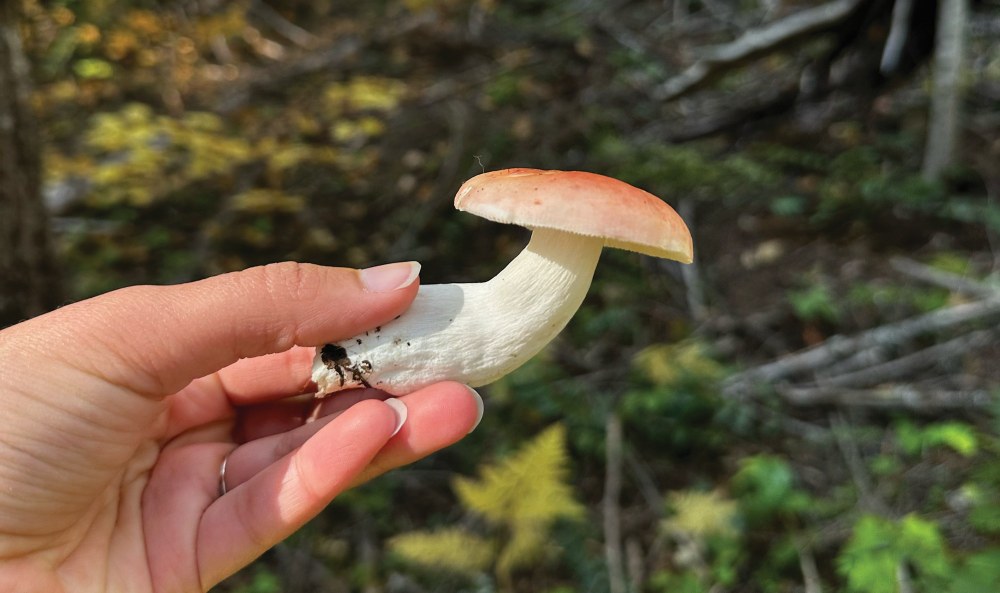
As I step into the warmth of the Meany Lodge common area, a cacophony of oohs and aahs leads me to a table at the front that is overflowing with various mushrooms. Beneath blacklight, one glows vibrant neon. Another puff ball mushroom releases dark clouds when I squish it. Across the table, I spot smaller species: tiny slime molds. Finally, my eyes and nose discover a prized matsutake emanating its iconic smell – spicy with notes of cinnamon and pine. With guidance, fellow curious observers and I are invited to taste, smell, and touch the species on display.
My introduction to mycology at the Meany Lodge Mushroom Weekend is a full-sensory experience. Soon, I’ll be learning about boletes, amanitas, chanterelles, and more.
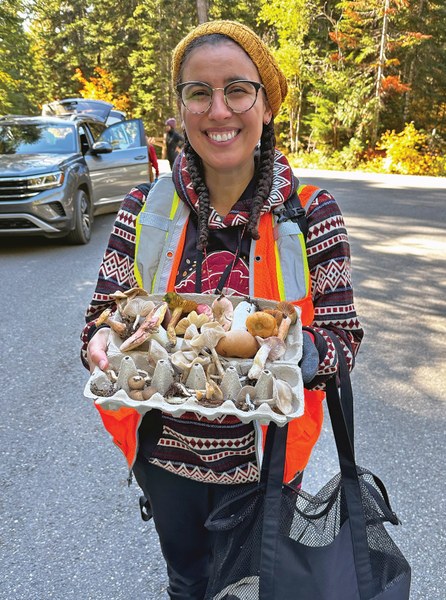 Vienna with an egg carton full of her first mushroom finds.
The magic of mushrooms and Meany
Mushroom Weekend is an annual lodge stay hosted by Meany Lodge volunteers. Members and nonmembers alike are invited to attend for the weekend and learn about Pacific Northwest mushrooms with experts from the Puget Sound Mycological Society (PSMS) and The Mountaineers. Gracious teachers and lodge hosts arrive early to collect an abundance of fungi for participants to learn from and observe, and then lead foraging outings throughout the weekend to teach participants how to spot, identify, and harvest mushrooms. Along the way, participants are treated to various surprises and mushroom-inspired workshops.
At the center of the weekend’s magic is Meany Lodge. When you arrive at the lodge, you are greeted by a Meany Lodge volunteer, such as Mountaineers member Sheridan Botts. After a thorough debrief on lodge stay information, muddy boots are swapped for slippers before you make your way up the well-loved wooden stairs. Exploring the building, you learn quickly that every nook and cranny holds stories that speak to the generations of volunteers who have cherished these grounds.
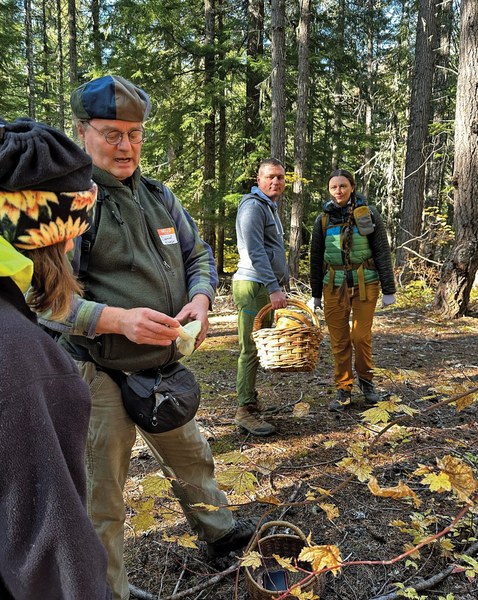 Daniel Winkler, Fruits of the Forest author, teaching foragers how to examine mushrooms.
Learning and dreaming of mushrooms
As I soak in the various sensations, the dining hall bustles with vibrant conversation and flowing libations. At the room’s center, long tables are lined with ID charts that we will later use to practice keying mushrooms.
Before long, the booming voice of long-time Meany Lodge Committee Chair Chuck Welter calls the room to order. Mycologist and avid fungi enthusiast Danny Miller briefs us on the basics of mushroom identification, and dispels myths and fears about mushrooms and how to handle them. I never knew that you could taste and spit out most mushrooms without incurring any harm. Swallowing is where the real danger lies. I also learn that most mushrooms are ok to touch, as long as you wash your hands thoroughly before you eat. As Danny continues to teach, any fear and trepidation I had about mushrooms melts away.
Though we were told dinner would not be provided, there is no shortage of snacks. We are invited to indulge in delicious mushroom appetizers. (As Chuck says, "If you leave Meany hungry, it's your own fault.")
As we snack, PSMS member and Mountaineers scrambling leader Jerry Stein teaches us how to safely and confidently forage this weekend. We’re invited to take our first stab at identifying species.
The night ends with drinks, dessert, and lots of mushroom talk. As I lie in my wooden bunk on the lodge’s upper floors, mushroom dreams fill my head in anticipation of the coming day.
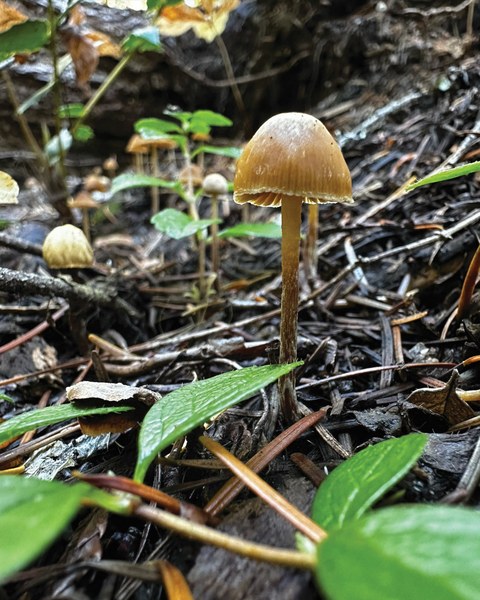 Tiny mushrooms found while foraging.
My first foray into foraging
Saturday morning, the smell of apple streusel French toast coaxes me from sleep. Today will be a long day of foraging and feasting.
Bellies full and lunch sacks packed, we separate into groups and head to the forest to see what we can find. As luck would have it, I am grouped with Daniel Winkler, renowned mycologist and author of Mountaineers Books publication, Fruits of the Forest. Donning a striped hat and gripping a foraging basket, Daniel lays down ground rules through the joyful lilt of his thick German accent. We forage from 9am to 4pm, and stop at three key locations near the lodge.
Our first leap into the foraging world is at a nearby campsite. As we explore the area, Daniel trains our eyes to see the mushrooms around us. Every few steps, a mushroom seems to materialize before him. At first, I struggle to notice anything, but soon my eyes begin to recognize fungi everywhere, from tiny slime molds no bigger than pushpins to jelly-like witches’ butters to massive russulas and rotting boletes. After about 30 minutes, we regroup in the parking lot and hold out our treasures. The variety found in such a short time is astounding. My prized finds include the western gilled bolete (Phylloporus arenicola) with its coffee-brown top and highlighter-yellow gills that bruise deep blue when touched.
At our next stop, we’re introduced to entirely new terrain. Daniel charges his way through towering trees and deep into the forest at unrivaled speed, while I clumsily claw my way up the steep hillside and do my best to leave no trace and keep my eyes peeled. I walk slowly, investigating decaying stumps and crumbling logs. The serenity of the forest, matched with the wonder of each new mushroom find, makes for an unforgettable experience. The hours feel like minutes and before I know it, we're sharing our finds back at the cars. One participant, Shelby Olson, reveals a striking blue stropharia and a giant shrimp russula (Russula xerampelina). Another participant holds out a king bolete with a cap as big and round as a dinner plate. We gush over our new treasures while enjoying lunch. Our egg cartons, baskets, and sacks are already overflowing with mushrooms.
Our last site of the day is closer to the lodge but no less abundant. After more foraging, we return to the lodge triumphant, loaded with prized matsutakes and golden chanterelles, as well as toxic amanitas and countless other finds.
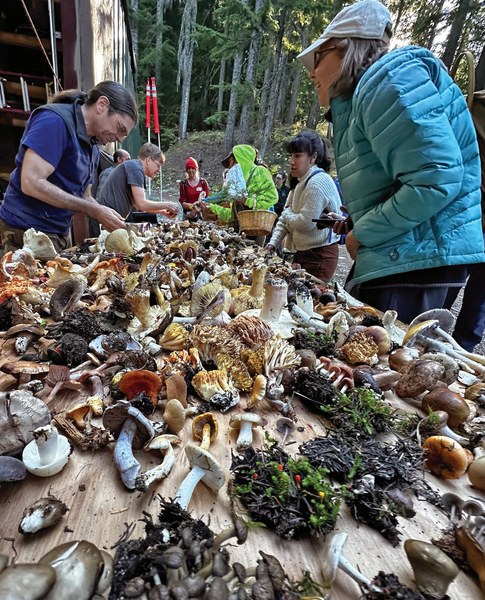 Jerry Stein, Danny Miller, and other PSMS mycologists receiving and sorting our bountiful fungi harvest at "The Zoo.”
A mushroom feast
Back at the lodge (in a specific building named “The Zoo”), Danny and other PSMS leaders help sort and identify our finds. Our haul is huge, filling several large tables with every shape, size, and hue of mushroom. The mycologists, equipped with years of knowledge and experience, distinguish our finds by genus and type.
As the mycologists continue sorting, we head back to the main building. Just outside the door, Chuck had been hard at work stoking a warm fire and setting up benches for us to eat and celebrate the day’s work. We snack on mushroom dips, succulent stuffed mushrooms, and mushroom ceviche. Mulled wine and spiced cider warm our bellies and hearts as we laugh and chat until dark.
After a few hours of free time, we’re ushered to the dining room for a special treat: the Meany Lodge volunteers had transformed our mushroom classroom into a fine banquet hall. Green tablecloths and flower arrangements adorn the tables, along with salads garnished with mushrooms, truffle cheese, and wine. Our servers are the children of Meany Lodge volunteers, who make up an important part of the vibrant lodge community. My mouth waters at the main course: a mushroom risotto and decadent pork roast with mushroom sauce.
With full bellies, lodge host volunteers and participants collectively clean up and wash dishes before Daniel takes the stage. For the next few hours, he blows our minds with facts and anecdotes about edible mushrooms and their dangerous lookalikes. Everyone is entranced by the fascinating world of fungi. (I was slightly horrified to discover that cordyceps, a genus of fungi, can inhabit and control living beings, like bugs, essentially turning them into mushroom zombies.)
Just when we think the night is over, we turn to find a spectacular dessert buffet before us. Trays overflowing with brownies, cookies, lemon bars, macarons, and mushroom-shaped chocolates are soon left bare. Laughter and storytelling continue long into the night.
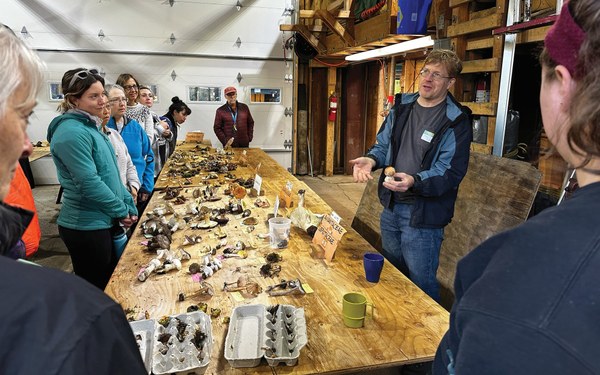 Danny Miller unpacking all our mushroom finds and their unique qualities.
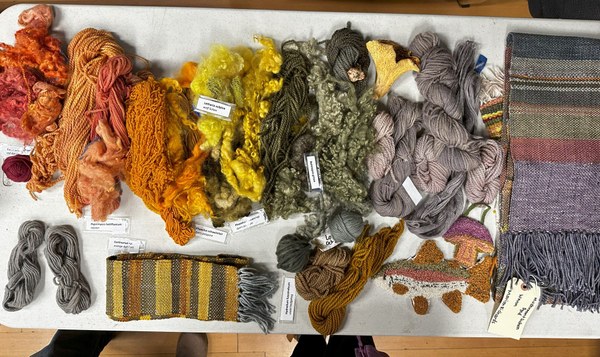 Textiles dyed with mushrooms and mosses.
The versatility of a mushroom
On the morning of our last day, another bountiful breakfast gives us the energy to hit the ground running. After a tour of the property provided by Chuck, Danny leads us through a deep dive on our finds from yesterday’s harvest. He gushes over each genus and species, and shares the unique qualities of each. Some smell as sweet as bubble gum or as foul as rotting fish, while others jiggle like Jello or snap like chalk. Our collection is going to be showcased at next week’s Puget Sound Mycological Society show.
Later, I learn that there’s far more you can do with mushrooms than forage and eat them. During a mushroom dyeing workshop, vibrantly colored yarn covers the tables as guest presenter Marium Richards dazzles us with a demonstration on how to dye textiles using mushrooms and mosses. I watch in awe as old man’s beard lichen is used to dye yarn a golden yellow, and dried lobster mushrooms are used to produce a lovely pinkish-red. Next, we receive a mushroom cooking demonstration on how to “dry fry” mushrooms so that our dishes don’t end up soggy and slimy. We learn how to make a delectable mushroom appetizer just before a hearty lunch of mushroom soup, featuring leftovers from our previous meals.
All too soon, it’s time to pack, clean up, and make our way back to the city. As a parting gift, we are sent away with mushroom growing kits so we can continue the fun from our very own homes. By the weekend’s end, we leave with new knowledge, new friends, and a new hobby — or in my case, obsession.
A special thank you to Chuck Welter and the Meany Lodge Committee, all Meany Lodge volunteers, and the Puget Sound Mycological Society for the intentionality, care, and hospitality that made this weekend my most treasured Mountaineers experience.
I encourage everyone to take a naturalist course or activity, read Daniel’s book, Fruits of the Forest, and sign up for the next Mushroom Weekend at Meany Lodge. Registration is open now.
This article originally appeared in our summer 2025 issue of Mountaineer magazine. To view the original article in magazine form and read more stories from our publication, visit our magazine archive.
