 Renee Lenti
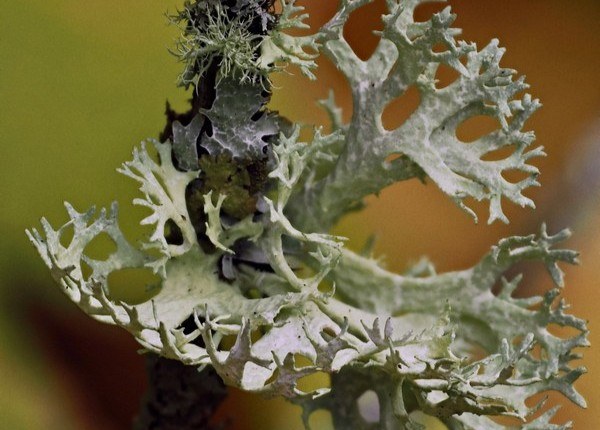
Some years it’s hard to transition from long, sunny days and fields of flowers to the rainy season here in the PNW. Yet the shoulder season repays that loss by ushering in amazing colors in the mountains and lowlands.
Just when the huckleberries lose the last of their berries, their vivid red and gold leaves reveal the contours of the hillsides and valleys. And then there are the larches, drawing many of us to the high country to see their needles shift from green to yellow to those final days of brilliant gold. Seeing the gold trees reflected along the edges of an alpine lake and the shadow of the mountains in the distance, it hardly matters if you hit the season at peak or find yourself walking among the fallen needles dusting the trails... it always feels like you’ve arrived at the right time.
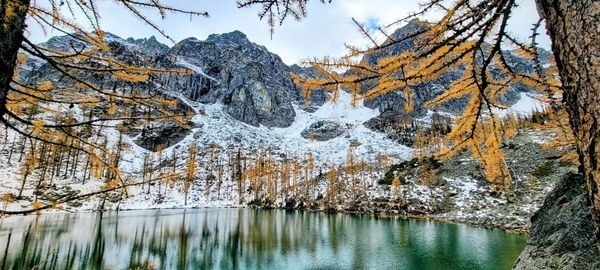 Larches at Copper Glance Lake.
For my first few years in Seattle, the larches often marked the end of the season for my naturalist and backpacking pursuits. I’d pack away my gear and wait out nature until the first sprigs of green emerged the following Spring. That changed during my first year as a Mountaineers member, when I signed up for a Moss & Lichen Course.
The course, led by Gary Brill and Stewart Hougen, was offered deep into winter and took groups of moss-curious students into the damp forest with lighted hand lenses. Gary and Stewart encouraged us to look closely at tiny green mounds on Douglas fir bark and the pendant-like strands hanging from the branches of bigleaf maples. It was almost shocking to see so many different structures and forms for the first time, to notice there were miniature forests within the forest.
Before that course, I had never really considered how much there was to see in our lowland forests during the wet months. While it’s almost impossible not to notice moss and lichen in the PNW, distinguishing species seemed impossible. Gary and Stewart had spent years exploring and documenting these tiny communities, and their collaboration produced a beautiful hardcopy field guide that still anchors the course today. With their instruction, we learned to recognize that our winter forests are still very much alive, with the forest’s background residents stepping into view even as understory plants compost into soil.
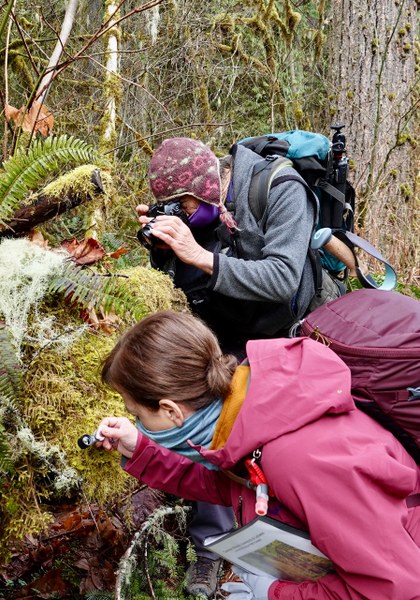 Gary Brill and Renee Lenti on the Old Sauk River Trail. Photo by Donna Rooke.
When Gary suffered a stroke last year, his absence on the trails made it immediately clear just how much his mentorship had shaped my relationship with the natural world. This course, and the community of naturalists around it, had become more than a way to simply learn about mosses and lichens. It had become a way to carry forward a tradition of curiosity and continued learning.
Today, I help lead the Moss & Lichen Course, continuing the work that Gary, Stewart, Lynn and many other Naturalists built together. Each February, our community gathers participants around moss and lichen display tables on a chilly day at Redmond Watershed. From there, we divide into small groups and head out on the trails searching for moss, lichen, and liverworts on bark, rocks, and the ground.
Why study moss and lichen?
In the PNW, the ecological importance of moss and lichen extends well beyond the forest floor to shape entire forest ecosystems. Consider the endangered marbled murrelet, who nests high in the canopy of our coastal, old-growth forests. Each year they return to lay a single egg on a thick mat of moss and lichen that can only accumulate, with time, on the branches of the region's oldest trees. Similarly, lichens also underpin complex food webs. Flying squirrels rely on Bryoria lichen as a key winter food source and in turn are primary prey for the endangered northern spotted owl.
Mosses and lichens often grow in conditions that would kill most vegetation, colonizing bare rock, thin soils, or disturbed ground. So, if your hand has ever brushed across a moss covered log or you’ve noticed brightly colored crusts attached to a boulder, then you have already connected with some of the most resilient organisms on Earth. The way that mosses and lichens link species throughout the forest and sustain ecosystems make them more vital than most of us ever considered.
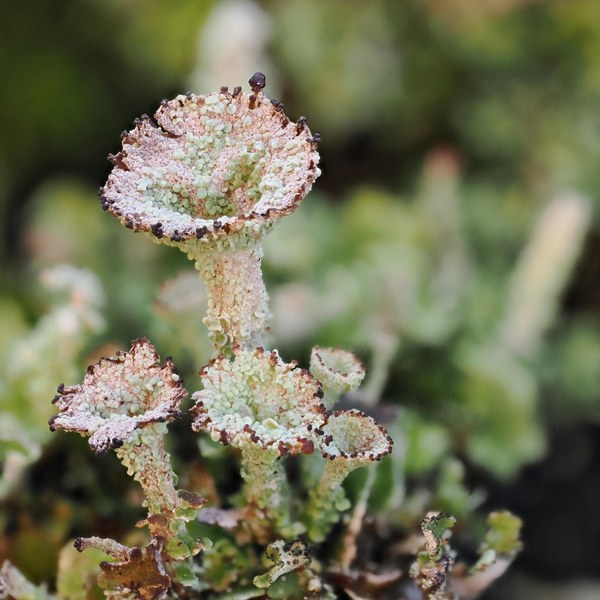
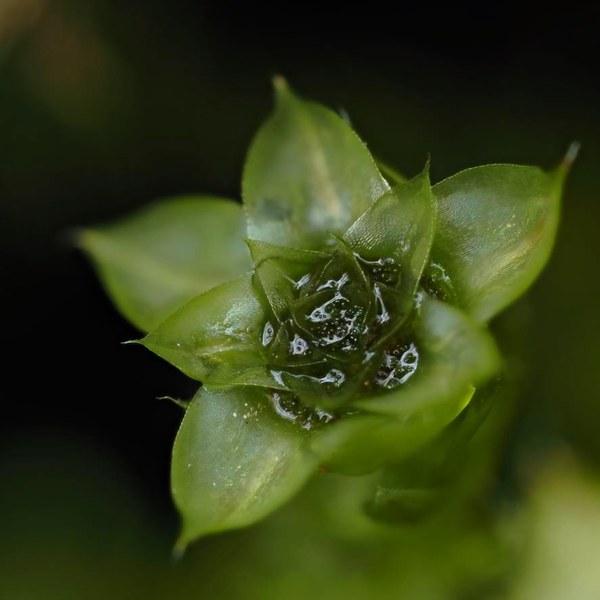
Learn more about Moss & Lichen on Feb 26 & 28, 2026
The Moss Workshop offers an opportunity to explore these organisms in detail. Participants in the course learn to observe and identify mosses, lichens, and liverworts through an online lecture paired with a field trip. Registration opens January 18, and many Naturalist trips throughout the season offer accessible entry points for anyone interested in taking a closer look at these remarkable organisms.
References
Sharnoff, Stephen & Sylvia. Lichens and Wildlife. Lichens of North America Information. Available from:
https://www.sharnoffphotos.com/lichen_info/animals.html
Washington Department of Fish and Wildlife. Endangered Species: Northern Spotted Owl (Strix occidentalis caurina). 2012 Annual Report. Available from: https://wdfw.wa.gov/sites/default/files/2019-03/northern_spotted_owl.pdf
Wilk, R.J., et al., Nesting habitat characteristics of Marbled Murrelets occurring in near-shore waters of the Olympic
Peninsula, Washington. J. Field Ornithol, 2016. 87(2): p. 162–175. https://www.fs.usda.gov/pnw/pubs/journals/pnw_2016_wilk001.pdf
