 Leslie Romer
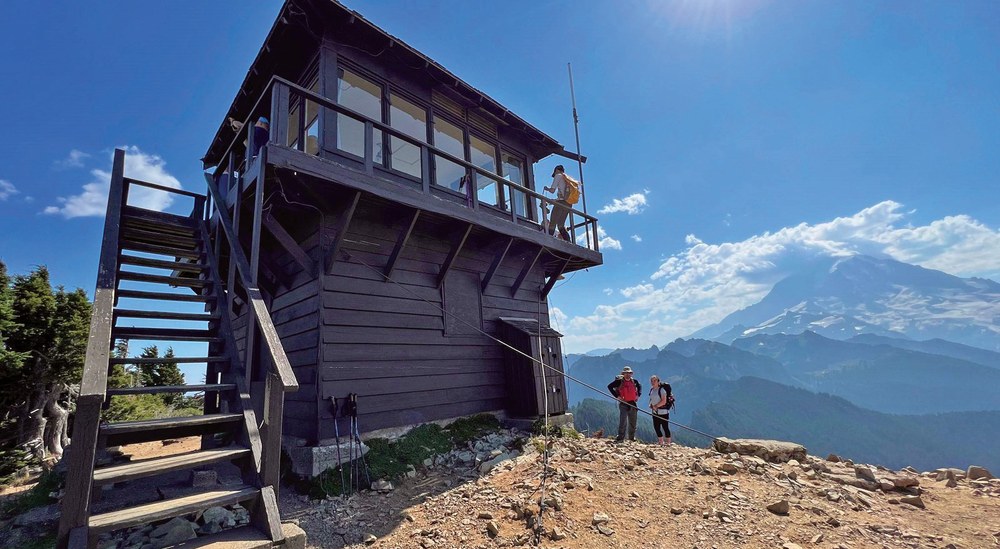
Four fire lookout cabins stand today near the four corners of Mount Rainier National Park: Shriner Peak, Gobblers Knob, Mount Fremont, and Tolmie Peak. Four other fire lookouts served the park for decades before being removed. When I started researching for my second book about fire lookout hikes and histories in the Mount Rainier region, I repeatedly read two different stories about the construction of the Park’s fire lookouts. Curious about which story was true, I investigated how some writers might have been misled.
Conflicting histories
Ira Spring and Byron Fish co-authored Lookouts: Firewatchers of the Cascades and Olympics for Mountaineer Books in 1981. The chapter on Mount Rainier National Park tells how the initial Anvil Rock Lookout was built by the US Forest Service in 1917, and the rest were built by private contractors or Mount Rainier Park staff between 1930 and 1948. However, at the beginning of this century, the idea that the Civilian Conservation Corps (CCC) built some of the fire lookout stations in Mount Rainier National Park began appearing in the Park’s signs and publications.
The CCC was a well-regarded federal program that provided jobs and training to thousands of Americans in the depths of the 1930s depression. The program served national, state, and local parks and forests by building trails, roads and bridges; extending telephone lines; landscaping park lands; fighting fires; and taking on temporary assignments for rangers and foresters. The CCC introduced the architectural style known as “national park rustic” to state parks and national and state forest buildings, and was known for building many fire lookout cabins and towers throughout the U.S. between 1933 and 1942.
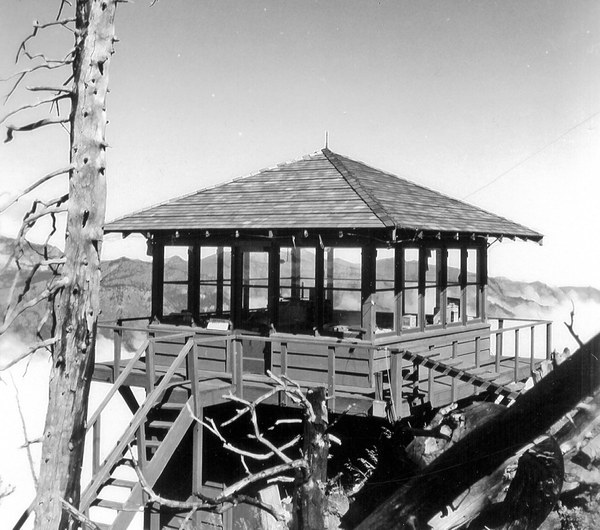 Crystal Peak Lookout. Photo courtesy of the National Park Service.
In 2000, National Park Service staff put signs on the Gobblers Knob and Tolmie Peak fire lookout cabins, crediting the CCC with their construction. While the Tolmie Peak sign has since been removed, a sign was still on the Gobblers Knob lookout when I visited in September 2023.
Later in 2023, I attended an exhibit in the Washington State Historical Museum on the history of the CCC’s work. The exhibit mentioned “The CCC built 240 fire lookouts in Washington alone.” I looked for more details about those fire lookouts in the displays, including information on the lookouts in Mount Rainier National Park, but I couldn’t find any. Seven hundred is the approximate number of fire lookouts now thought to have been built in this state. Crediting the CCC for 240 of them, excluding Mount Rainier National Park, seemed reasonable.
Although the Park’s fire lookouts were not mentioned in the displays, a Sunday Seattle Times article about the exhibit (by Gregory Scrugg, published November 5, 2023) stated, “the CCC built four fire lookouts in the Mount Rainier National Park.” The only lookout named in the article was Tolmie Peak.
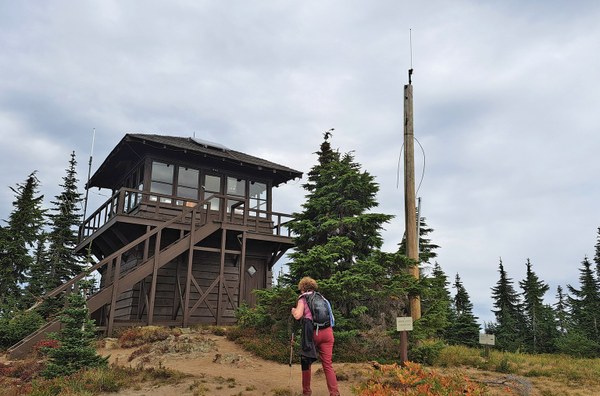 Shriner Peak Lookout. Photo by Leslie Romer.
What the archives revealed
In 2024, I visited Mount Rainier’s archives to look for historical documents that would resolve the difference between the two versions of the Park’s lookout history. I found details on the CCC’s lookout-related work in the Park: they worked on the trails to Mount Fremont, Gobblers Knob, and Crystal Peak in 1933 and 1934; they maintained and constructed many miles of phone lines to fire lookouts, and they may have transported construction materials to the fire lookout building sites in 1934. But, as historian Theodore Catton said in his book Wonderland: an Administrative History of Mount Rainier National Park, “The CCC crews were mainly assigned to jobs that required less skill than construction of buildings… Some of [the Public Works Administration] funds were used to hire temporary, skilled workers for building construction. That was how many of the ranger residences, patrol cabins, fire lookouts, and other… buildings [in Mount Rainier National Park] came to be built.”
I also reviewed microfiche copies of a November 1933 contract status report, September 1934 activity reports, and a 1934 construction project completion report. Each detailed a different phase in the construction of fire lookout cabins at Gobblers Knob, Tolmie Peak, Crystal Peak, and Mount Fremont. They identified a local, private construction firm, the American Building Company of Seattle, as the contractor. The agreed upon amount for building the four lookouts was $5,042.
The details in the historical records matched those in Lookouts: Firewatchers of the Cascades and Olympics. Ira Spring, Byron Fish, and Mountaineer Books had it right.
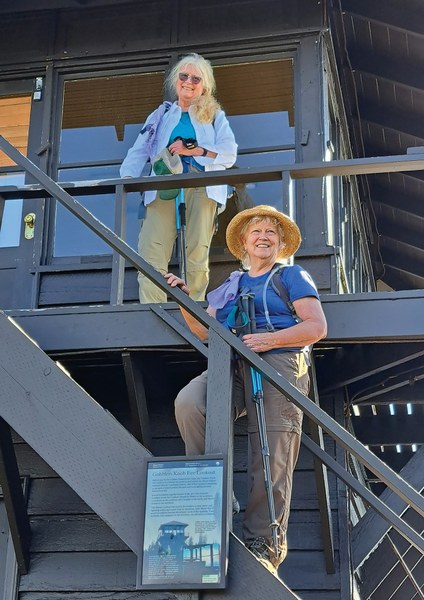 Gobblers Knob Lookout. Photo by Leslie Romer.
Where the inaccuracy started
How did this misunderstanding develop in modern Mount Rainier National Park records and culture? In his 1966 PhD thesis, Mountain in the Sky, A History of the Mount Rainier National Park, Arthur D. Martinson stated, “By 1934, with Civilian Conservation Corps assistance, other lookout stations were operating.” Martindale’s work is often listed as a source of information on the history of the Park’s fire lookouts. In addition, two writers that I contacted pointed to the Park’s website as their likely source for incorrect information. The webpages for the Gobblers Knob, Tolmie Peak, and Mount Fremont Lookouts all credit the CCC for their construction; two of the webpages list the incorrect date of construction; and the webpage for Shriner Peak Lookout provides its construction date without revealing it was a highway construction contractor who accepted the assignment in 1932.
When all’s said and done, I think the error was built with good intentions, a vague statement that was repeated, and the knowledge that the CCC was actively working in the Park during the 1930s. (Park staff has committed to correcting information on the history of these fire lookouts).
Leslie Romer joined The Mountaineers in 1993 to take the Sea Kayaking course with the Olympia Branch. She published her first book, Lost Fire Lookout Hikes and Histories: Olympic Peninsula and Willapa Hills in 2021.
This article originally appeared in our fall 2025 issue of Mountaineer magazine. To view the original article in magazine form and read more stories from our publication, visit our magazine archive.
