 Seattle Scramble
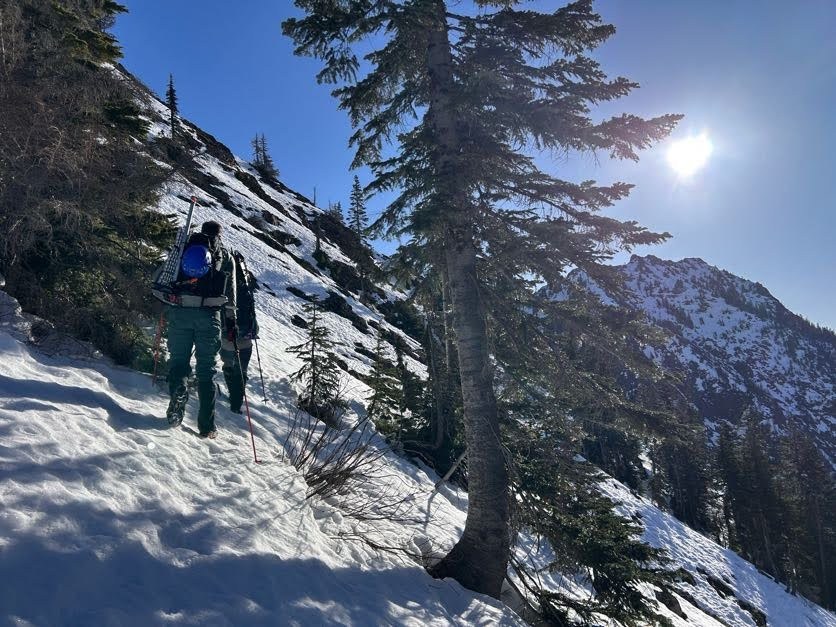
This report is written by the Seattle Scrambling Leadership team as part of an incident review. A scrambler fell/slid several hundred feet and required a helicopter evacuation during this trip, which is the focus of this report. As reported a few weeks after the incident, the fallen scrambler experienced no major injuries and is well on their way to a full recovery.
Route Conditions
Moderately firm snow on the approach and start of the ascent becoming quite firm as elevation was gained. Some exposed rock and rock sections at the higher elevations.
Trip Report
The group size was ten including a primary leader, two designated co-leaders, five 2025 Scrambling grads, one 2025 Basic Climbing grad, and one 2024 Basic Climbing grad.
Crampons and ice axes were not required equipment for this outing but it was recognized they might be required for the ascent, and this was discussed during the pre-trip briefing at the parking location. Seven in the group had crampons, three did not. Only one individual (the primary leader) did NOT have an ice axe. The possibility of splitting into separate groups was discussed, with participants not having the necessary gear or not feeling safe staying behind rather than ascending to the summit. The group proceeded with the outing with the Red Mountain summit as the objective.
The approach through Commonwealth Basin was completed successfully with no noted significant observations or concerns. The temperature was believed to be right around freezing level (32 degrees F).
During the ascent out of the Basin, the group started to become separated. One scrambler (A) proceeded ahead of and across a ravine from a middle “core” group. A co-leader in this group yelled to the scrambler ahead to rejoin the group and again to stop and wait but this scrambler reported not hearing any verbal communications. The leader and at least one other scrambler were proceeding below the middle group. A scrambler (B) who had been slowed by multiple crampon on/off transitions followed the path of scrambler (A) and proceeded relatively quickly off to the side and then above the middle group. Scrambler (A) had stopped and was waiting when scrambler (B) approached to a point near them and stopped close enough to have a discussion. Scrambler (B) had crampons and helmet on and were using their ice axe at this time. Scrambler (A) and (B) were out of sight of the middle and lower groups.
As communicated by the fallen scrambler (B) - “I got complacent up there, chose a poor resting spot, and my side hill grip blew. Ice axe ripped out of my hands on the first self arrest attempt.” They proceeded to fall and slide, sometimes becoming airborne, for several hundred feet down the slope including between two scramblers in the middle group and then past the trailing group who were yelling “Arrest, Arrest.” At one point, they hit a tree but bounced off and continued to fall/slide. They were eventually able to stop by using their feet and crampons to brake. The fall occurred at about 11am.
The lower group yelled down to the fallen scrambler but did not hear a response. A co-leader called 911, and the first aid lead immediately and cautiously started heading down to the fallen scrambler. The primary leader who was at the end of the group and closest to the fallen scrambler also headed down toward them. The rest of the participants also started to descend and it was noted that there was some rockfall initiated by Scrambler (B) endangering the rest of the group but not resulting in any impact or injury.
The First Aid lead provided care to the fallen scrambler and called 911, communicating the assessment and condition of the fallen scrambler. A helicopter evacuation was initiated and an extraction occurred at approximately 2pm.
The fallen scrambler's backpack, which had fallen further down the slope during helicopter evacuation, was found and retrieved by the trip leader and the group descended and hiked out to the cars. At the cars, the remaining nine scramblers formed a team circle and shared a group hug, followed by each person sharing their thoughts and reflecting on the day’s events. This was felt to be emotionally supportive and helpful for everyone in the group.
This is part one of a three-part series. Please read Part 2: the first hand experience of the scrambler involved, and Part 3: lessons learned, to get the complete picture about what happened, how it felt, and takeaways to inform future trips.
