 Seattle Scramble
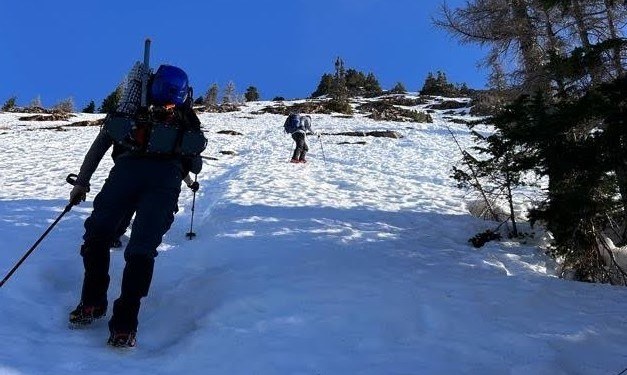
As I was figuring out how to tie my crampon straps back during our snow overnight, a SIG instructor waxed poetic to me about just how great crampons feel when you knew how to use them. The grin on his face was filled with a level of stoke I couldn’t quite understand at the time; to me, they were just another tool to buy and learn to use. He went on for a minute or two about how the feeling of being “locked in” to the slope was like nothing else, and at the time, I just nodded.
In retrospect, he was getting at this idea that crampon use is a pure expression of alpine accomplishment. This is a sport of never-ending learning - a cycle of putting tools in our toolbox, getting out there and experiencing terrain we haven’t before, learning how to apply those tools from others and our experiences, and thinking about how to improve for next time as we set our sights on something else. Your risk tolerance grows as your fear of exposure diminishes. However, this sense of confidence isn’t unearned; it’s assembled from those tools, experiences, and tips from others.
This Red Mountain scramble was part of a continuing mission to build out my alpine “toolbox.” Basic Alpine Climbing was my first experience with snow travel. I didn’t grow up skiing, snowboarding, or snow hiking, so I supplemented the Basic curriculum with learnings and intuition from fellow climbers and scramble leaders. This scramble was more of the same for me; a pretty way to sharpen technique and pester an experienced climber with questions as they came up. I felt good about the day ahead - so good that I even had planned on hosting a birthday party for myself later that day.
The approach to the base of the mountain was beautifully uneventful. There had been a couple of freeze-thaw cycles that week in a time of record-low snow but it was a great day to be out and our group had a plan to turn around if it got too icy.
I made my initial assessment at the base of Red Mountain when the rest of the scramblers were almost out of sight. It looked like the route started around 30 to 35 degrees, with sections closer to 40 or 45. At that moment, I considered how there were almost ten people in front of me doing it in microspikes (or not) and trekking poles. But this looked similar to terrain I had traversed in crampons before and had to be careful in; “f*ck yeah, you want crampons” I can still hear in my head (can I swear in a Mountaineers blog?). At this point, I assumed that the group of scramblers ahead of me had made their own risk assessment, and set off to catch the others - crampons on, ice axe out, and helmet on.
The way up felt so good. I felt “locked-in,” my toolkit robust enough for the conditions, the snow accepting crampons perfectly - firm, but not too icy, thin near the rocks but predictably sturdy everywhere else. I was opting in to my level of exposure and technique needed, practicing some of the dagger techniques a climb leader had shown me previously. Quickly, I passed the other scramblers that were kicking steps with microspikes on and trekking poles out. Eventually, I caught up to the first scrambler in our group and stopped to chat.
I had a loose, one-handed cane grip on the axe plunged into the snow. The snow was shallow around the rocks and I wouldn't have trusted it to hold in a full self-belay hence the loose grip. This is a sketchy resting spot - something that did not clock for me at the time. But it felt good… I was the only one in crampons, what did I have to worry about!? As we talked, I moved my foot to stretch out my calf, being a bit careless in retrospect and moving out of balance.
I stumbled a bit and found myself on my side. I was baby falling. On my hip, moving maybe 1 mph. The ice axe came out like a charm and I made an intentional gather, getting two hands on the shaft in an arrest position, easy and unstressed. I remember thinking that I might catch my crampon front points if I turned into the slope and got behind it. That would be stupid. Maybe I’d slip further because I’d lose contact with the surface. This was a little stumble - I could already see myself laughing this off. Knowing the axe would be more than enough to stop, I just… put it into the snow with two hands. Then, in a slo-motion way that felt surreal, my hands let go of the shaft.
A quick sidebar: When you learn self-arrest, you learn it in a safe setting. Usually, this means working extremely hard to gain enough momentum to simulate a life-threatening slide. You can get the technique but you can’t infinitely simulate different falling conditions. So you try it using trekking poles, your elbows, your axe, your axe upside down, with a running start, doing it so many times in differing variations that you’re convinced that when it’s life or death you’ll have that muscle memory. No complaints here. But it’s innately different from an unexpected fall.
My immediate thought? “Damn dude, you really just let go of that.” I hadn’t yet clocked the severity of the mistake and was more embarrassed than scared. Second thought? “You idiot. You just did the thing you swore you’d never do after someone told you they almost died from it too.” On this slip with “no momentum, no steep slope below,” I had failed an arrest attempt with my axe pick above my head on a 45-degree slope. Within seconds, I was launched by a rock outcrop that acted as a ramp, catching over 15 feet of air, beginning an uncontrolled tumble of over 600 feet.
Falling was a blur of going airborne, smacking all parts of my body on the ground, and repeating that cycle again and again. I landed forehead-first on a rock at some point, convinced I’d be unconscious by the end of it. Before I was able to clearly see anything, I ended up hitting a tree back-first, the solid plastic snowshoes stuffed into my pack serving as a back brace. I was going so fast that I didn’t even know I’d hit a tree until someone told me. Hitting that tree, while the most concerning part to those watching, was what allowed me to eventually arrest. It cut my speed in about half, righted me up so I was on my butt, and put my feet downhill. I got very lucky for the mistakes that I made.
In retrospect, there were many warning signs and peeks at the terrain that could have been done prior to feeling fully relaxed in this resting spot. But I wasn’t standing there thinking about how terrible of a resting spot it was. I was talking at a distance with another climber, both of us first up, taking in the sun as we chatted about bucket list climbs, with skiers at Snoqualmie visible in the distance.
This fall was entirely my fault. Complacency kills. But no one ever thinks they’re being complacent. As mountaineers, we assess risk and bring out the tools to match. We don’t just opt into choices we know are bad. At no time was I standing there thinking I was being complacent. I was there, second up, feeling good about the techniques I was dialing in, and feeling more than prepared for the terrain. How could I fall? I had done everything in my power to mitigate risk. I was the only one with an ice axe out and a helmet on!
The task of keeping ourselves in the perfect zone over hours is impossible, creating a breeding ground for complacency. But while insidious, complacency is also inconsistent. I guess that’s just how it goes - you can’t be at 100% an entire climb.
At the end of the day, my ability to stop this fall was the result of the small details. I was able to algorithmically run through the “if you ever need to” techniques that were mentioned off-handedly at a field trip, a snow overnight, a skill night. It was the heuristics - the “if this, do that” rules that had my back when I got complacent.
Surface area! Make yourself big. No axe? Dig an elbow in, braced by the other and with your whole bodyweight behind it. That day, none made a difference in my speed. But it’s like I had every climber I knew telling me advice at the moment - including a SIG instructor mentioning “don’t ever arrest using your crampons, you’ll either flip over or break your ankles.” As a result of this flurry of comments flying through my head, I was able to assess the fall line, determine that the continued steep scree field below was potentially lethal or debilitating, and opt into arresting using my crampons. Our experience is larger than the sum of our own.
Would I have had my helmet on had it not been drilled into me that “if your ice axe is out OR your crampons are on, your helmet goes on”? Maybe, maybe not.
We’re not perfect. But my takeaway from this? Just maybe sometimes - especially when you’re feeling good - take a 360 look and think about something you hadn’t quite thought about yet, whether it's your exposure, the future terrain and new gear you might need to get out, or how grateful you are to be out there. We’re all capable of rapping off the end of our rope or tripping in terrain we could never imagine - especially when we’re feeling good.
This is part two of a three-part series. Please read Part 1 for an incident overview and Part 3 for lessons learned to get the complete picture about what happened, how it felt, and takeaways to inform future trips.
