 Thomas Bancroft
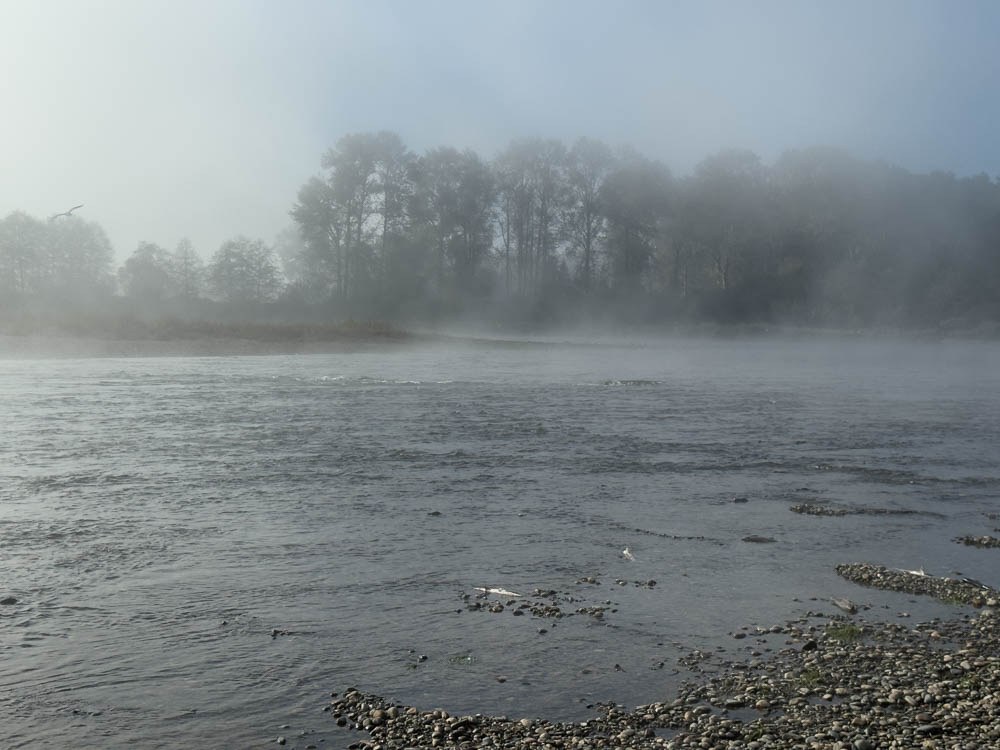
Fog filled the valley near the Snohomish River on this mid-October day, as if someone had draped the waterway with a white quilt. The cool air, in the high 40s, was sweet and moist on the hill above Bob Heirman Wildlife Preserve. The maples and alders were beginning to color, and a few chickadees flitted and chattered in the trees.
Donna Rooke, Stewart Hougen, and I had come to explore this area for future Naturalist trips, but really the goal was to get out of my office while the weather was nice. I zipped up my fleece, and we headed for the trailhead.
The trail dropped down a slope to the floodplain of the Snohomish River. The first part of the trail passed through large, big-leaf maples and red alders. The fallen leaves were damp on the trail, and our feet made little noise as we moseyed. At the bottom of the slope, a grass and shrub-filled field extended to the right, and the trail ran along the edge of a wooded area on the left.
Two song sparrows darted into some blackberries, making their unique chip notes. A slightly larger sparrow flew along the trail and up into a red osier dogwood. Of course, three-quarters of the bird was obscured by leaves, and it sat moving its head back and forth but made no sound. I shuffled three feet to the right and then could see a dark gray bill, a brown, plump head, and a slight bit of yellow on its forehead. A first-year golden-crowned sparrow was here from where it hatched in Canada or Alaska.
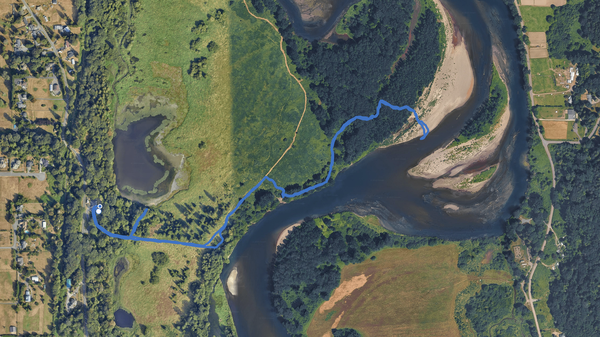
This part of the trail was wide, like a tractor road, and ran straight for three hundred yards before turning left, to the north. To our right, the river was beyond a thicket. After another three hundred yards, a side trail took us closer to the water.
The fog was still thick enough that it was difficult to see across to the other side. A flock of bushtits passed us in the canopy, each tiny bird zipping as if racing. Do they ever go slower than full steam ahead. “Oh, give me their energy,” I thought. A golden-crowned kinglet chattered, and a northern flicker called in the distance.
We reached a narrow part of the trail with lots of blackberry branches to avoid and several logs that required careful maneuvering to climb over. We had to duck under a few tree branches. A spotted towhee gave its “cat” call on our left and then darted across the trail in front of us, white feathers flashing in the subdued light. The riparian woods here wrapped around us like a blanket. My friends went around a corner, and it was as if I was lost in a maze.
The River
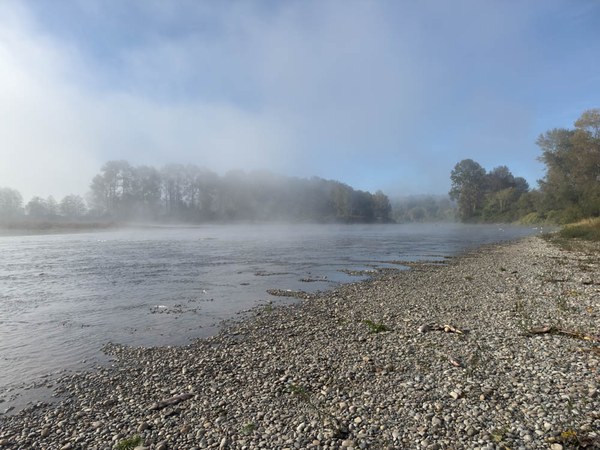
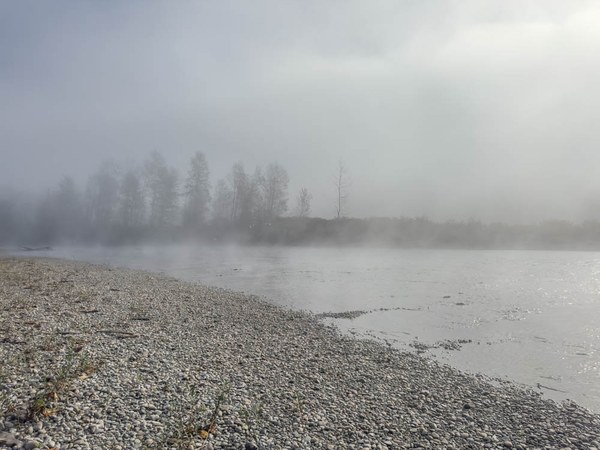
A side path took us down to a sparsely vegetated gravel bar along the river. (Thankfully, Donna had waited so I’d make the right decision at the junction.) The white wings of gulls flashed in the fog. I handed Stewart a rounded oblong rock that was about two inches long and an inch across. He rolled it over in his hand and pointed out crystals: black hornblende, quartz, and flat mica. It was a piece of granite from the Cascades. The ground was covered with similarly sized pebbles brought by floodwaters from further up the valley. On another day, we could have fun trying to figure out all the rocks and their origins, but the gulls called.
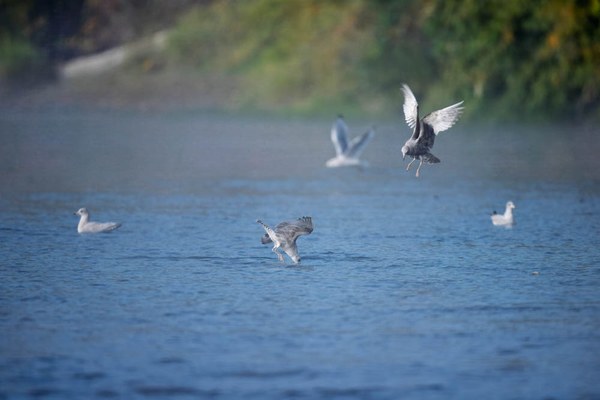
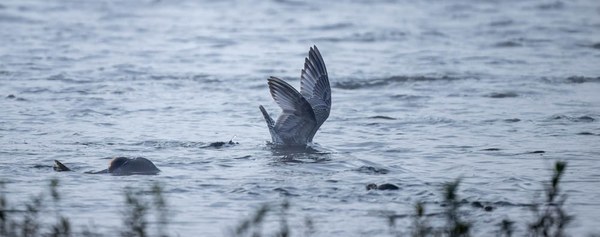
A dozen short-billed gulls flew in large circles over the water, partly obscured by the fog. They called back and forth, landing briefly before retaking flight. One stood in shallow water a few feet from shore. It jumped into the air and then dove headfirst into the liquid. A second one flew low over the surface, then plunged headfirst. They were fishing.
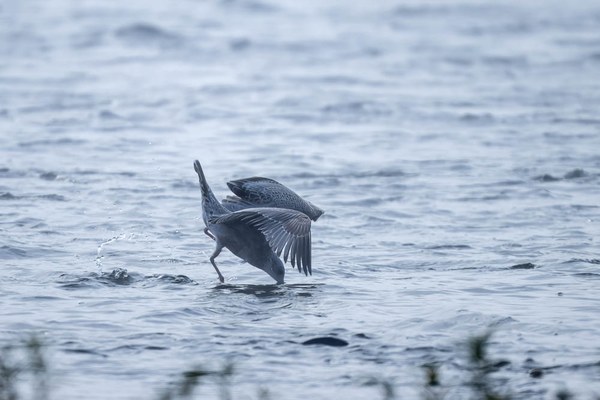 The plunge.
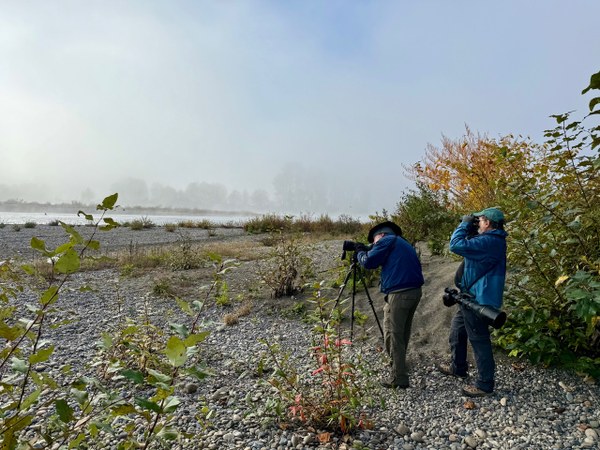
Donna waved her arm toward the water and called, “Salmon are spawning.” The fish’s back fins wiggled in the water. When they snapped their tails, they shot a few feet forward. “The gulls must be going for the roe,” Donna continued, “They're pinks, look at the humps on some of them.” We raised our binoculars and Stewart set up his scope. This side of the river was shallow for a few dozen yards out. The pebbles would be ideal nursery areas for the fertilized eggs and the alevins (newly hatched salmon).
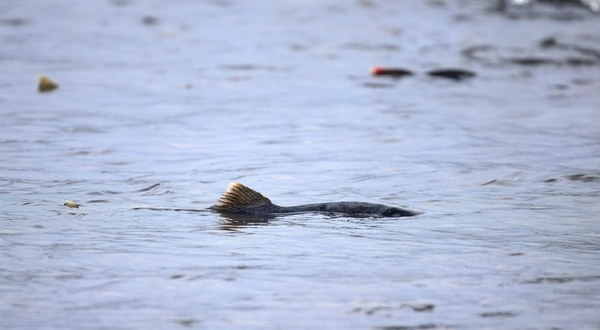
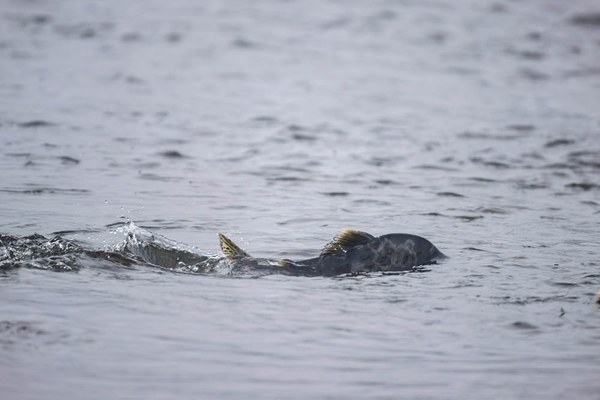
Pink salmon, Oncorhynchus gorbuscha, are the smallest of the seven salmon species, five of which spawn in Washington [1]. Adults grow to about five pounds. The Russian common name for this species is gorbúša, which translates to “humpies,” and they are often referred to as humpbacks in the United States.
As the males come into reproductive condition, they develop a large hump in front of their dorsal fin. The hump is a sexual attractant for the females. A larger hump makes the male more likely to pair successfully with a dominant female.
In the Puget Sound area, pink salmon spawn in large numbers every other year [1]. They have a two-year life cycle, and during odd years, like 2025, large numbers return to their natal rivers. A few do spawn in the even years, but not anywhere near as many.
We crept toward the shore and watched the gulls move up and down stream, but the salmon remained focused on their reproductive tasks. Dozens were through the shallows - ones, twos, threes clumped together, often side by side. Their dorsal fins were visible as they came in and out of the water, and occasionally their caudal fin rose above the surface. A snap of the tail would shoot one forward three or four feet.
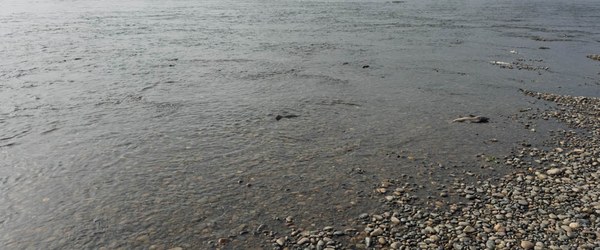
Mostly, the salmon faced upstream. A few moved back and forth through small channels in the gravel.
The females were building redds (nests) or defending them. To build a redd, the female digs a slight depression in the gravel with her tail, and when she lays her eggs, one or more males will release sperm to fertilize them. She then uses her tail to put a shallow layer of gravel over the fertilized eggs, which she will defend from other salmon until she dies a few days later.
There were dozens, if not hundreds, of salmon along the hundred yards of shallow water. They seemed active from the big bend upstream all the way down to the next bend. The three of us gradually spread out, each engrossed in studying the spectacle in front of us.
Each female may lay one to two thousand eggs in a clutch, and she may do this several times over a few days until she is totally spent. The eggs will hatch from December to February, and the alevins stay in the rocks until they have absorbed all the yolk. The fry (juvenile salmon) then emerge from the gravel in March or April and begin to move toward their nursery grounds near the estuaries. In 2027, if we come back, we may see adults who survived from this batch of eggs.
Mid-October is approaching the end of the spawning season for pink salmon in Puget Sound [2]. This run may have started as early as late June. None of us knew we’d be able to get so close to the Snohomish River on this trip, so finding these spawning Salmon was an incredible treat.
I shuffled upstream to a small gravel bar where I could be a little closer to the water. I moved slowly and took my time so as not to bother the fish. Several killdeer called from across the river, and the gulls circled a hundred yards away. Two groups of salmon, three to four each, were only a dozen feet in front of me. I watched for a long time before moving back on the shore and away from the water’s edge.
These salmon spent approximately 18 months at sea. There, they fed on marine life, growing and avoiding predation before returning to this river to complete their lives. The air was filled with the aroma of those who had accomplished that circle.
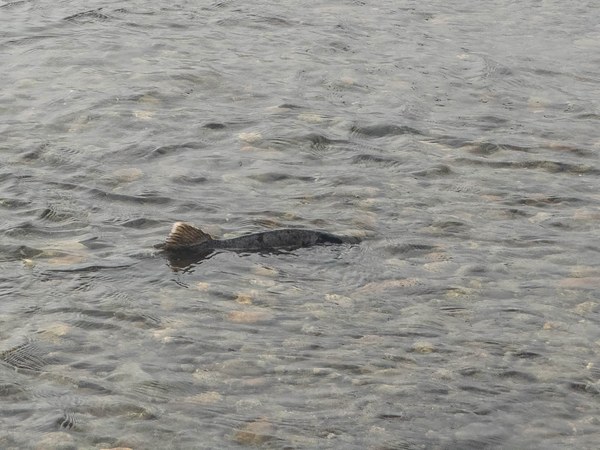
The watersheds of Puget Sound once supported thriving populations of several salmon species, and numerous humans depended upon them for food [3, 4]. Some species are threatened with extinction or in decline. But pink salmon seem to be doing well in the Puget Sound. The Washington Department of Fish and Wildlife estimates that a little more than 300,000 adult pink salmon might return to the Snohomish in 2025 [2]. The catch limit for the Snohomish River is set at six fish per day for 2025. Some are concerned that the high numbers of pink salmon aren’t good for the recovery of Chinook and, therefore, are hurting the Southern Orca population [5].
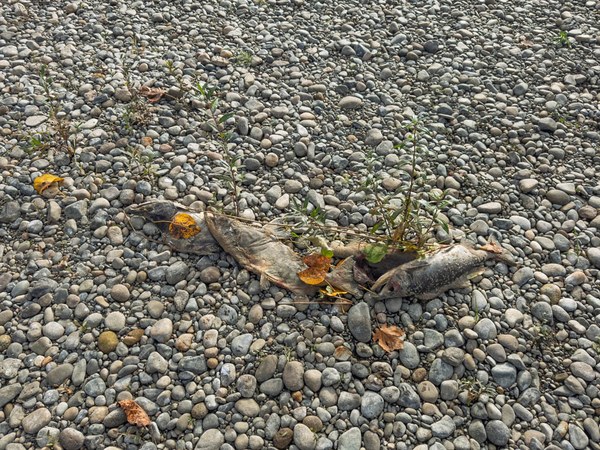
Several carcasses lay in the water, and a clump of three was on dry gravel, possibly dragged over by gulls. All the dead salmon had recessed eyes. I couldn’t tell if the eyes had been pecked or just dried out. The flesh seemed intact along their sides. Gulls aren’t strong enough to puncture the skin. There was also no evidence of raccoons scavenging the carcasses.
Surprisingly, no eagles appeared to be around. Using my binoculars, I scanned up and down the river, checking branches, down logs, and the shore, but all I spotted was a great blue heron in addition to the gulls.
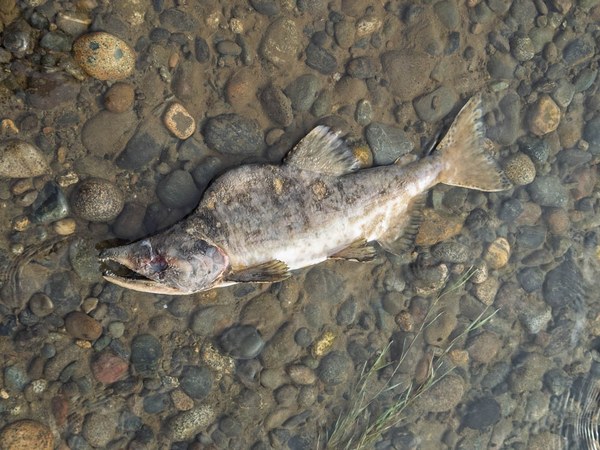
The three of us stood, staring at the water before coming back together. The expressions on our faces conveyed the amazement we felt about what we’d witnessed. Stewart pointed at one of the carcasses and said, “It turns out that fungi move a lot of the salmon nutrients back into the riparian zone through their mycelia. Maybe, a hundred yards or more [6].”
I’d known that dead salmon were an important source of nutrients along water courses [7, 8] but I’d never thought about the role that fungi played in distributing those ocean nutrients. Stewart continued, “The fungi send fibers into the carcasses, dissolving the flesh, and they take the nutrients through their fiber networks. It is an incredibly effective mechanism. They feed the trees,” he finished as he waved his hand toward the bank and the thicket of maples, alders, nine-bark, and other plants.
“How can one top that?” I thought. Life is so incredible. Then in silence, we turned together to head back up the bank and continue our explorations of the natural area. I stopped on the top of the bank to look back at the water and thought, “Definitely a place to bring a Mountaineers group.”

References
- NOAA Fisheries. Pink Salmon. 2025. [17 October 2025]; Available from: https://www.fisheries.noaa.gov/species/pink-salmon.
- Yuasa, M. It’s time to think pink salmon! 2025. [17 October 2025]; Available from: https://www.mywdfw.org/fishing-highlights-think-pink-salmon-chapter-1/.
- NOAA Fisheries. Saving Pacific Salmon and Steelhead. 2025. [10 October 2025]; Available from: https://www.fisheries.noaa.gov/west-coast/endangered-species-conservation/saving-pacific-salmon-and-steelhead.
- Montgomery, D.R., King of fish : the thousand-year run of salmon. 2003, Boulder, Colo.: Westview Press. xii, 290 p.
- Aronsom, E. Why too many pink salmon in Snohomish County may not be a good thing. 2025. [17 October 2025]; Available from: https://www.heraldnet.com/news/why-too-many-pink-salmon-in-snohomish-county-may-not-be-a-good-thing/.
- College of the Environment. Fish, Forests and Fungi. 2023. [17 Octover 2025]; Available from: https://environment.uw.edu/news/2022/11/fish-forests-and-fungi/.
- Dennert, A.M., E. Elle, and J.D. Reynolds, Nutrients from spawning salmon influence leaf area, tissue density, and nitrogen-15 in riparian plant leaves. Ecology and Evolution, 2024. 14(2): p. e11041.
- Quinn, T.P., et al., A multidecade experiment shows that fertilization by salmon carcasses enhanced tree growth in the riparian zone. Ecology, 2018. 99(11): p. 2433-2441.
