Jeannette Stawski
Excerpted and adapted from The Outdoor Leader: Resilience, Integrity, and Adventure by Jeannette Stawski (February 2024). Published by Mountaineers Books. Reprinted with permission.
Navigating the unknown, the uncomfortable, is a primary task for all outdoor leaders. The ability to tolerate challenging times and people is an asset. Change and challenges require the ability to move seamlessly from a determined, communicated, and vetted plan to one that navigates unforeseen (but time- and resource-anticipated) components. It’s vital to lean into and embrace adversity with confidence and to withstand doubt (self-doubt and that of others). Being okay with not being okay, and showing this to those who follow, is key. Being vulnerable and transparent as a leader allows others to find the strength to withstand that which may not have been anticipated.
Costa Rica Chicas
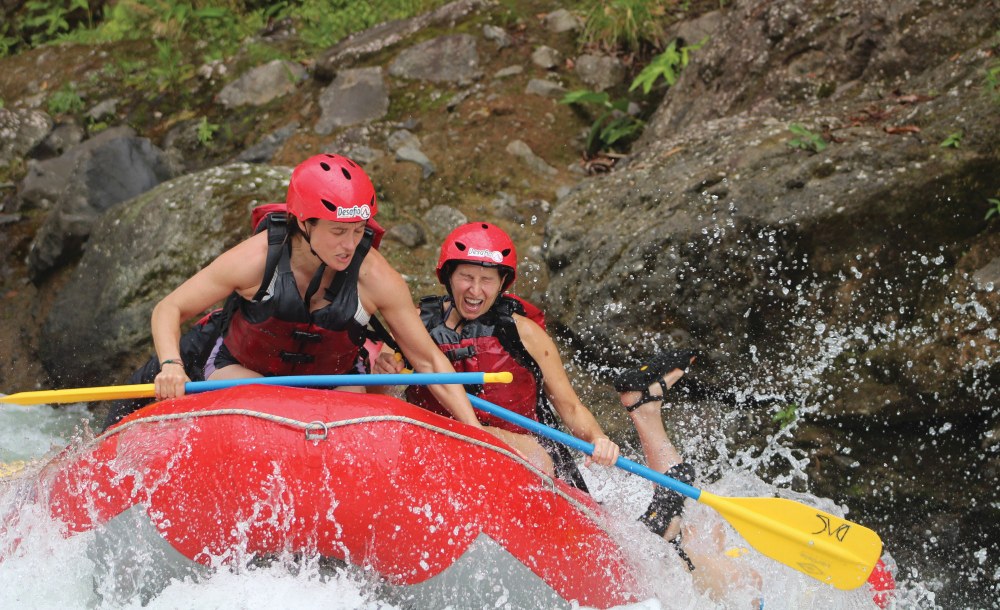
In 2019, I co-facilitated a once-in-a-lifetime learning expedition to Costa Rica that was intentionally designed for women leaders working in outdoor recreation and education. This adventure made me think a fair bit about being brave. Being outside without the comforts of technology — or climate control, and without a reliable means of transportation — requires confidence and a willingness to face uncertainty. There is a beauty in that, in which the unknown lies around the next corner and the process is filled with wonder.
In our first four days of adventure, we had swung from ropes into jungle rivers, had seen waterfalls and volcanoes, SUP’ed on Lake Arenal, and whitewater-rafted. Day five moved us away from volcanoes and into the jungle as we headed toward the Atlantic side of the country.
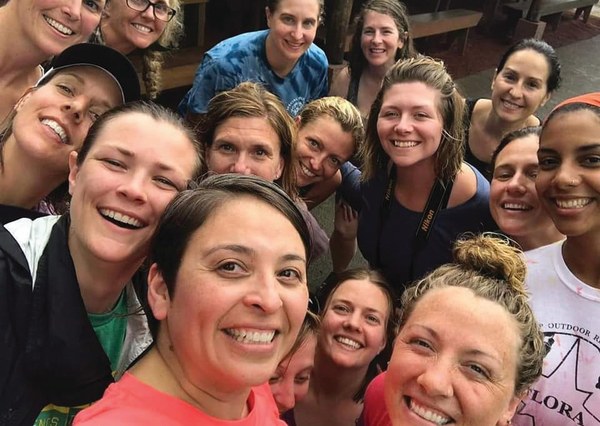 The Costa Rica Chicas. Photo by Victoria Lopez-Herrera.
Moving through discomfort and facing fear
The rain brought a mixture of emotions — first was the feeling of not wanting to be wet, but then, after realizing we were about to be kayaking, came the feeling of acceptance that being wet was bound to happen anyway. The temperature was comfortable, and the rain was moderately heavy — nothing to be concerned about, we felt, until the lightning and thunder started. Many on the trip were outdoor instructors, and they mumbled about best practices and not wanting to be on water in a lightning storm. The other participants who were leaders, but not in an outdoor context, were unaware of these issues and unconcerned, but they were open to actively and respectfully following the outdoor instructors. After some discussion among our group, we justified our decision by noting that the dense foliage around and hanging over the river would mitigate our exposure to the electrical storm, so into the boats we went.
Down on the river, it was hard to hear each other. The group of kayaks was pretty spaced out, and from my perspective the guides didn’t seem too concerned about, well, anything. One participant, who also had experience guiding groups and was comfortable on her kayak, went on ahead while I stayed back to be the sweep.
We were still in shallow water when I heard the first screams after a kayak capsized. It was the dumping, not the depth, that caused the cry. The sit-on-top kayaks were incredibly tippy, and a strong stroke or leaning too far out of the boat resulted in capsizing. As I came up on Jill, I found her drenched but standing in only a foot of water. The river was that depth most of the time but grew to four feet at the deepest channel — you had to navigate away from the sandbars into the channels to avoid getting stuck. Getting out of a sit-on-top kayak can be awkward and walking on a river bottom can be unnerving, but Jill was a trooper and I helped her get back in her boat. The rain continued. We floated easily down the river, with our convoy stretching farther apart.
However, kayaks were now flipping over frequently. Most participants felt a mixture of surprise and fear, shouting when they fell into the water. But for one participant, it was also emotionally challenging. After she flipped out of her single kayak, we decided as a group to pull off to the side to talk about why this was happening and what to do when it did. This participant had had a negative experience on a prior kayaking trip, nearly drowning when her boat capsized. So the two of us decided to share a tandem kayak. We had enjoyed a good connection on the trip, and I was happy to help comfort and reassure her, given my experience working as a river guide. Off we went on what was now a leisurely float trip, drifting downstream in the rain, dipping in our paddles to move away from shore or into deeper waters.
And then it happened. Coming around a corner, the light dimming from heavier rain and a thicker canopy, my partner and I found many overturned kayaks. Women yelled from the water, and there was general mayhem. My partner and I paddled to catch up to assess the situation — the Costa Rican guides were farther downstream. We joined forces and worked to make sure everyone was indeed out of the water — found and not trapped.
Some participants were freaked out. One, Nicole, recalled, “Our [tandem] boat dumped again. When I came up, I was trying to push up the boat because I thought my partner was stuck under it. Then I got stuck between a downed tree or branch and the boat.” With her face out of the water but the current tugging at her, Nicole began screaming for help, panicking, until someone came and pulled her out. She said that her partner felt awful about the capsizing, as if it had been her fault, though of course this was far from the case — they’d all been abandoned by the so-called guides.
The kayak trip was all over the place — people being upset about the flip and pinning, the absent guides, the decision to be on the river during the storm. At this point, the only thing I could do was to get everyone into their boats and floating downstream to the take-out.
Processing challenging events
Once off the river, the group circled up to process the day’s experience. More than a dozen amazing women came together with wet hair, some with red eyes, some with arms around another, and one missing a flip-flop. Each person talked about what had happened. For some, the focus was on the events of the kayaking (mis)adventure; for others, it was on how they felt in the aftermath. We all checked in with each other. This adventure marked the biggest leap several had taken in their lives: they’d felt uncomfortable and exposed, but also alive in a new, vibrant way, having to trust ambiguity and being without the normal constraints and comforts of their lives back home. After the expedition, I became even closer with the members of the trip.
In discussions more than a year later, Nicole remembered, “When I got back to our room, Victoria asked me what happened. I broke down. She stood there, looked me in the eyes, and cried with me. There was no judgment; she just listened, loved, and supported me, and she let me have my feelings. It was amazing. Looking back now, I can identify so much of what went wrong. Sometimes I feel embarrassed about the meltdown, but mostly I accept that what I experienced was traumatizing, not just for me but for the whole group. It was a turning point for me, in some ways. From my lens, this part of the trip was the first time we were pulled from significant comfort.”
Individuals can process a common experience differently — both positively and negatively. I saw this with the women on the kayak trip, who started processing it right after it happened, then again in a group debriefing, and years later when they reflected on impactful moments in their lives. At the time of the flip, some responded with action and others with emotion, while others remained unaware of the potential risks. In the group debrief, many shared how the experience felt to them in the moment, with one member connecting the potential loss of a participant to the recent loss of a family friend. Years later, when many of the women connected over breakfast, at least two stated, upon reflection, that the Costa Rica trip was the space and time that allowed them to make significant changes to their lives, including career change and starting a family.
It should be noted that leaders also process events themselves! Following a situation that the group has navigated, leaders will not only personally process and internalize their experience but will need to be intentional about helping and often facilitating the group’s experience. After our kayaking debacle, I focused on the group’s need to process right after we got off the water, and I recall how important it was for me to create space for each person to share. Then, afterward, I processed the event as an individual, exploring my feelings and understanding of the day’s events.
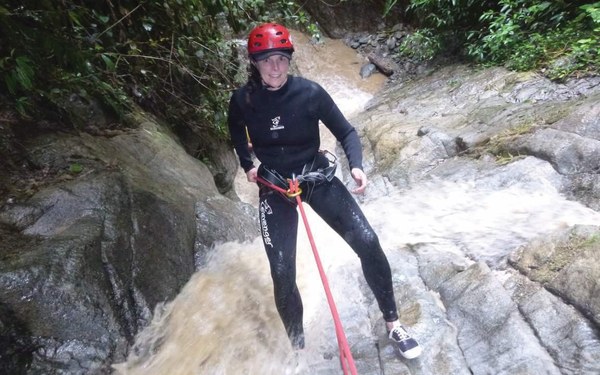 Having Type 2 fun while canyoneering in Ecuador. Photo courtesy of Jeannette Stawski.
How a leader’s tolerance for adversity affects others
One thing became clear to me after the Costa Rica expedition: a leader’s ability to tolerate challenging times and people can also be a liability. There is a very fine line between tolerating some discomfort, especially when you help cause it (as our river guides had), and ignoring things that are uncomfortable or even unsafe, to the detriment of those you lead.
Being on water during a lightning storm, as we were in Costa Rica, is always a bad idea. Water conducts electricity, and being in the water or on it in a boat can be a recipe for disaster. (A good rule of thumb is to not be on or in water until thirty minutes after you hear the last peal of thunder.) In Costa Rica, as the head leader of the trip, I should have done more to set aside my own tolerance for risk and adversity and instead queried members of the group as to where their threshold lay. However, by not voicing concern for getting on the water, especially as an experienced river guide myself, I chose Compliant Leadership — low care for myself and a low commitment to the group. Ultimately, it was not the best decision to go, and we were lucky that things didn’t go any worse.
REFLECTION EXERCISE: EMBRACING ADVERSITY AS A LEADER
- It is paramount for leaders to assess what is and isn’t working. When things don’t go as planned, which complementary abilities will you need to modify your efforts?
- Which outdoor experiences have required you to assess your ability to tolerate adversity? What did you learn about yourself and others?
- It is easy to avoid things that make us uncomfortable. Identify an area you are intentionally avoiding. Can you become more comfortable with being uncomfortable?
- What do you turn to when things become challenging? How do you acknowledge the discomfort yet still find a way to navigate through?
- What is your biggest fear in becoming an outdoor leader? What are you doing to address this fear?