 Juliane Gust
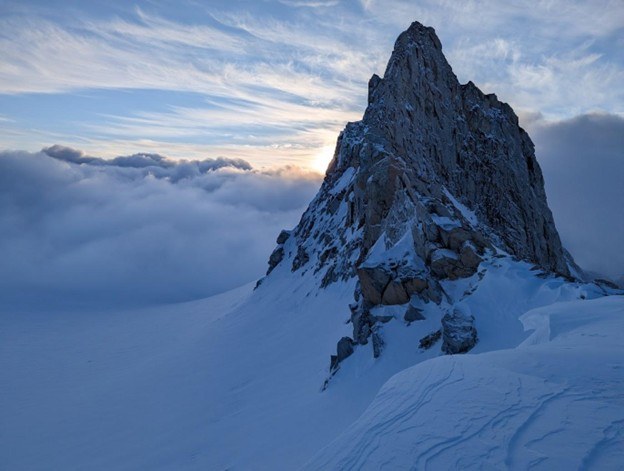
The Mountaineers is a group of people who love the outdoors, and who share their experience freely. As a volunteer organization, we hold a unique spot in the continuum of leader-follower dynamics: on one end is the IFMGA-certified guide, goddess-like in her competence and inspiring absolute confidence by her clients; on the other side is a group of buddies stumbling around in the woods with a dog eared copy of Freedom of the Hills. Sometimes our trips may look more like the first case, sometimes more like the latter. Let’s talk about how this affects safety.
Learning from incident reports
As an activity safety representative, I get to read all the incident reports that come in from our climbing workshops and field trips. Take this report for example: on an instructional field trip, a student noticed that the instructors seemed to be teaching an incorrect ice axe self-arrest technique for glissading. The student went to the instructors and explained the concern. Even though they had a long conversation and the student was insistent, the instructors did not think the concern was warranted. It was not until the leader of the field trip demonstrated the correct technique that the instructors realized they made an error - the student was right.
What were the factors at play? The student, a white man, felt uncomfortable contradicting the female instructors in an effort not to “mansplain.” The instructors had each other as backup, which probably strengthened their resolve to believe that they were correct. And in the end, the word of the senior course leader was more credible to them than the word of a student.
What can we learn from this? First, I want us to remember that we all do our best. Individual mistakes can be corrected by the individual, but they always happen in a system that allows the individual to make a mistake in the first place. Here, it could have been prevented by more solid instruction of the instructors, both during the basic climbing course, and again in an instructor briefing for the field trip. Perhaps nobody thought it necessary to double check on such a basic thing. It turns out, the basic things are usually the most important. A simple solution is implementing a short demo for all participants by the most experienced instructors at the beginning of the outing before breaking into small groups.
When I reply to incident reports, I always try to stress that the reports are a way for us to improve ourselves, and not to assign blame. It can feel stressful for reporters caught in a perceived power dynamic, and I have had multiple people tell me that they were worried their reporting might have negative repercussions for their standing in the organization. I cannot overstate how big a deal this is, so let’s address it head on! We should be proud if someone with less experience catches a mistake and feels empowered to speak up, because that means we are creating a welcoming and safe learning environment.
How can you help your leader be a good leader?
Here are some practical tips newer climbers can do to contribute to the team’s safety, specifically within the dynamic of The Mountaineers. Nobody is a professional. Your climb leaders are your peers. Your instructors are your peers. Your students are your peers. This means you are responsible for your own well being as much as that of the other members of the group.
Follow along everything your leaders and instructors do, and try to do it for yourself. Check the weather forecast and learn how to use advanced forecasting tools – are you seeing what they are seeing, and why or why not? Do you understand the route well enough to be able to get there and back by yourself? Because you just may have to, in case of an emergency. Do you know what the crux parts and decision points are on the route? Because those may be spots where you should be ready to speak up and weigh in.
What areas CAN students and new climbers take responsibility to help prevent accidents?
Slips on steep snow, rockfall, and - the most consequential - rappels are some of the most common sources of incidents, and paying attention during these moments will give you a big bang for your buck.
Ice Axe Practice
Steep snow inspires terror in many people, and the best way to address this is to proactively practice your ice axe and snow climbing skills. Our climbing courses have so much material to cover, the class time alone is not sufficient. Go to a closed ski hill with your friends, find a safe runout, and rebel against the constraints of physics. Fall backward and upside down with the axe in your nondominant hand. Do you hesitate and puzzle about what to do? If yes, then practice more.
When you are on a trip and the terrain gets steep, stop and discuss before you commit. Is the snow the safest and most efficient route? It often is, but think about it carefully. Stop and take out your ice axe and put on your crampons before you are in an uncomfortable spot and tempted to just gut it out because you're almost there. Decide what will happen if you slip. Is it really possible to do an ice axe arrest? If you are not sure, what do you think the likelihood is of falling, and is the risk worth it? Don’t feel shy about saying “this is making me feel uncomfortable.”
Our emotions are a really good guide unless we learn to suppress them. Emotions can also take over and paralyze us, but fortunately in climbing, we usually have enough time to stop, take a breather, and talk through it.
Rockfall
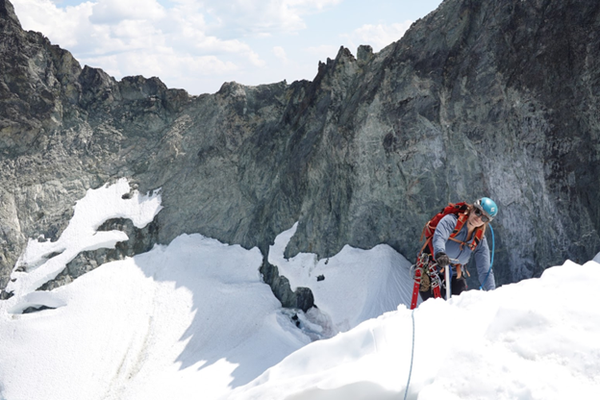
Mountaineers are great about wearing helmets (good job, keep it up, proudly wear your name taped to your forehead!). Route selection and timing of ascent are the biggest factors influencing rockfall, and unfortunately, our melting glaciers mean that rock fall is becoming a bigger issue in many alpine places. Remember that when rocks are whizzing through the air, getting closer to the wall is usually the safest response (see this brief video by the American Alpine Club’s safety guy, Pete Takeda).
So, the lesson for new climbers: be the first one to put your helmet on, and if you see rocks located above your head and the helmets are not on, ask your leader, should we be wearing helmets?
Rappels
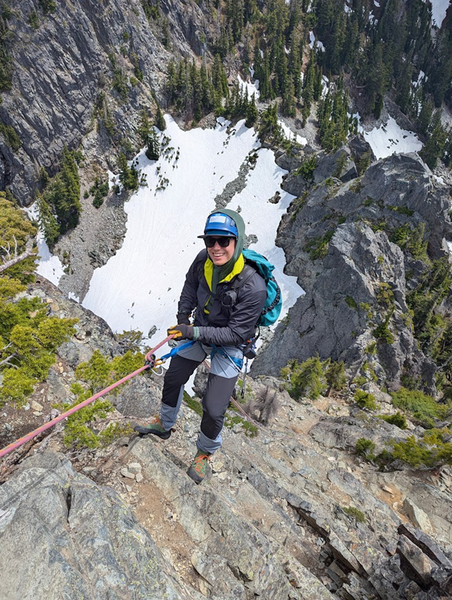
Rappels are the most dangerous thing we do in the mountains, as illustrated by the recent tragedy at Washington Pass (see Seattle Times accident write up and learning discussion *). When I climb with new climbers, I try to impress upon them their responsibility for their own survival. When you are doing rappels and you get to an anchor someone else has set up, how do you know they didn’t make a mistake? Is it good enough for you to trust this with your life? It takes just a few seconds to check every part of the anchor, trace the material all the way around to check for cuts and nicks, check the rock or tree that your anchor is attached to, check how the rope is threaded, and ask whether someone put knots in the ends of the rope.
We are really good at teaching a process for checking your personal rappel setup every time, and you should always always do it. You are an airline pilot going through your pre-flight checks. And don’t forget to check EVERY part of the system EVERY TIME, even if others tell you they already checked it. The pilots do it, the surgeons do it, the nurses do it, and they start over if they were interrupted. These systems were created because of lessons learned from catastrophic errors.
Another way to mitigate rappel risk is to critically evaluate whether rappelling is really your best option. On more obscure alpine climbs, it is common to see evidence of people rappelling on questionable anchors when it really could have been downclimbed. When there are no good and safe options for rappel anchors and the terrain is less than vertical, you can often downclimb on belay and place gear on the way down. Yes, the last climber down could fall, but likely it won’t be as catastrophic as a rappel anchor failure. And you don’t have to leave gear, so you can be more generous with backing up what you have.
Safety culture is a conscious choice
Mistakes can be made by the most experienced professionals, and the more power someone has, the more impactful their mistakes might be. A system where one individual’s mistake can have severe consequences is not a well set up system. A system of double checks and peer checks improves safety.
The most important part of this safety culture is that everyone is required to speak up. A safe system requires us to ignore perceived hierarchy, and sometimes swallow our pride. In our world of optimized everything, imperfection seems so uncool. But acknowledging and embracing our imperfection will bring more joyful activities. We are not professionals and most of us never will be. I argue that professionals provide experiences, but we have the experiences.
Everyone who gets involved in The Mountaineers should be doing it because they want to be part of a community. We don’t need to be doing the hardest thing – instead, we can do the right thing in the most graceful way.
If you are interested in writing a safety blog please reach out to safety@mountaineers.org with your proposed topic. Topics related to all activity types (hiking, kayaking, snowshoeing, canyoning etc) are strongly encouraged along with stories and best practices related to emotional safety and group dynamic scenarios.
*USFS report cited in Seattle Times rappel article appears to be an un-authorized USFS/OkWen Search and Rescue publication but the breakdown of the incident is nonetheless a helpful discussion piece.
Add a comment
Log in to add comments.
Seattle climbing is hosting a fun social event around Safety in September- sign up here- https://www.mountaineers.org/locations-lodges/seattle-program-center/events/seattle-climbing-social-annual-safety-briefing
