 Mauri Pelto
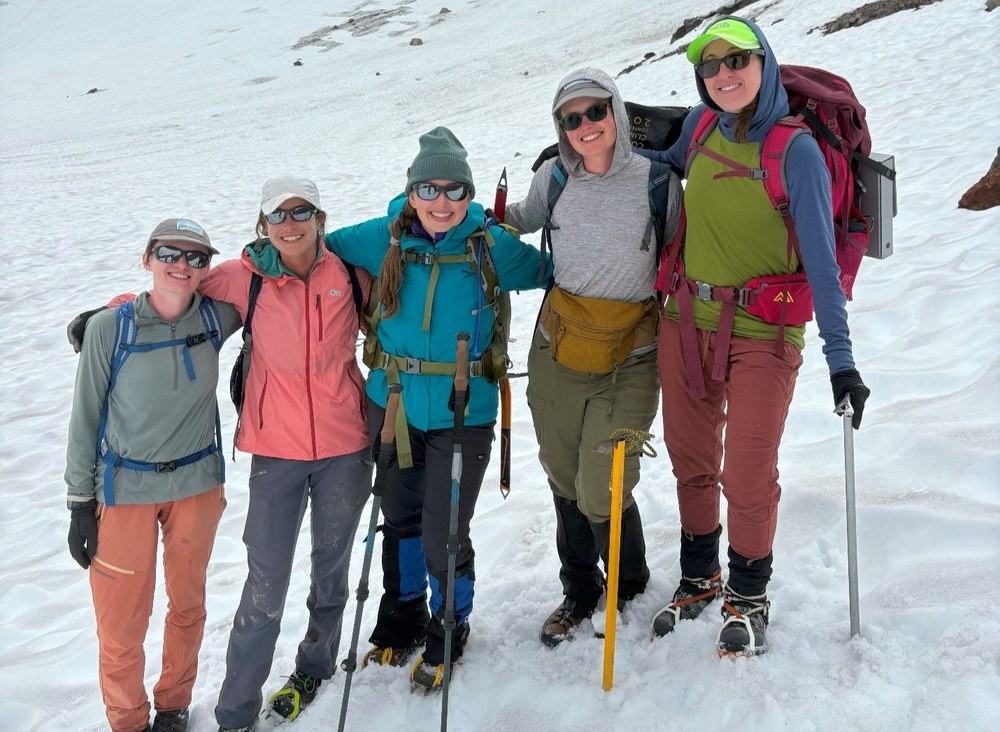
The North Cascade Range is shaped by glacial ice which blankets the slopes, sharpens the peaks, and fills the rivers each summer with runoff. In 1984, The North Cascade Glacier Climate Project (NCGCP), a group of artists and scientists who backpack into North Cascade glaciers and monitor their condition, began annual observations of these glaciers to chronicle their rapid response to climate change. We completed our 42nd consecutive year of detailed glacier observations in 2025.
Since 1984, our project has focused on the annual measurement of the mass balance on 12 glaciers. Mass balance is the difference between the amount of snow and ice accumulation on the glacier and the amount of snow and ice melt (ablation) lost from the glacier. (This is like your bank account, with accumulation being deposits and ablation being withdraws). Mass balance is considered the best measure of glacier response to climate change.
Eleven of the glaciers we measure are in Wilderness Areas. Hence, we designed our research around backpack access and non-mechanized equipment.
For the fifth consecutive year, our data shows that North Cascade glaciers lost on average more than 4 feet (1.3 meters) of glacier thickness. Most of the glaciers that are 25-40 meters thick cumulatively lost 9-10 meters, representing at least 25% of their volume lost in just five years. For the larger glaciers that average 40-60 meters in thickness, such as those on Mount Baker, the loss represents at least 18% of their volume.
This is not a sustainable pace of loss.
Monitoring glacial retreat
The rate of retreat for the glaciers we observe has accelerated so quickly that we are faced each year with changing terrain and new challenges. Beyond that, we are starting to see the dramatic effect this retreat and the decrease in water has on the ecosystems both near the glaciers and further downstream.
Foss Glacier
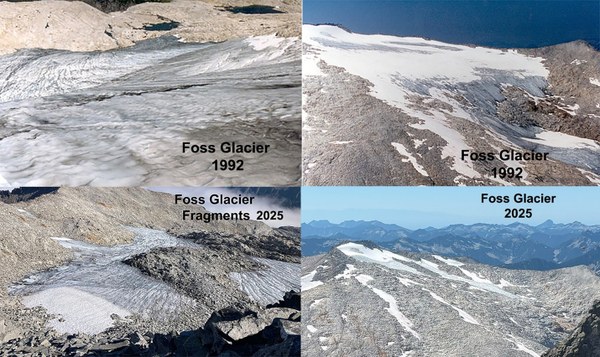
The trajectory for most North Cascade glaciers is one of fragmentation. This is illustrated by Foss Glacier on the east flank of Mount Hinman, which we began observing annually in 1984 but stopped measuring as it fragmented. From the top, Foss Glacier was 1 kilometer long and nearly 600 meters wide in 1984. In September 2025, Cal Waichler (artist and participant in NCGCP) photographed the top of Foss Glacier revealing two main fragments that were less than 300 meters long and 50 meters wide.
Lower Curtis Glacier
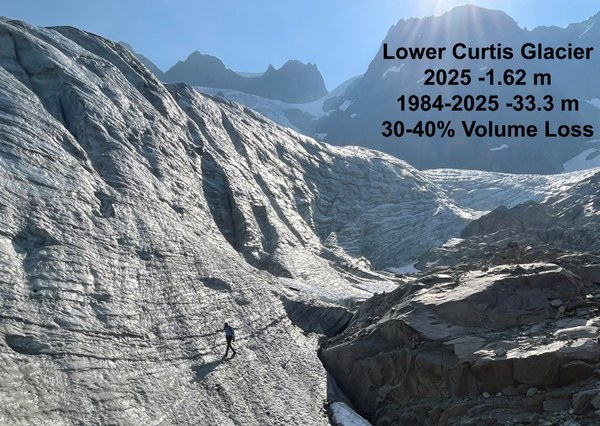
Lower Curtis Glacier on Mount Shuksan is below the start of the Fischer Chimney route. When we began observations of Lower Curtis Glacier in 1984, it was advancing. A slow retreat followed from 1987 to 2003. In the last two decades, the glacier has experienced rapid thinning that has led to retreat, as well as a decline in height and number of seracs that had once towered above the terminus. In 2025, this glacier retained avalanche accumulation, leading to a less negative mass balance than other North Cascade glaciers.
Rainbow glacier
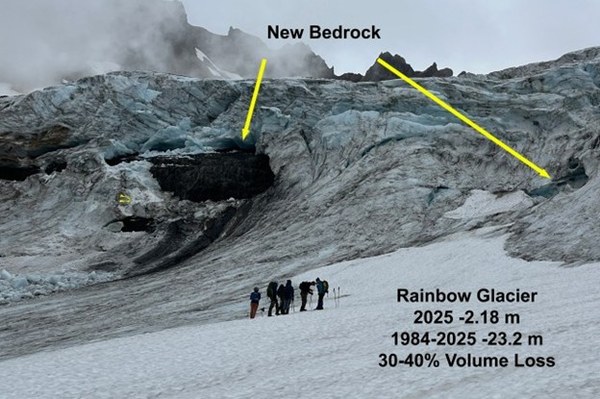
Rainbow Glacier on Mount Baker is one of the sixty global reference glaciers (The World Glacier Monitoring Service identifies key glaciers with at least 30 years of detailed continuous mass balance observations as a reference glacier). This glacier was advancing when we began our annual observations in 1984. By 1988, it had begun to retreat, and by 2025, it had retreated 900 meters. This year, new bedrock began to emerge and expand in several icefalls (leading to several serac falls) that we observed.
Easton Glacier
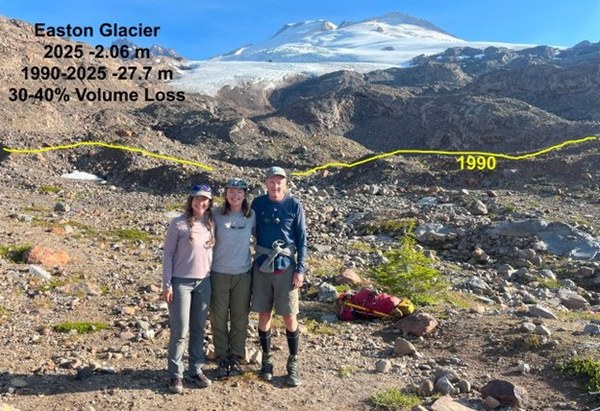
Easton Glacier is also a global reference glacier and is crossed by one of the most popular climbing routes on Mount Baker. This glacier began to retreat in 1990. By 2025, it had retreated 700 meters, with 50% of that retreat occurring over the past 10 years. The extensive glacier thinning extends across the glacier, with bedrock emerging in the main icefall at 2,000 meters and several locations in the 2,500-2,800 meter range.
Columbia glacier
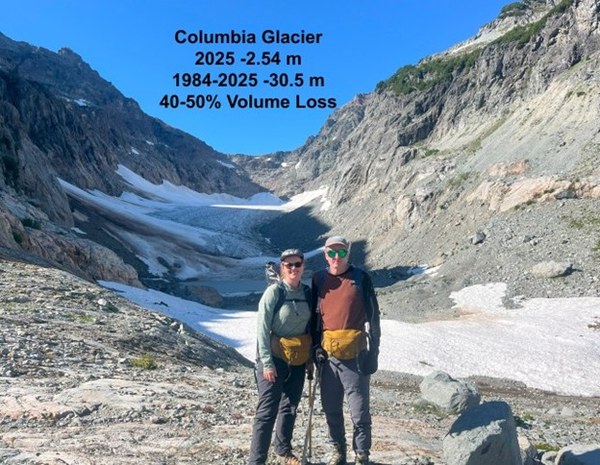
Columbia Glacier, another global reference glacier, lost 5% of its volume in the summer of 2025, a typical percentage for recent years. The glacier is fed by avalanche. With less ice and perennial snow filling the shallow basins on the slope above the glacier, avalanches occur far less frequently. As a consequence, the several avalanche zones that once fed the glacier are no longer supplying the glacier. Glacial melting has also led to the expansion of a lake at its terminus, which began forming in 2009.
Shaped by Ice: Changing Ecosystems
In the summer of 2025, we worked with a variety of artists – two oil painters, one watercolor painter, and one printmaker – who backpacked into the field with us to observe glacial change. The artists, led by Art Director Jill Pelto, use their art to explore how our glacial regions are changing and the deep impacts these changes have on human and natural communities, from the loss of freshwater resources to ecosystem shifts.
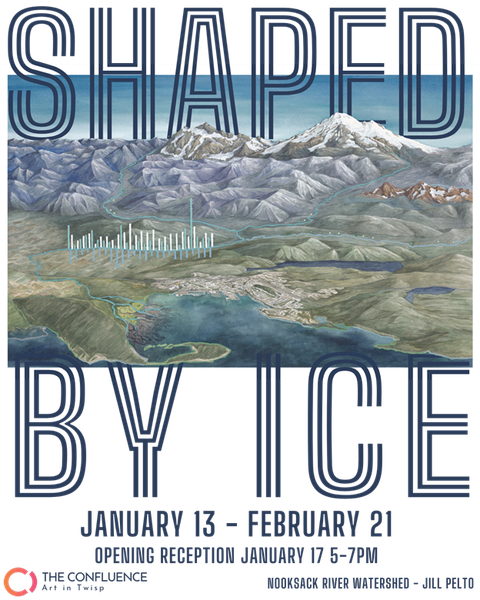
Glacier loss is a visible sign of climate change. Our goal is to increase awareness, foster curiosity, and inspire personal connections between people and glaciers. You can view these artists’ work and the glacial changes they showcase in the exhibit “Shaped by Ice: Changing Ecosystems” at the Confluence Gallery in Twisp until Feb 21. The show features work from: Jill Pelto, Cait Quirk, Emma Mary Murray, Danielle Schlunegger-Warner, Cal Waichler, Claire Seaman, Rose McAdoo, and Margaret Kingston.
For more updates on our research, keep an eye out for an upcoming article in the Spring 2026 edition of Mountaineer magazine.
The Mountaineers is committed to doing our part to respond to the climate crisis by advocating for public lands protections and investments in climate action, reducing our organizational carbon footprint, and educating the outdoor community by publishing books and other content that promote climate solutions, sustainability, and stewardship.
