 The Mountaineers
In building a culture of philanthropy at The Mountaineers, we’re always seeking ways to communicate clearly and concisely the importance of our mission to funders. This work requires a deep understanding of the connection between our daily efforts and long-term impact.
Recently, members of our Community Engagement team undertook a Theory of Change exercise to examine our Conservation & Advocacy program. The exercise guided us through pinpointing challenges; proposing solutions; identifying our inputs, activities, and outputs; and establishing desired outcomes and impacts. Results highlighted how the efforts of our staff and volunteers directly connect to our mission and strategic plan, and recognized The Mountaineers as uniquely qualified to create tangible, lasting change for our community and the natural world. These findings strengthen our case to external partners and help us ensure that every charitable contribution and volunteer hour is strategically invested for maximum impact.
Let's pull back the curtain and look at some key components from this exercise.
Understanding the starting line: Premise & problem statements
Every effective initiative begins with a clear understanding of the challenge it aims to solve. For our Conservation & Advocacy program, this means articulating the conservation and outdoor recreation issues we focus on through education, stewardship, and advocacy.
Our access to public lands is under threat because public lands themselves are under threat. These vital spaces face critical challenges, including chronic underfunding of land managers, drastic cuts to the land manager workforce, increased visitation, climate impacts such as wildfires and flooding, extraction policies of lumber harvesting and mining, and public land sell-offs to private interests.
Charting the course: Proposed solutions
Once we define the challenges, we identify the specific strategies and interventions we can employ to address them. These are our “proposed solutions” — the core of our programmatic approach.
Our Conservation & Advocacy program leverages our long history and standing as the voice for outdoor recreation and conservation in Washington. Through our coalition work with outdoor partners and deepened relationships with land managers, lawmakers, and tribes, we advance innovative and collaborative solutions that address the protection of and access to public lands with an outsized impact on conservation efforts, state and nationwide.
In our mission to help conserve the natural world, one of our proposed solutions is to educate and engage our community around how to care for and steward the places they love through sustainable and responsible practices, as well as how to take personal action to address the challenges facing public lands.
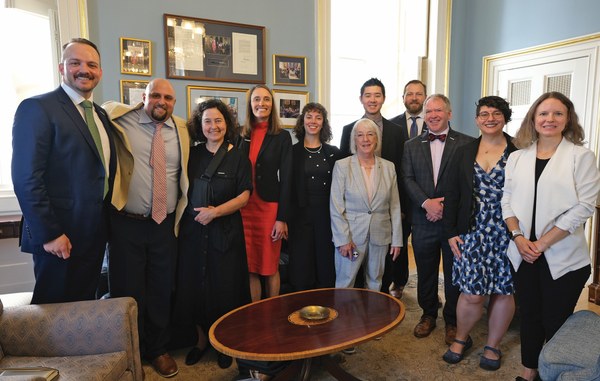 Mountaineers Conservation & Advocacy staff and Outdoor Alliance partners with Senator Patty Murray in D.C. Photo courtesy of Conor Marshall.
The fuel for our work: Inputs
Inputs are the resources we need to execute our proposed solutions. This includes everything from funding and Conservation & Advocacy staff expertise to volunteer hours and crucial partnerships. In other words, it's the "what we need" to get the job done. For our Conservation & Advocacy efforts, primary inputs include:
- Our Conservation & Advocacy Director: This role leads programming, drives partnerships, executes policy and advocacy campaigns, and supports fundraising efforts that protect public lands and the outdoor experience.
- Our Advocacy & Engagement Manager: This role inspires action through conservation communications, develops educational opportunities for our members on policy issues, and engages our community to take action to help protect the outdoor experience.
- Our Associate Manager of Policy & Planning: This role builds vital relationships with land managers, leverages those connections for special use permits, and advocates for issues like increased funding for public lands.
- Our dedicated volunteers and member advocates: Your passion and time are indispensable for grassroots efforts and amplifying our advocacy. When it comes to advocacy, there’s no replacement for constituent outreach.
- Financial resources: Funding ensures we can organize campaigns, lead coalitions, and sustain our expert staff.
Our actions in motion: Activities
Activities are the specific tasks and processes we undertake to address challenges and drive our mission forward. This is how we do our work, the day-to-day operations that drive our mission forward. Some Conservation & Advocacy activities include meeting with lawmakers, authoring advocacy letters on behalf of the outdoor recreation community, and building relationships with land managers to understand their capacity and unique challenges. We also engage our community through blogs, action alerts, and eLearning courses, while enlisting key volunteers and leaders to further engage our members and the wider community.
Measuring our reach: Outputs
Outputs are the direct results of our activities. They are quantifiable measures of what we produce or deliver, indicating the scale and reach of our work. Our Conservation & Advocacy outputs could include the number of comment letters and action alerts sent to members, the number of people who complete Conservation & Advocacy eLearning courses, or the number of meetings that we have with Indigenous tribes, land managers, or lawmakers.
Immediate shifts: Outcomes
(near-term effects)
Outcomes are the short-to-medium-term changes that occur as a direct result of our outputs and activities. Desired outcomes of our Conservation & Advocacy work are that lawmakers prioritize action on public lands and recreation issues, Mountaineers members feel more connected to and protective of natural spaces, and members of our community are well-educated on policy issues that directly affect their ability to recreate in the natural world.
The lasting legacy: Impacts
(broader, long-term effects)
Finally, impacts represent the long-term changes and goals we strive to achieve. These are the significant, sustainable differences our work makes in the world that directly align with The Mountaineers mission and strategic plan, Adventure With Purpose. Potential impacts of our Conservation & Advocacy efforts include the permanent protection of critical public lands and wilderness areas, increased and sustainable access for outdoor recreation, and a robust, empowered movement of public lands advocates who actively shape environmental policy in Washington and beyond. These impacts directly fulfill our mission to explore, conserve, learn about, and enjoy the lands and waters of the Pacific Northwest and beyond.
The value of understanding our Conservation & Advocacy impact
The Theory of Change exercise is more than a tool for crafting a stronger case for funders — it’s a process for deepening our understanding of our work’s true value, which ensures that every dollar we raise and every hour our staff and volunteers dedicate are strategically invested to create the greatest possible impact.
This rigorous self-reflection on our Conservation & Advocacy work allows us to communicate to our members and partners that their support isn't just a contribution — it's a direct investment in a clear pathway toward lasting change. Your support helps us permanently protect critical public lands, increase sustainable access for outdoor recreation, and build a robust movement of advocates who actively shape environmental policy in Washington state and beyond.
The Mountaineers conservation and advocacy work is made possible through philanthropic support from our community. Consider a gift to protect public lands and the outdoor experience today.
This article originally appeared in our fall 2025 issue of Mountaineer magazine. To view the original article in magazine form and read more stories from our publication, visit our magazine archive.
