 Salomé Stähli
I watch the little frog at my feet, barely bigger than a thumbnail, and scoop it gently into my small hands. My sister, nearly two years younger than I am, tries to imitate me. I worry she’ll squash the baby frog she’s trying to catch.
As the frog moves around in my hand, I giggle, then eventually let it go. Near the pond, my mother holds my toddler brother’s hand and tries to keep him from the shore, but he continues pulling her toward the water. I catch another frog while my mother watches me with a smile.
Navigating belonging among people and places
I feel safe at this pond. Surrounded by trees, frogs, my siblings, and my mother, I don’t have to worry about the kids at school. Just yesterday, my classmates teased me with song lyrics they changed to make fun of my name, my dialect, and my tall, clumsy body. While they sang, I stared at my feet, and wished I could disappear into the comfort of these waters.
Being left out isn’t an uncommon experience for me. That same day at school, I was excluded from a game of jump rope. As my classmates played without me, I hid under the yew trees surrounding the schoolyard and cried. Beneath the branches, I found peace in watching the tiny ants crawl in an almost perfect line to a nearby hole.
Over the years, nature has become a refuge from life’s challenges. When my peers make me feel that I don’t belong, the natural world and its wonders invite me in. Embraced by the mountains, I don’t have to worry about anyone’s judgement. There’s no one to tease me for stopping to move a snail from the trail so it doesn’t get squished. No one to tell me I’m weird for pausing longer than usual to admire a leaf or flower. No one to make fun of what I wear, how I look, or how I move.
But as I become a teenager, the sanctuary of the natural world fades. I receive failing grades in P.E. and repeatedly get chosen last for grade school soccer games. I start to believe there’s something wrong with me and my body.
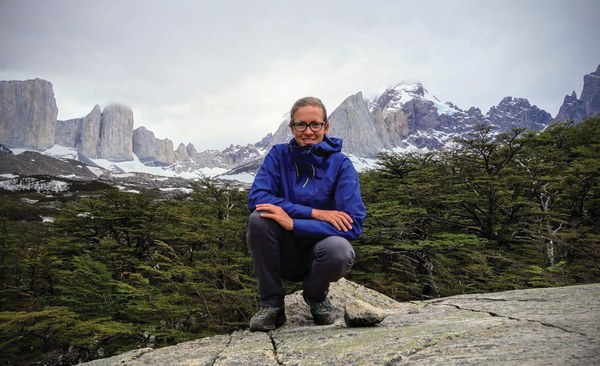 Tired after a long uphill to the Mirador Britanico in the Torres del Paine National Park, 2015.
The trail to trusting myself
Fifteen years later in Patagonia, I am setting camp in the Torres del Paine National Park in winds so strong that anything untethered to the ground will be carried away. I feel in over my head, and wonder whether I can handle this popular hike by myself. This is my first experience camping and hiking alone, and I am eager to prove to myself that my body is capable of more than people think.
The next morning, I lift my impossibly heavy backpack onto my shoulders and question how I’ll be able to carry all the equipment. Gingerly, I put one foot in front of the other. A gust of wind nearly throws me into the rocks, but I catch myself with my hiking poles.
The next few days are a test of grit as I drag myself from camp to camp. At times I feel defeated, but moments of natural beauty, like sunlight turning ice masses from white to light blue, keep me going.
For nearly two months, I hike and camp solo until I feel ready to hike the remote Cabo Froward without the comfort of rangers, huts, and other people.
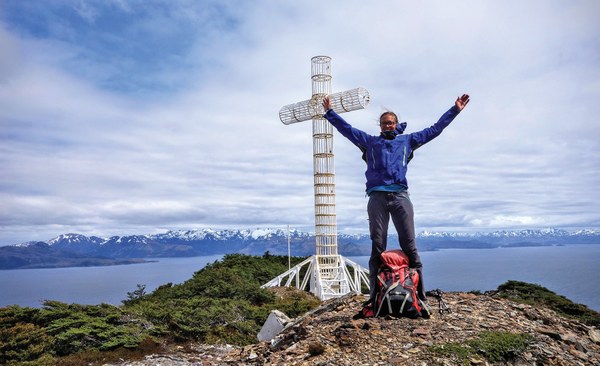 Standing proud after reaching Cabo Froward, the southernmost tip on the Chilean mainland after a harrowing hike, 2015.
Finding resilience in the natural world
Journeying alone on the Cabo Froward isn’t easy. I feel afraid as I fight through tangled, dark forests, and doubt whether I can find my way out or handle the experience on my own. As I navigate between dense trees, across rivers up to my armpits, over slippery cliffs, and through a marsh so deep I nearly lose a shoe, I doubt myself again.
I cry with the rain and let the wind dry my tears. Every time I hit a dead end, I scream in anger – at the trees, at myself – and then eventually… I emerge from the forest.
Exhausted, I drop my pack and gaze at the wind-battered trees along the coast whose branches, growing only on the downwind side, barely move in the gale. In them, I see resilience that deep down, I know I have too.
Toward the bay, I see the black-and-white bodies of Commerson's dolphins splash and play in the water. With them, I smile. Later, I spot humpback whales, their exhales the only sign of their presence. With them, I exhale. I did it, I think to myself. I completed my first remote route alone.
I reflect back on my first hike in the Torres del Paine National Park – to when I couldn’t imagine completing a week-long popular hike solo – and realize it’s time to see my body differently: not for what it can’t do, but for what it can.
Back at the hostel kitchen, I eat dinner by a warm wood fire when a man, whose smile lights up his entire face, enters the room and changes my life. We start talking about adventures and he tells me about climbing Mount Rainier with The Mountaineers. At 6am, as he’s ordering a taxi to the airport, we’re still talking.
“Maybe one day we could go on an adventure together?” I ask shyly.
“I’d love that,” he answers, then waves goodbye.
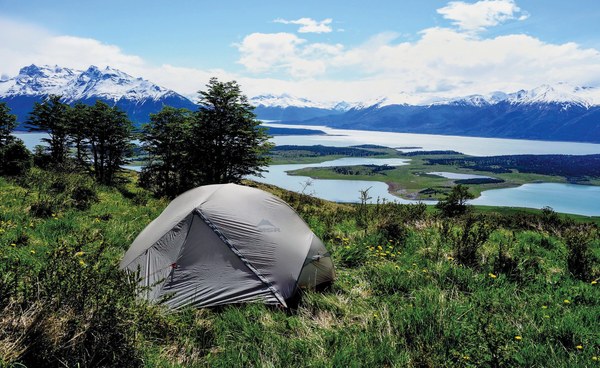 Slowly getting used to camping alone above the magnificent Lago Argentino in Patagonia, 2015.
The challenge of feeling at home
Two months later in Seattle, I am visiting that same man, Ricardo. We meet at Fremont Brewing, and I tell him about my dream to do a long backpacking and packrafting trip – one more remote than I’ve ever done. Intrigued, Ricardo starts researching the best packraft brands that night.
Over the course of a few weeks, he takes me hiking around Leavenworth and snow camping on Crater Lake, and I start imagining what it would be like to call this place home.
I move to Seattle a couple months later, excited by the promise of adventure that this new landscape holds. Ricardo starts a new job, I go back to school, and soon, talk of adventure fades under the weight of books, exams, and long nights studying. My “hikes” consist of walking from my bedroom to my office, and on some days to the school library. I no longer stop for leaves turning red in fall or flowers emerging from their buds in spring. I grow out of place and out of touch with myself and the natural world, and my childhood doubts about whether I belong start to return.
Disillusioned about the uncertain future of my career in this country, exhausted, and homesick for the first time in my life, I feel lost. The hiker who told Ricardo about remote backpacking and packrafting dreams is gone, replaced by a shell of herself.
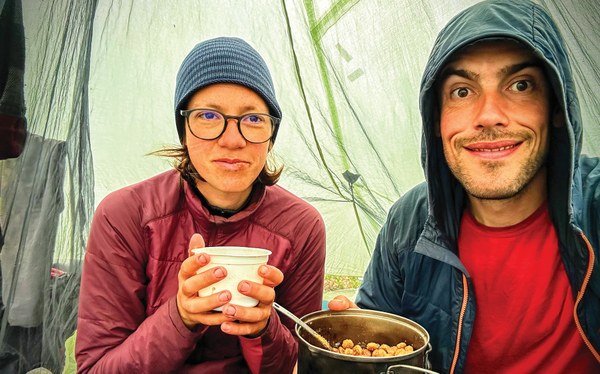 Ricardo and Salomé eating breakfast one morning during their hiking and packrafting trek through Alaska, 2023.
Re-inspired at Banff Mountain Film Festival
One evening, my head buried in books and my eyes sore from reading, Ricardo begs me to take a break and join him at Banff Mountain Film Festival. I resist, anxious about falling behind on studying, but he insists.
Sitting in Benaroya Hall, I watch the screen fill with stories of people skiing down impossibly steep slopes, biking through rugged landscapes, and paddling across rivers with waves so tall that they disappear between the barrels. Gradually, I feel something inside me stir. A film titled Into Twin Galaxies, featuring three kayakers’ attempt to cross Greenland’s ice fields and explore an unknown canyon, begins playing and I start to cry.
By the end of the movie, I catch myself thinking of adventure again. The next day, I nervously suggest to Ricardo that maybe, after the bar exam, I could hike the Pacific Crest Trail (PCT) for two months.
“You should go,” he says with a smile. “I’ll drive you to the Southern Terminus.”
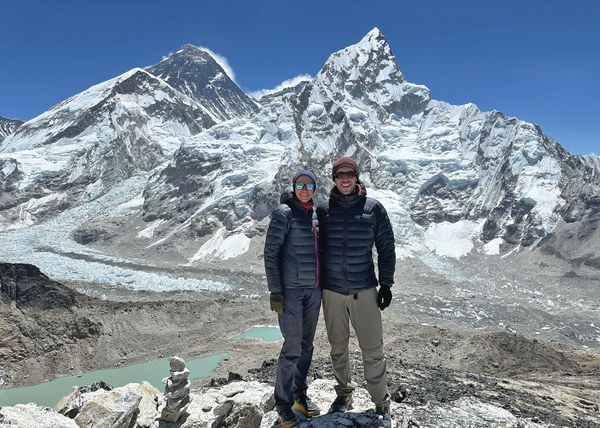 Ricardo and Salomé enjoying views of Mt. Everest on the Three Passes Trek in Nepal, 2024.
Nature’s invitation back home
Three months later on the PCT, I am sitting on a rock watching silvery green sage brush move gently in the wind as my legs rest from a steep climb. For the first time in months, deep breaths come with ease and my body relaxes in a way I had forgotten was possible. A smile makes its way onto my face. After a generous and rejuvenating pause, I lift my backpack back onto my shoulders and continue hiking.
A month later, Ricardo visits me on the trail with a cake to celebrate my success passing the bar exam.
“You look so happy and relaxed,” he says. “And your hands are so dirty!”
I examine my fingers, black from the desert dust, and laugh. After months on the trail, these dusty hands have become normal, as has the absence of stress, darkness, and doubt I brought with me to the Southern Terminus. I look ahead to the other hikers I’ve met, my little trail family who helped me find belonging in a country I had failed to feel at home in.
As we settle in for the night, enveloped by the peace of the trail and its visitors, I realize I wasn’t homesick for my home country, but for the mountains and the reassurance they offer when I feel like I’m losing my sense of myself.
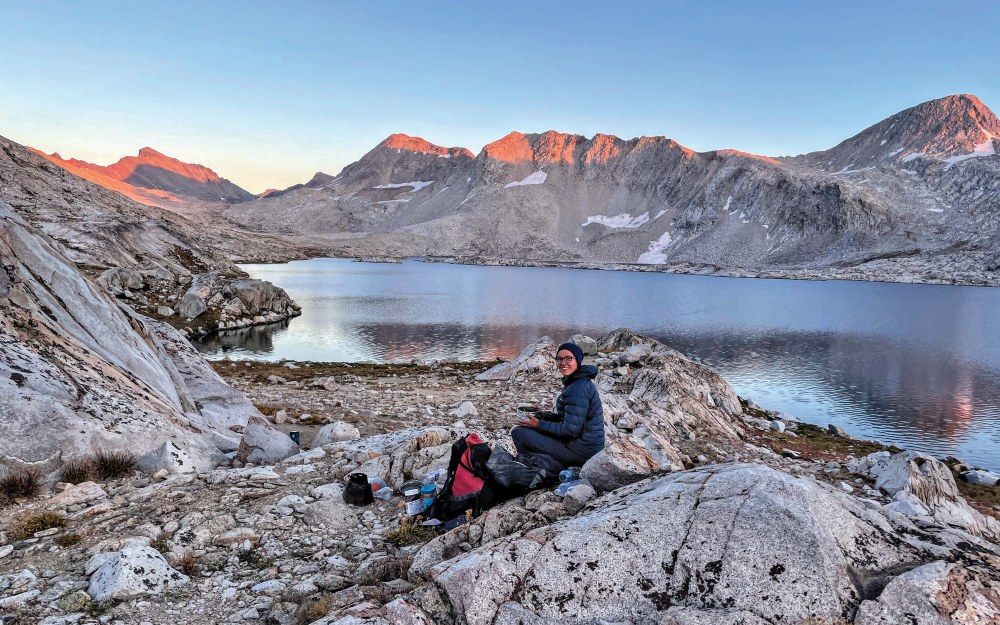
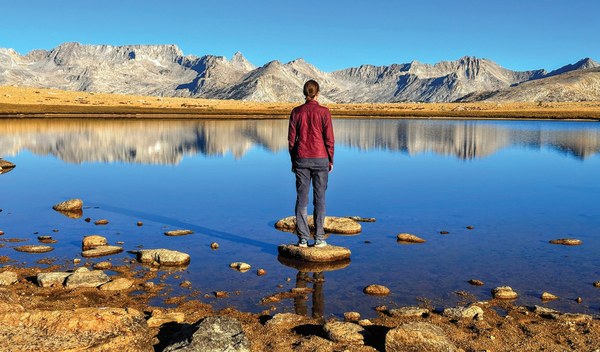 A calm, contemplative morning in the Sierras on the PCT, the trail that healed Salomé from depression, 2018.
A promise to myself and the natural world
I return to Seattle with an injured leg but a healed heart and vow to never neglect my love and need for time outdoors. I start exploring the mountains of the Pacific Northwest and make a commitment to solo hike portions of Washington’s PCT every summer.
Three years later, Ricardo and I finally follow through on our dream to go on a big, remote adventure together. We leave for Alaska, to cross the entire state on foot and by packraft.
When those moments of doubt or challenge arise, I think back to that little girl scooping frogs by the pond and reflect on how far she’s come, and how much further she is capable of going.
This article originally appeared in our fall 2025 issue of Mountaineer magazine. To view the original article in magazine form and read more stories from our publication, visit our magazine archive.
