 Katjarina Hurt
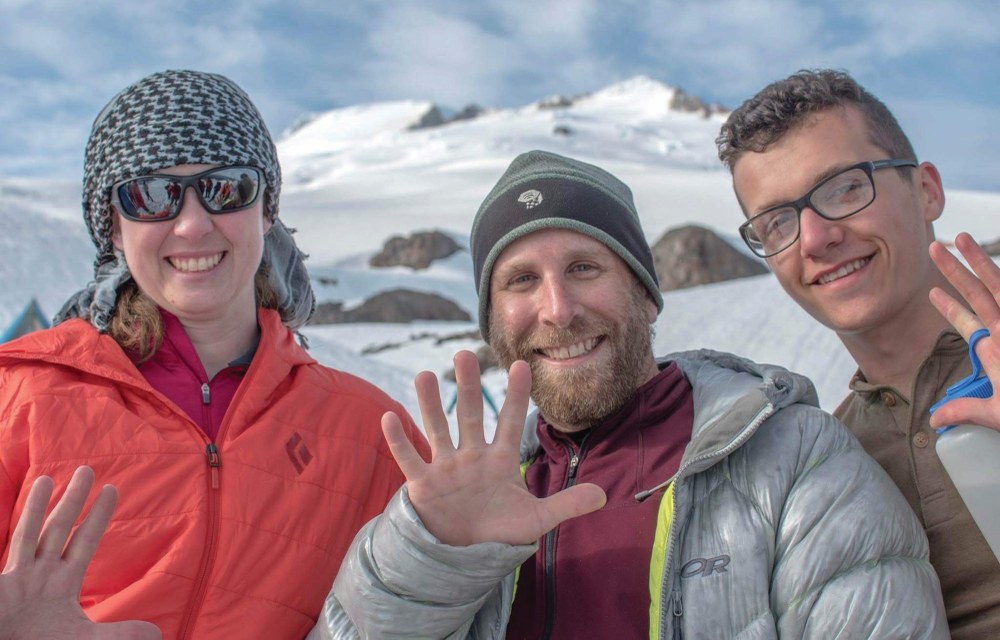
On August 14, 2018, my best friend Stephen Kornbluth and two other climbers set out to summit Dewey Peak on the Sunrise side of Mt. Rainier. During the descent, the anchor built to support their rappel down the mountain failed, and Stephen fell. Despite heroic efforts from the other climbers to provide emergency care, Stephen did not survive.
Two weeks later, I was part of a team that summited Dewey Peak to try to recreate the accident. We brought with us photos from Stephen’s phone and materials to rebuild the anchor. Our goal was to learn from the tragedy and share our findings with the greater climbing community to prevent future accidents. While the technical findings were helpful, the human-centered elements of the incident impacted me the most. With the learnings from our climb, I developed a new approach to risk management that I call Breaking the Halo.
This is my sixth year presenting Breaking the Halo with The Mountaineers. During the 2025 South Sound Leadership Conference, I was approached by audience members who wanted to know how I was able to keep talking about the tragedy that took the life of my best friend. “Is it hard?” a senior member of the Olympia Branch asked. “Some days more than others,” I replied. “But it keeps his memory alive for me. If there’s even a chance of saving more lives, I will keep talking about his story forever.”
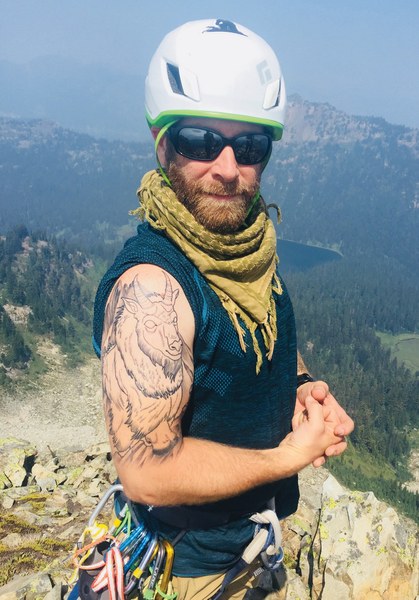 Stephen showing off his new mountain goat tattoo on the top of Dewey Peak shortly before the accident that took his life.
What tragedy teaches
The reports from the survivors of the Dewey Peak climb included small details and decisions that became much more consequential when examined retrospectively. They chose to climb Dewey Peak largely because it was a summit on the Rainier 100 list that could be done in a single day with relatively inexperienced climbers. The number of ropes and kinds of anchor building materials brought were based on trip reports that described the route as “not a real climb” and more of a scramble. The location of the rappel and construction of the anchor came down to the experience of just one lead climber. It was reported that shortly before the group began to rappel, Stephen said he “did not like the look of the anchor,” but after some discussion, the group proceeded. That any one of these decisions was the sole factor resulting in Stephen’s death is unlikely; however, the combination of them all resulted in a tragic outcome.
We can learn how to avoid tragic outcomes like this by looking at these decisions through the lens of heuristic traps. Heuristic traps are mental shortcuts or assumptions that lead to poor decision making. The concept of these traps was first developed (thanks to the research of NOLS instructor Ian McCammon) in reference to the human-centered causes of avalanche fatalities and has since become well known in outdoor risk management, especially as it pertains to snow recreation. Many Mountaineers and outdoor enthusiasts encounter the concept of heuristic traps in avalanche awareness courses when learning the acronym FACETS: Familiarity, Acceptance, Commitment, Expert Halo, Tracks/Scarcity, and Social Proof. FACETS represents six common thinking errors and areas of complacency that winter recreationists encounter in avalanche terrain.
As a Basic Alpine Climbing course student, Stephen was taught these traps. The problem was that Stephen and other students were generally only taught to consider these heuristics in avalanche terrain. However, Stephen’s rock climb took place in August, on a route with no snow or avalanche risk. And as a result, the risk management framework was far from top of mind.
Had the climbers thought to apply avalanche-related risk management to their summer recreation, maybe the outcome would have been different. Perhaps they would have realized that checking another peak off the Rainier 100 list wasn’t a good enough reason to climb that day. Or perhaps the two novice climbers would have vocalized their concerns with more certainty.
These hypotheticals started several long conversations that eventually led to two realizations: 1) There needs to be a universal tool for identifying hazards and risks in any season, and 2) Anyone in a student, beginner, or subordinate role should know how to vocalize concern, especially if they don’t have the technical understanding or confidence.
“Talk about a halo,” one team member said as we descended Dewey Peak after re-creating the incident and processing our painful conclusions. I agreed, but I wasn't convinced that the halo was just over the climb leader.
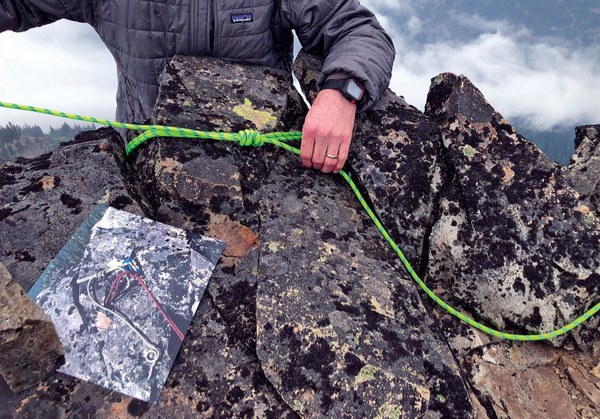 A mixed team of climbers and rescuers re-creating Stephen's
accident at Dewey Peak using photographs recovered from his phone.
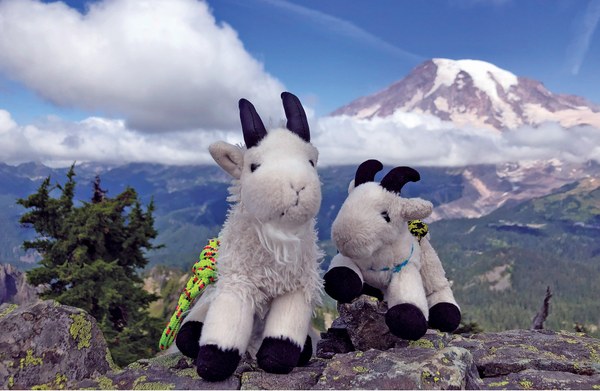 Katjarina and Stephen bonded over a love of mountain goats and both carried stuffed animal mascots on their adventures. Since Stephen's death, Katjarina has continued to carry his goat for him.
Halos: A universal approach
A common misconception is that the trip leader is the only one responsible for managing risk, but participants play a pivotal role as well. “See something, say something” is a common refrain when it comes to managing risk, but many times people don’t know what they are seeing or how to put what they see into words. Thus began Breaking the Halo, a risk management framework that gives participants the ability to recognize when and how halos are placed, and vocalize when something feels wrong.
Halos can appear anywhere, at any time. They are metaphors that suggest a mark of omniscience appearing over the person in the group with the most experience, skill, or wisdom. These halos stand for assumptions, complacency, failure to properly communicate, ego, and other human characteristics that jeopardize safety. When we see someone and put a “halo” on them, we’re more likely to follow them into dangerous situations, and less likely to speak up even when our gut screams something is wrong.
The “expert” in the group isn’t the only one who can get a halo placed on them. Halos can appear on the instructor or group leader, on the peer with more experience, or on the person who steps onto the trail first and literally leads the group forward even though they’re not the actual trip leader. Halos can appear on anyone we look to for information or choose to rely on for decisions, and they can be placed on any of us without us even knowing.
Halos can also be placed on the intangibles such as skills, certificates of achievement, or outdoor resumes like miles paddled and mountains summited. We can place halos on people with the most impressive recreation accomplishments without considering how current their knowledge is, how recently they’ve refreshed their skills, or what their motivation is for choosing a destination (i.e. if the location is the best fit for the group or merely the next goal on their checklist).
Halos can appear over the gear we carry and the reliance we place on our safety equipment. A skier or bicyclist who wears a helmet may choose to go faster when the helmet is on because they know their head is safe — but what about their unprotected back, chest, or pelvis where other life-sustaining organs are housed? In addition, the halos over those with newer gear can blind us to the abilities and experiences of others with older, less expensive, or unfamiliar gear. (Just because someone has the newest and greatest equipment doesn’t necessarily mean they know how to use it.)
From the trails we follow to the effectiveness of GPS technology to what it really means to rely on the essentials we carry in an emergency, halos can appear anywhere we make assumptions or let habit and muscle memory replace observation and critical thinking. By using a universal symbol for when something is wrong or a risk isn’t being addressed, a participant can speak up when they see something, even if they don’t have the vocabulary to name their concern. Someone can say, “I see a halo” and the group will understand there is something worth examining and discussing. If assessed appropriately, that halo can be broken and the risk properly managed.
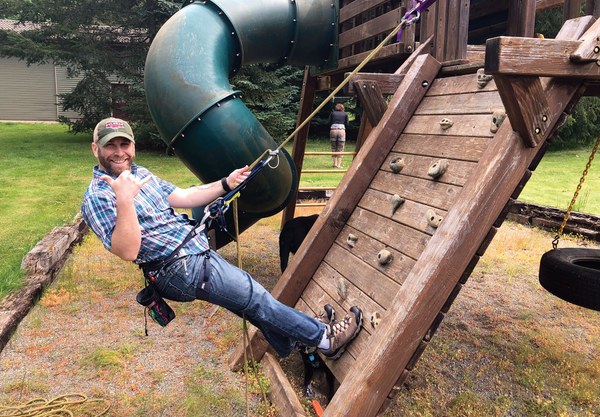 Stephen "hanging out" while practicing rappel skills outside of class.
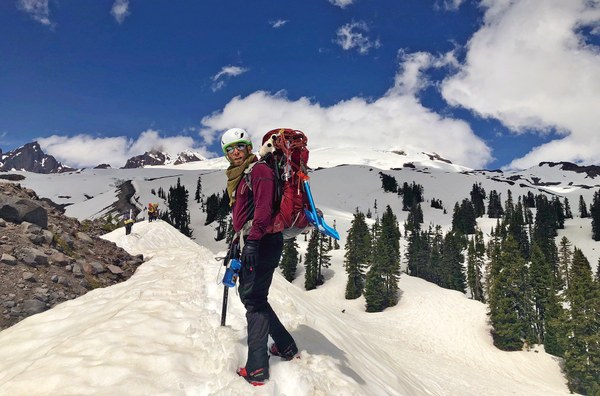 Stephen at Mt. Baker for crevasse rescue practice during the Basic Alpine Climbing course.
The impact of breaking halos
Breaking the Halo was first presented to members of the Olympia Branch Alpine Scrambling and Basic Alpine Climbing courses in 2019. That fall, the presentation was given at the NOLS Wilderness Risk Management course, and word quickly spread about a simpler way to talk about risk, as well as the need to give students and subordinates more confidence to speak up. The following year, The Mountaineers hosted five Breaking the Halo presentations. The number has increased every year since, and the presentation has spread to wider audiences, including multiple statewide agencies in Washington, Search and Rescue teams across the Western and Rocky Mountain regions of the United States, and international conferences.
With a growing audience, is this framework really making a difference?
Mountaineers Safety Committee reports show a correlation between the increase in Breaking the Halo presentations and an increase in annual reports of Near Misses and Safety Concerns. Numerous instructors and leaders across activities have shared how they incorporate the idea of halos into their courses and activities, and every year more students share stories of being on activities where talking about halos helped them express fear or concern. These impacts are larger than I could have dreamed when I started talking about breaking halos six years ago. While I don’t have hard data to prove the framework is making a difference, if even one life was saved or one outcome changed because of these presentations, then the work is worth it.
Is it hard to talk about Stephen’s death over and over? I have to admit, it is. After every presentation I feel both elated and exhausted. More than once, I’ve made a quick escape from the room or computer camera when I felt myself starting to cry. No matter how many other lives I might try to save, I cannot reverse the outcome of that day and bring Stephen back.
Those who have experienced grief know it comes in waves. With time, the waves get smaller and farther apart, and that helps me to keep going. What also helps me is to imagine Stephen is with me every time I talk about halos. He is like my guardian angel now, calling me out on the halos I create and reminding me to keep telling our story, so that others may live and love the outdoors as much as he did.
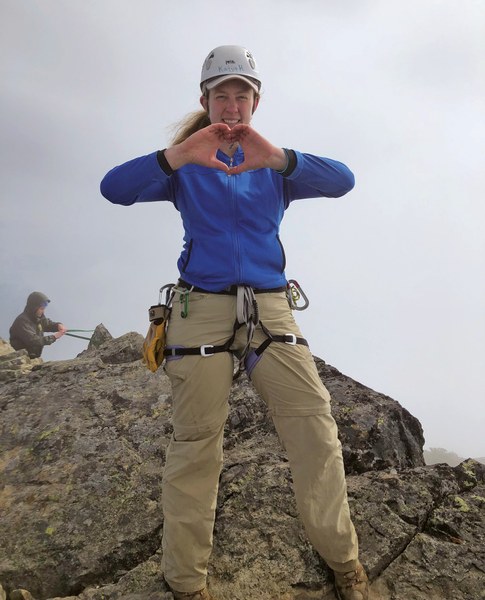 Katjarina sharing her gratitude with the mountaineering
community from the top of Dewey Peak. This photo was taken during the investigation of Stephen's accident.
TIPS FOR BREAKING THE HALO
Instructors
Discuss halos before the activity. Begin your trip by having a group discussion about risk management, and encourage participants to share their concerns whenever they arise.
Find messaging that sticks. When learning a lot of new skills (especially during complex courses like Basic Alpine Climbing), many adult learners hit their cognitive load quickly. New acronyms like FACETS may not stick, but what often does are more familiar adages such as “See something, say something,” which implies similar halo-breaking messaging.
Be aware of your own halo. As a trip leader, you are at a high risk of having a halo placed on you by participants. To reduce the halo effect, you can pose decisions as questions so that participants take part in group decision making rather than solely relying on you to call the shots.
Students
Speak up, even if you can’t get the words right. It can feel embarrassing not knowing the technical terms for how to clearly articulate an issue, but that should never stop you from voicing concern. Saying “I don’t know why but something about that doesn’t look right” is perfectly acceptable.
Ask for options. If something feels wrong, don’t be afraid to stop and consider your options. Not all options are going to be good ones, but you should be involved in decision making when there could be significant consequences.
Always do your homework. Leaders and instructors play important roles, but they aren’t infallible, and you have the right to know how current their skills are and what experience they have with a particular location or activity. Leaders also shouldn’t be the only ones with information. Before heading out, make sure you read up on the area you are visiting, look at recent trip reports, and check the weather.
This article originally appeared in our summer 2025 issue of Mountaineer magazine. To view the original article in magazine form and read more stories from our publication, visit our magazine archive.
