 Mountaineers Books
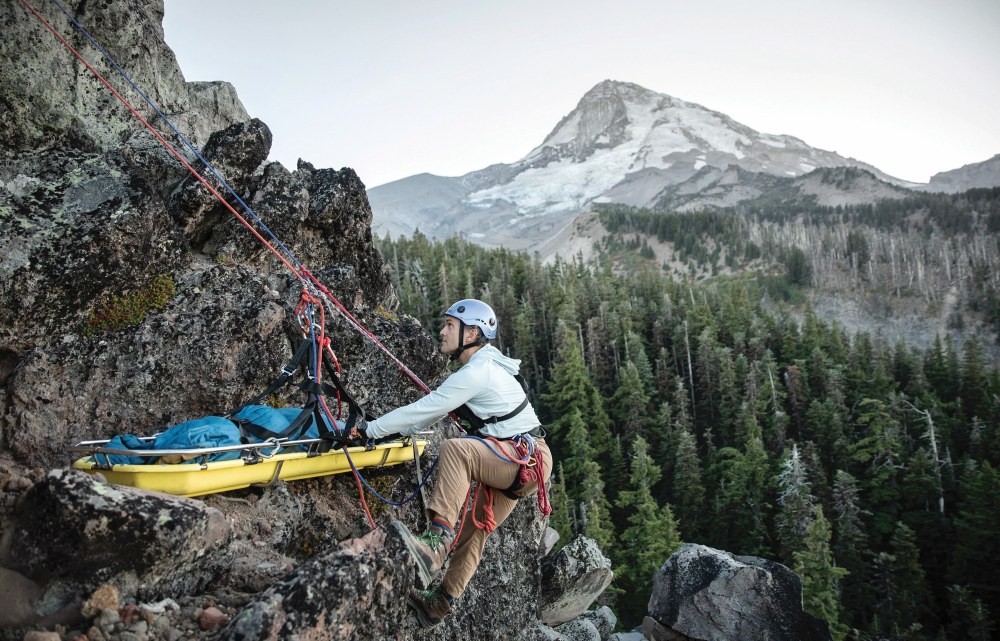
The Hood River Crag Rats, America’s oldest all-volunteer search and rescue team, is situated in the foothills of North America’s most-climbed glaciated peak: Mount Hood. Author and emergency room doctor Christopher Val Tilburg recounts many of the highs and lows of the Crag Rats' hundred-year history in his new book Crisis on Mount Hood. As climate change and overcrowding alter the shape of mountain rescue, the Crag Rats remain unwaveringly dedicated to keeping adventurers safe.
Enjoy a sample of what Crisis on Mount Hood has to offer.
In Eagle Creek, the single most common trail for rescues, if we don’t go after someone with a sprained ankle or knee, it’s more often an injury from a cliff jumper at Punch Bowl or someone lost on Benson Plateau. We’ve also hauled out a woman actively seizing with new-onset epilepsy and another with hypothermia and hypoglycemia for new-onset insulinoma, a benign pancreatic tumor that causes too much insulin to be released and thus drops blood sugar to a critical nadir. Today, though, the call is for wildfire rescue. Apparently, a fire has moved to a point just a mile from the parking lot, choking off the trail near the first set of cables. Several scores of people - an exact number is not possible, but it might be as many as 160 - are trapped at Punch Bowl Falls, many wearing flip-flops, T-shirts, and shorts or swimwear.
My first thought: Let’s get a crew.
My second thought: We’re not prepared for fire.
My third thought: If the one mile downhill hike to their car is blocked by fire, they’ll all need to walk thirteen miles uphill to Wahtum Lake, where they can be picked up via a dilapidated, potholed road that leads down to Hood River.
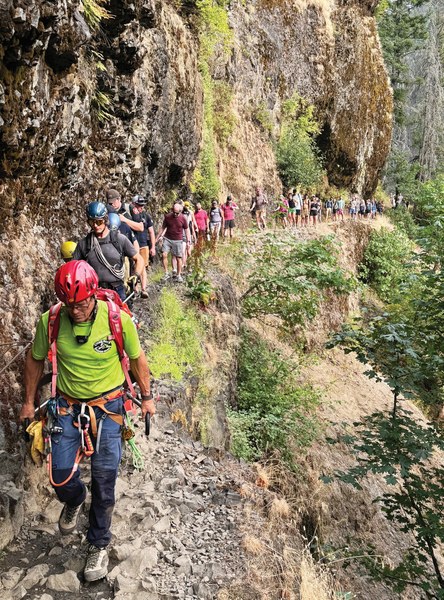 Crag Rats, along with Pacific Northwest SAR and Cascade Locks Fire/EMS, complete a difficult extraction from a remote trail in the Columbia River Gorge National Scenic Area. Photo courtesy of Hood River Crag Rats Collection.
The hikers are instructed to head uphill, away from the fire. As darkness nears, a sole Forest Service ranger runs down the trail from Wahtum Lake, finds the group, and shepherds them to a flat spot near Tunnel Falls, where they hunker in for the night. The youngest is three, the oldest a septuagenarian.
It’s still the middle of the night, so they distribute snacks and water and wait for morning. John Rust has the brilliant idea of writing a number on each person’s hand with a marker to keep track of them all. At dawn, they begin the long hike out to Wahtum Lake, seven miles from the makeshift camp. At the top, the rescued hikers are loaded onto buses for the ride back to their cars. By early afternoon, all are safe. “Mission complete. Stand down. Not one death or major injury.”
At a debrief weeks later, Wes sounds calm and deliberate about the hike down the trail to Tunnel Falls, into the fire. “I was scared. We could hear the fire crackling and see the flames just a few hundred yards away.” I don’t tell him, but at that moment I have a great awe and respect for him just getting the mission completed.
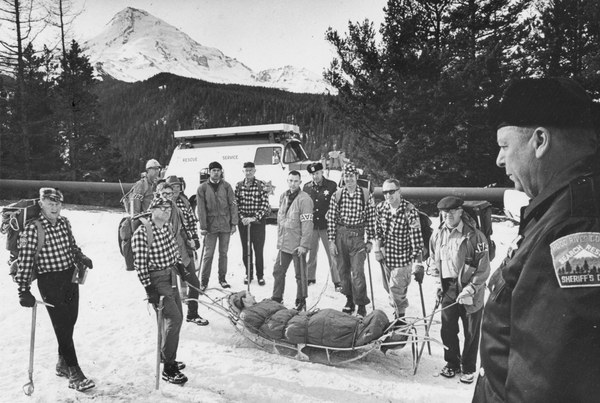 Crag Rats circa the 1950s use an akja to evacuate an injured patient from Mount Hood's north side. Photo courtesy of Hood River Crag Rats Collection.
Two days after the rescue, the fire will travel west to within a few miles of Portland, grow to over thirty thousand acres, and start spot fires across the Columbia River in Washington. In the following week, one thousand personnel, a dozen aircraft, and at least a gross of vehicles will battle the blaze. It will burn full-on for three weeks, smolder for months, and pop up a year later from a subterranean smoldering stump.
The Eagle Creek Fire was not a routine mission for the Crag Rats. But then, nothing has ever been “routine” for us. Consider that in our history we’ve had a broad range of volunteer duties beyond the alpine: assisting the US Forest Service to fight wildland fires in the 1920s; helping the sheriff with law enforcement and lifeguarding in the 1950s; and up until the late 1980s, helping the Soil and Water Conservation District with snow surveys. Basically, if someone asks us for help, we’re likely to assist.
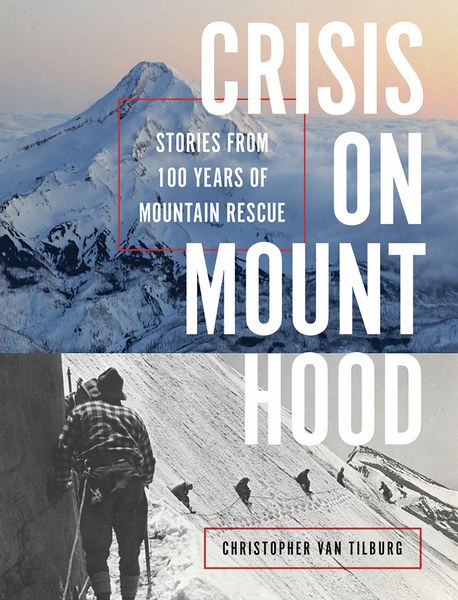
Crisis on Mount Hood is available for purchase at our Seattle Program Center Bookstore, online at mountaineers.org/books, and everywhere books are sold.
This article originally appeared in our summer 2025 issue of Mountaineer magazine. To view the original article in magazine form and read more stories from our publication, visit our magazine archive.

