 Jan Fite
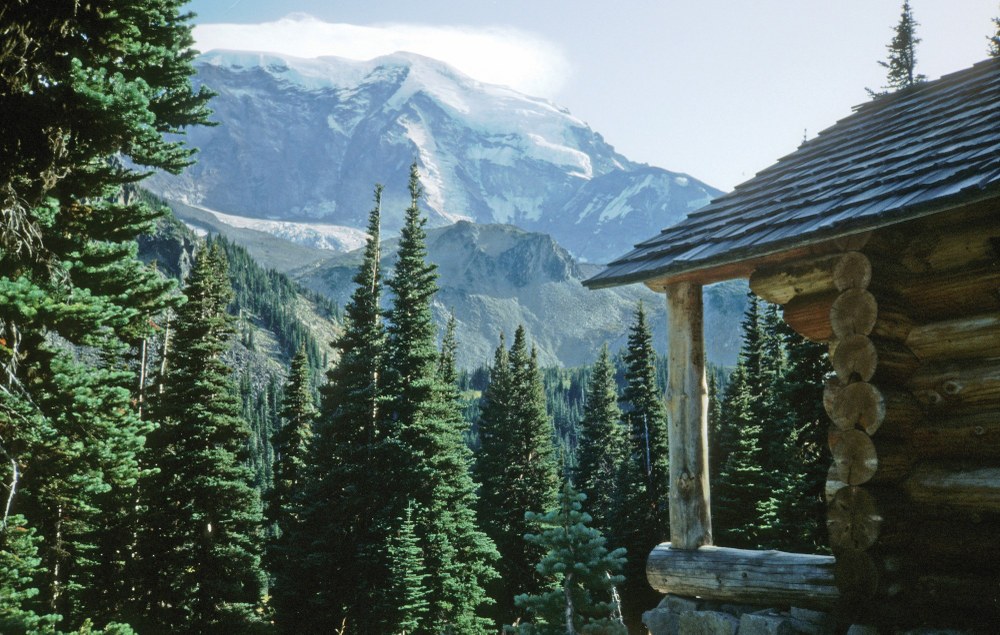
The Wonderland Trail is not for the faint of heart, but what happened to us on the trail would make anyone’s heart skip a beat.
The word "wonderland" conjures images of a fairyland, Disneyesque. But don’t let that name fool you. In actuality, the loop is 93 miles, with elevation gains and losses equivalent to climbing Denali: 27,000 cumulative feet of elevation gain and 27,000 cumulative feet of elevation loss. It’s not a piece of cake.
On the trail, you can see everything from trail runners slurping electrolyte gel and whizzing past to circumnavigate in three days, to inspiring 70-year-olds making their steady but sure climb. As for us, we chose to savor our experience by hiking ten days and nine nights, and carrying elaborate backcountry meals to fuel our six- to nine-mile days.
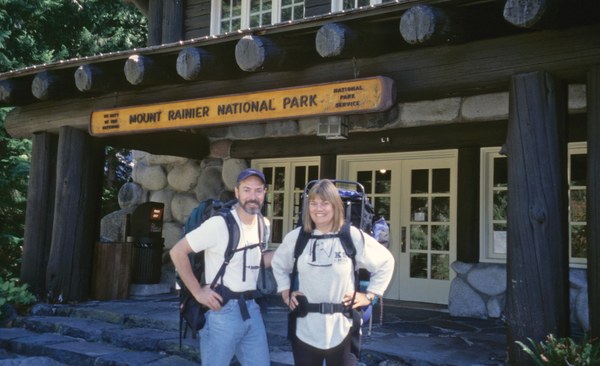 Jan and Mic ready to begin their trek after acquiring permits.
Trail meals worth a chef’s kiss
My husband, Mic, is an “all-I-need-is-a-toothbrush-and-a-peanut-butter-sandwich” kind of guy. Not me. Mic packs light, whereas I need my creature comforts. Even more importantly, I love backcountry cooking. No lightweight, freeze-dried, stir-boiling-water-into-a-foil-bag food for me. Our meals included pasta primavera, angel hair pasta with smoked salmon and pesto sauce, Thai coconut noodles with shrimp, chicken with curry couscous and mandarin oranges, peach crumble. And wine! You get the idea…
Which brings me to our decision to cache two boxes of food rather than carry nine days’ worth of luxurious camp meals on our backs. The first four nights we’d carry food, then pick up Cache 1 on day five, and Cache 2 on day seven.
To prepare our caches, we weighed each excruciating ounce of food on a scale, set out a package of Ziploc bags and ingredients on our kitchen table, then carefully bagged and labeled each meal: breakfast, lunch, and dinner. Then, a week prior to our hike, we put Cache 1 and Cache 2 in cardboard boxes and set out for a several-hour drive to Mt. Rainier National Park.
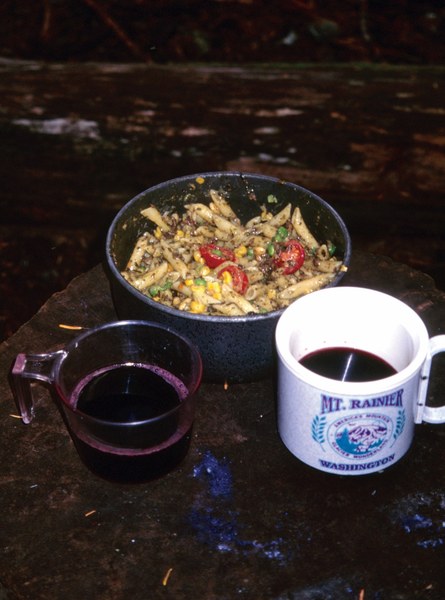 A full pot of pesto pasta with smoked salmon and cabernet.
Caching our camp meals
The Park Service provides two options for caching food: 1) mail it in advance, or 2) drop it off in the park. To be safe, we decided to drive to the park and hand-deliver our two caches.
Delivering Cache 2 to Sunrise was easy enough. As the ranger took our food, we felt assured it would be in the appropriate location when we arrived. Next, we headed to the Wilkeson Wilderness Information Center to drop off Cache 1.
The planning instructions sounded simple: just drop off the box. When we arrived at Wilkeson and took our place in line, it was still early in the morning. Upon seeing our food box – containing three days’ worth of precious survival supplies – the volunteer ranger told us to “Just put it over there.” She pointed to a shelf, and within one second, moved on to the next person in line.
We eyed our box sitting on the shelf and wondered what would become of it. The plan, as we understood it from the ranger’s explanation, was that the day before we arrived at the Mowich Lake Ranger Station, the on-duty ranger would take the supplies out of the cabin and place them in a metal corrugated lidded garbage can behind the ranger station.
At that moment, one of my favorite mantras, “Make room for emergencies,” whirled through my head. I had read earlier about two intrepid hikers who carefully followed similar cache drop-off instructions. When they arrived at the pick-up spot, their chache was alarmingly missing. Worried about meeting the same fate, I put together an emergency box to be delivered by my brother when he met us at Ipsut Creek Campground.
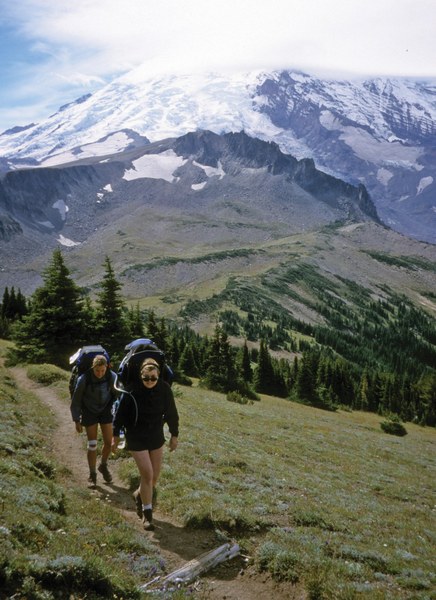 Jan and Denise with heavy packs and bandaged knees west of Berkeley Park.
Making dinner friends
Summiting Tahoma (Mount Rainier) is a mountaineer’s dream, but to me, hiking its perimeter was a much more intimate experience. I loved it.
The first night, Mic and I arrived at Devil’s Dream after 6.5 miles of switchbacks and rugged climbing. Whoever named the campsite Devil’s Dream wasn’t kidding – it was eerie, dark, and muddy. We comforted ourselves by cooking a big batch of pasta primavera and pouring ourselves a generous cup of red wine.
The only other soul at our campsite was a solo hiker named Denise. We offered her our extra pasta primavera but she declined, explaining that she needed to eat her food to reduce the weight of her pack.
Denise had a large backpack, opting to carry all her meals on her back for the entirety of her trip. She had packed a hardback copy of War and Peace, as well as ten packages of instant oatmeal. What an interesting and resilient woman, I thought to myself, grateful that I had warm cinnamon buns to look forward to for breakfast.
Apprehensive about hiking alone, Denise asked if we could hike together. Over the next few days, we became close trail companions, helping each other through washouts, trail diversions, and various weather conditions such as rain, sleet, and snow. And, of course, we ended each evening together enjoying a rewarding camp meal.
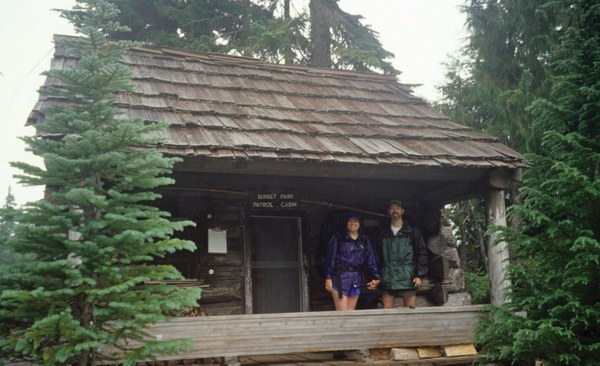 Finding shelter from the rain at the Sunset Park Patrol Cabin, Golden Lakes.
A soggy surprise
No doubt about it: our hike around Tahoma was phenomenal. Each day brought another view of the mountain. And with each day, we could feel ourselves growing stronger, as well as more eager for our cache pickup.
The Wonderland is as exhausting as it is phenomenal. Most days found us dropping 3,000 feet only to climb 3,000 feet back up to another ridge. And the unremitting rain didn’t help. With four solid days of rain from Devil’s Dream to Golden Lakes, we were thoroughly soaked. Each grueling step was eased by the thought of clean t-shirts, cushy fresh socks, and – most importantly – blackberry-rich cabernet (to be sipped by firelight) nestled in our cache box.
At noon, we spotted the Mowich Lake Ranger Station, circled around it like hungry wolves, and found a corrugated metal trash can complete with lid behind the cabin. At least they didn’t put our food in plain sight for others to sift through, I thought to myself. We held our breath and lifted the lid.
The can was empty! Only bits and bobs of throw-aways, detritus left behind by others tossing extra weight, were left at the bottom. Supply rejects. Moldy power bars were not quite what we had in mind for dinner.
We peered into the can in disbelief. Had we missed something? We rummaged through the can over and over, then boldly knocked on the ranger station door. No answer. That’s when we began to lose it.
At this point, soggy clothes were the least of our worries – that missing cache represented three nights without food, toilet paper, film, fuel, batteries, and fresh socks. We waited around for as long as we could, until we had no option but to continue hiking before night fell. Dejected, we plodded along, pulled forward only by the thought of the emergency box waiting for us in my brother’s car.
The bite at the end of the tunnel
I love quiet. It’s one reason why I love backpacking. But never have I been so happy to hear the sound of traffic. Gradually, the light of a distant campfire, welcoming souls, and a battered box came into view.
When I met my brother’s eyes, I blurted “Where’s that box!?” Being the kind souls that he and his partner are, they saw our dog-tiredness and bandaged knees and immediately began setting up our tents and helping us out of our packs and soaked clothing. Then, and what I remember best, my brother ripped open that emergency box and poured us each a glass of wine.
The reason for our missing cache remains a mystery, but Cache 1 was mailed to us once we returned home, and the bottle of wine was more aged!
If you’re interested in backpacking the Wonderland Trail, visit the National Park Service's Wonderland Trail webpage for more information on route details, planning tips, and most importantly, caching food.
This article originally appeared in our fall 2025 issue of Mountaineer magazine. To view the original article in magazine form and read more stories from our publication, visit our magazine archive.
