Packrafting Course
Intermediate Whitewater Packrafting Course
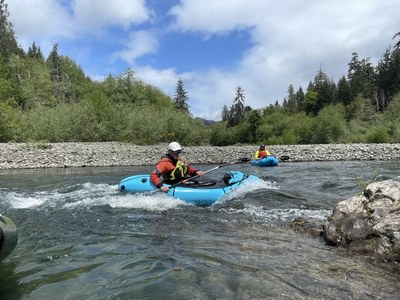
This course provides instruction and practice on how to navigate and safely paddle down Class III rivers. Topics covered include intermediate paddling strokes and maneuvers, reading class III whitewater, advanced self and partner rescue, high consequence safety preparation, and others.
- Wed, Apr 1, 2026 - Tue, Jun 30, 2026
- Committee: Seattle Packrafting Committee
- Members: $825.00 Guests: $895.00
- Availability: 8 (8 capacity)
- Cancellation & Refund Policy
ACTIVITIES
Over the course of 3-4 months during the Spring river running season in Washington, the following activities will be offered. There will be a different Lead Instructor for each activity giving students exposure to different expertise. Lead Instructors have ACA or SSI certification or professional guiding experience.
- One midweek evening lecture to cover gear, course requirements and instructional videos
- Three 2-day weekend field trips on the Olympic peninsula
- Three single day field trips in the Cascades
Participation in the lecture, two of the weekend trips, and two of the day trips is required of all students (a minimum of 6 days on the water). Students may attend all field trips provided there is room.
Application
In order to register for this course, prospective students must complete submit the Intermediate Whitewater Packrafting Course Application.If you can not access the form, email the course administrator (Lead Instructor) and they will add you. After review by the course administrator, prospective students may be offered a chance to register for the course based on safety and group dynamics considerations. The application deadline is January 15, 2026. The application review period is January 16 - 30 during which time applicants will be offered a chance to register for the course.
SKILLS
INTERMEDIATE PADDLING SKILLS
- The Power Forward stroke mechanics and physics
- Develop a strong Draw Stroke and Sculling technique
- Rudder steering down rapids
- Stair-stepping - drop into and out of small ledge drops sideways
- Catching and exiting from Class III eddies
- Boat speed management by back-paddling, back-ferrying, and sideways floating
OTHER INTERMEDIATE SKILLS
- Surfing a standing wave, enter and exit without swimming
- Overcoming a Strainer, practice on a releasable mock model
- Square up and paddle through a Class II hole
- Negotiate a Class III wave train with multidirectional laterals
- Launching into swift current; launch from a steep bank
- Vertical exit onto a dock and vertical entry from a dock
reading whiteWATER
- Identify current, eddies, boulders, holes, wave trains
- Identify wood hazards, strainers and how to avoid them
- Identify sieves, siphons, whirlpools and how to avoid them
- Identify several routes down a Class III rapid in order of consequence and difficulty
INTERMEDIATE river Swimming
- Swim down a Class III river: perform a flat jump into whitewater, get into the safety position, transition into an aggressive swim, catch an eddy, exit the river in a seal crawl
- Swim across a Class III river: flat jump into current, ferry swim across, aggressive swim to a thrown rope, hold safety rope in the correct position for a pendulum, seal crawl exit
- Swim with a paddle in hand 30 yards in current, reach shore, seal crawl exit
INTERMEDIATE RESCUE SKILLS
- Self-reentry in deep water quickly and efficiently
- Exiting one's boat on a riverbank with no eddy
- Partner rescue: stabilize a partner's boat and assist them back in their boat, tow or bow carry a tired swimmer 10 yards, right a capsized boat and boat bump 10 yards to an eddy, paddle with an extra paddle 10 yards
- Throw a rescue rope to a swimmer and belay them to shore, provide a moving shore belay, stabilize a rope thrower as they bring someone to shore
GRADUATION REQUIREMENTS
PARTICIPATION
- Attendance at the night lecture in Seattle in person is mandatory
- Participation on 2 of the weekend trips plus 2 of the day trips for a total of at least 6 days of on-the-water course trainings
- Participate in 2 additional experience trips on Class III trips within one year
COMPETENCY
- Demonstrate competency in all of the intermediate paddling skills listed above
- Demonstrate competency in all of the intermediate river swimming skills listed above
- Demonstrate competency in all of the rescue skills listed above
- Demonstrate competency in all of the knowledge based skills listed above
TESTS
|
Skill
|
Test
|
|
Self Rescue
|
3 times in 90 seconds in deep water
|
|
Surfing
|
30 seconds on a standing wave and no swimming on the exit
|
|
Back Ferrying
|
20 meters across a 2-2.5 mph current and return without losing ground
|
|
Ruddering
|
20 seconds continuously down a rapid
|
|
Stair-stepping
|
Down a series of 4 class II ledge or boulder drops
|
|
Eddy-hopping
|
Eddy-hop across a Class III boulder garden to the opposite shore and return without losing ground, catching at least 5 mid-stream eddies
|
|
Draw or Scull
|
Paddle laterally for 5 meters and return in 2 minutes in still water
|
|
Throw Rope
|
Throw a rescue rope 10 meters to within 1 meter of a target twice in 60 seconds
|
| Course Activity | Date | Availability | Leader |
|---|---|---|---|
| Weekend Field Trip Olympic Rivers - Intermediate Whitewater Packrafting Course | |||
| Dosewallips River |
Sat, May 9, 2026 -
Sun, May 10, 2026 Registration closed Mar 15
|
11
participants
|
|
| Quinault River (North Fork) |
Sat, Jun 6, 2026 -
Sun, Jun 7, 2026 Registration closed Mar 16
|
11
participants
|
|
| Day Field Trip Cascades Rivers - Intermediate Whitewater Packrafting Course | |||
| Sauk River: White Chuck River to Darrington |
Sat, May 23, 2026
Registration closed Mar 16
|
11
participants
|
|
| Nooksack River (North Fork) |
Sat, Jun 20, 2026
Registration closed Mar 16
|
11
participants
|
|
Required Equipment
Students will need to provide the following equipment.
Whitewater packraft. A packraft with a spray deck or a self-bailer. Should be made out of rugged material designed for whitewater. Largely, that disqualifies any “light weight” rafts. It must be rigged with bow and stern grab lines. Thigh straps are not required, but most intermediate packrafters prefer them.
Dry suit. Goretex does breath better, but is more expensive and heavier. See the Kayak Academy's Buyer's Guide
Whitewater Helmet. Bicycle helmets, climbing helmets, or other types are not acceptable. Whitewater helmets are designed to take multiple impacts from all directions. Fit is most important. Allow space for a hat or balaclava. Consider how sunglasses fit.
PFD. A Type III Coast Guard approved PFD is required. A wide range of options are suitable. You might choose a light weight PFD if you anticipate carrying it, or choose a rescue PFD if you’re goal is more difficult rapids.
Paddle. A paddle designed for whitewater. Must be strong. 4-piece are easiest to transport. 2-piece or 1-piece are acceptable. A 1-piece paddle takes up considerable space in the car and makes car shuttling difficult.
River shoes. Most shoes that can get wet will do. Soft neoprene boots can work but will be uncomfortable for walking on river rocks. Functionally, your shoes should:
- Offer good protection from rocks
- Be oversized to allow thick wool socks or neoprene booties. Generally one full size bigger than your usual shoe size works
- Drain water easily
- Not have loose laces or other features that may catch on something
Whistle. A waterproof whistle is required that is safely reachable at all times. The Resqme by Whistles For Life is effectively loud, waterproof, and compact.
Warm Layers: The outdoor layers that you use for other sports likely work well underneath the drysuit.
Hand Protection: Some combination of warm paddling gloves, pogies, and blister protection. We like these lightweight, windproof and waterproof Socdolager pogies.
Deck Bag / Dry bags: For storage of equipment on and in the boat. We find a bow bag or a lap bag to be super useful to carry the day's gear and internal cylindrical dry bags to be extremely useful on overnight trips. You can make do with several dry bags.
Repair Kit: An adequate repair kit comes with Alpacka Rafts. If your raft does not come with such a kit, anticipate putting one together.
There are no materials for this course.