Climbing Course
Following Alpine Rock
Applications are open for rolling enrollment: Please read the course description (click on the More+ button below) and check course requirements tab to make sure that you can make all of the dates. To apply- scroll down and look for the "Apply" button on the right. Please read the information on the course page before applying or reaching out- you will have to click on +info to expand.
Contacts

- Sun, Mar 1, 2026 - Sat, Oct 31, 2026
- Committee: Seattle Climbing Committee
- Members: $430.00 Guests: $505.00
- Availability: 6 (12 capacity)
- Cancellation & Refund Policy
Please click [More+] and read THE WHOLE COURSE DESCRIPTION before emailing with questions.
If you still have a question afterward, email us questions specific to this course at following.alpine.rock.seattle@gmail.com. If you have a more general question, or a question about which course to take, email info@mountaineers.org
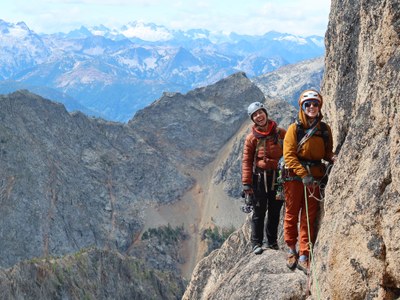
This course prepares you to participate safely as a follower on basic rock climbs that reach alpine summits in the Pacific Northwest.
The top-rope belay skill badge requirement can be met by applying for equivalency with member services, if you hold a top-rope belay card from a local gym.
If you are familiar with other Mountaineers courses, this course is the rock component of the larger Basic Alpine Climbing course as a separate course in a modular structure along with Scrambling and Glacier Travel. It's useful for students who want to participate on Basic Rock climbs, but do not wish to take the entire Basic Alpine Climbing course to do so, as they either do not currently have an interest in glacier travel, or, they already have glacier-travel experience and don't want to repeat that portion of the larger Basic course. Either way, you are welcome here!
PREREQUISITE SKILLS FOR STARTING THE COURSE:
(For more detail, click here.)
- Experience moving through scramble terrain*. (Applicants need to either be a graduate from the Mountaineers Scramble course, or have equivalent experience.)
- Basic Ice Axe & Crampon* experience on sloped snow
- At least some top-rope belay experience (i.e. a belay card from any indoor climbing gym)
- An adequate level of physical fitness for mountaineering. Alpine climbs often mean 12 hour days, 30lb packs, and ~4000'+ elevation gain. Later in the course, there will be a fitness test, which requires going up the Mt Si trail (from parking lot to treeline) in under 2 hours while carrying a pack that's 20% of your body weight with a minimum of 25lbs and a maximum of 45lbs.
* If you don't yet have experience with scramble terrain and basic ice axe & crampon usage, you would be better served by the Mountaineers Scramble Course.
Application Process
- Currently we are accepting students as rolling enrollment and accept and respond to applications as they come in (please give us 72 hours to respond to applications).
- Since we only have capacity for a limited number of students, the applicants that are the best fit will be offered spots in the course first. The remaining well-qualified applicants will be placed on a waitlist.
- After the application review, if you are accepted (we'll let you know by email) only then do you return to this page and go ahead and register as a student, which will charge you the course fee at that time.
- In the event that we accept someone, notify them, and then don't hear back from them for over a week, we'll give the next person down the waitlist the option to take that student spot instead. If you know you'll be traveling/offline around that time, send us an email heads up about that so we know to expect a longer response time from you.)
- Course activities will start in March.
Skills taught in this course:
- Discussion of gear appropriate for alpine climbing.
- Some basic knots relevant to climbing, especially rope coiling
- A brief review of belay skills, how to belay a lead climber
- A backup technique for belaying if you've lost your belay device
- Belay escape. (A skill that's an element of self rescue, although complete rescue skills are beyond the scope of this course.)
- Rappelling (how to setup an extended rappel, and how to maximize safety)
- A backup technique for rappelling if you've lost your belay device
- Cleaning trad gear (i.e. how to remove trad gear from the rock)
- The multipitch sequence, and multipitch transitions
WHAT'S NOT TAUGHT IN THIS COURSE:
Sometimes more clarity can be gained by explaining what a thing is not. This course does NOT teach:
- How to belay, starting from scratch. We welcome relative-beginners, but we really need you to come in with the muscle memory of a top-rope belayer. If you've never belayed before at all, consider a local gym (like Vertical World or Edgeworks). They offer brief courses that teach how to top-rope and belay in the gym. Then go to the gym a handful of times with a friend, and pretty soon at least top-rope belaying will be second nature.
- Scramble skills. Students are expected to come into the course with some prior experience moving through some 3rd and 4th class scramble terrain.
- Ice axe & crampon usage. Along with the scramble skills, we are going to encounter sloped hard snow at times on our way to alpine rock climbs, and we need students to come in with experience using these tools. Especially because none of this course's teaching workshops are on snow, so we have no opportunity to teach these skills, but the alpine climbs likely will involve snow & these skills.
- Glacier travel. Glacier-travel skills are neither taught in this course, nor are they a prerequisite. Most applicants to this course either have previous glacier-travel experience, or have no interest in glacier-travel (yet.) Otherwise, those applicants would be better served taking the larger “Basic Alpine Climbing” course.
- How to lead climb. Neither leading on bolts, nor leading on trad gear is taught during this course. However, if your ultimate goal is to learn to lead trad, this course does cover a lot of skills you should know before you get into trad climbing, and is still a valuable stepping stone on your journey to get there.
- Self rescue. Or at least, not a complete skill set to fully prepare you for self rescue in a multipitch rock setting. The course does teach belay escape, which is a key part of self rescue, but it's just the tip of the iceberg.
Time Commitment
(For more detail, click here)
- A few additional supporting courses/activities are required that you'll have to schedule yourself:
- Wilderness First Aid (WFA) certification. (A 16-hour weekend course. Separate sign up.)
- Wilderness Navigation- a multi-day day course wit its own fee.
- Low-Impact Recreation course (a 1-hour online course)
- Spend one day doing an activity that represents Stewardship of the wilderness. Participating in a WTA Trail Work Party is the most popular option or a Mountaineers Stewardship activity.
- Ongoing self-driven physical conditioning is strongly recommended:
- doing something to gain at least 2000' at least once every week is strongly recommended as a minimum bar to build & maintain fitness
- We gently recommend climbing at an indoor climbing gym once a week or so. It's not required per se, but it will likely increase your enjoyment of the course.
- The core instructional content of the course (during March & April)
- 5 weekday-evenings
- 2 full-days on different weekends
- At least one actual alpine rock climb during this summer that successfully reaches the summit (may require a couple of summer weekends)
- Optional extras:
- An evening meet & greet and gear-talk and belay check
- Possibly extra & optional skill-practice evenings
- Possibly extra & optional conditioning hikes
Monetary Commitment:
- The course fee (scroll to the top of this page)
- There is a gear list of things students need to bring. Depending on how much of the appropriate gear you already own, you may have to spend anywhere from a couple hundred to up to a thousand dollars buying the necessary gear for yourself.
- Unless you're already WFA (or WFR) certified, you'll need to take a WFA course. For example, RMI offers them.
SCHOLARSHIPS / FINANCIAL ASSISTANCE
The Mountaineers is committed to making our courses accessible to everyone, regardless of ability to pay. Our courses are priced to cover our costs, but we know that costs add up quickly, especially when students also need to purchase gear. We encourage students to apply for our scholarship program, which is funded by generous donors to make courses more accessible. Applications may take up to 2 weeks to process and Financial Assistance can not be applied to courses or activities already registered for. You can learn more about and apply for a scholarship.
Requirements to graduate:
See this Graduation Form to get an idea.
See also, this FAQ for the larger "Basic Alpine Climbing" course. Nearly all of it is the same for this "Intro to Alpine Rock" course.
What is a Basic Rock climb?
A "Basic Rock" climb is shorthand the Mountaineers use for trip categorization. To learn what we really mean by that, click here.
If you have any questions about the course or want to talk about ways to meet the prerequisites, please email us at following.alpine.rock.seattle@gmail.com
Badges you will earn:
 Multipitch Systems
 Lead Belay Certification
 Following Alpine Rock Course
 Rappelling
 Belay Escape
This course has no scheduled activities.
Additional badges needed to graduate
Completed
 Low Impact Recreation
 Basic Navigation Course
 Stewardship Credit
 Wilderness First Aid Course
Here's the Gear List document. 👈
In that gear list document, the left column on the first page are the hard-requirements for the course. You definitely need to bring everything listed under "Technical Gear for Rock Climbing" to every workshop in the course. Also bring the 10 Essentials.
In that gear list document, the right column on the first page lists things that may be required for the Basic Rock alpine climbs we'll eventually go on. It's a good idea to own that stuff, know how to use it, and be ready to go with it in case you get on a climb that requires it.
Only the first page lists the required gear. All pages of that document beyond the first one just go into detail about what that gear means, with some suggestions and recommendations on what to look for, in case it's helpful.
You must register for this course to see course materials.