 Justine Park
 Chris Finley
There’s a moment on many Mountaineers trips when the last bar of cell service disappears. It might happen quietly, somewhere along a forested trail, or all at once as you round a ridge. Either way, from that point on, communication changes.
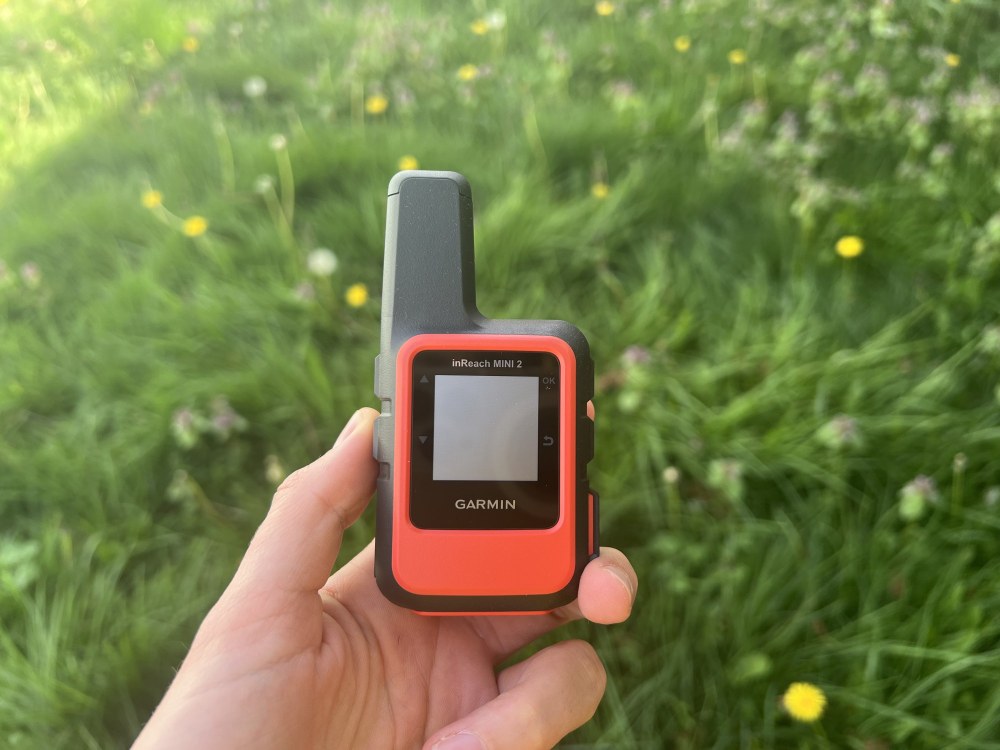
Satellite communicators, such as the Garmin inReach, Zoleo and Spot X, are how we stay connected. As valuable as carrying the device is the shared understanding of how, when, and why it will be used. Knowing how to call for emergency response is essential, but just as critical is knowing who is receiving the message, what is possible should trip plans change, and who has access to a device.
When you activate an SOS on an inReach, SPOT, or Zoleo device, it alerts a 24/7 professional emergency response coordination center which determines your location, notifies local emergency services, and coordinates communication between you, emergency services, and your emergency contacts.
For non-emergency purposes, satellite communicators allow SMS messaging to cell phone numbers or messaging to email addresses. The recipient can often respond, but that may be limited depending upon the carrier, elapsed time, or country SMS restrictions. Zoleo and Spot X provide both a device-specific email address and phone number that allow anyone with that contact information to reach the device, even if the message needs to be sent by satellite. This also allows device-to-device satellite communications. Garmin inReach provides an email address used specifically to contact other inReach devices. There is some limited ability to communicate with Spot X and Zoleo from the inReach. Below is a summary of the device to device capabilities.
Satellite Communicator Device-to-Device Communication Capabilities
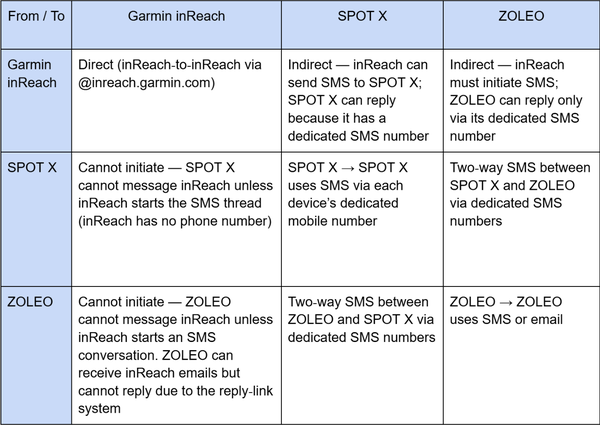 Summarized by Copilot. Fact-checked and edited by organics.
At The Mountaineers, we treat access to satellite communication with care. Members may now choose to share their device-specific email or phone number in their profile’s contact information section, in a field called “Satellite Contact Info.” The satellite contact information does not appear on the member’s profile. Primary trip leaders (and co-leaders who have trip leader privileges) are able to view this information. If the event is part of a course, primary instructors and those with lead instructor privileges can also view the satellite contact information. Beyond that, sharing is more flexible. Some participants are happy to make their device information available to the group, while others prefer to keep it private. Treating satellite communicator contact information similarly to emergency contacts — available to leaders, shared more broadly only when agreement has been reached — helps participants feel that there is a good balance between privacy and safety.
Real World Examples
The Good Samaritan. Your party is climbing Mt. Stuart and you come across another group. One person had fallen on a snowfield, but was able to self-arrest. Unfortunately, they have dislocated their shoulder and are in too much pain to self-evacuate. Your group can call SOS. Be aware, the emergency response center will have the tendency to notify the device owner’s emergency contacts when SOS is activated.
What is that smoke? There wasn’t a fire when you left. Message a trustworthy contact and have them check InciWeb to give details.
Where did you go? Some old knees have the party moving at different paces down the forested slope. The faster group notices they have pulled ahead and responsibly stops. Unfortunately, just over the rise, the slower group passes by. For the first group, their companions never show up. Do they head back up, wait a little longer, head down? There is no cell phone coverage, but ideally, one member from each group has a satellite communicator.
I need a shower. You are on a Global Adventure and your group is busting the miles; you expect to be in town a day early. You might be able to contact the hotel via email using the communicator, but it would be more reliable to have that trustworthy contact check room availability.
Too much of a good thing. It’s a multiday trip and one of your party decides they’ve had enough. Instead of ending the trip for everyone, perhaps the faster companions can escort them to an access point and safety. Sharing the device-specific addresses of several communicators allows the groups to stay in touch and coordinate a rendezvous.
I’ll take the low road. The party could scramble another peak and head down the west slope or take the low road and follow the contour around. Or they could do both. With shared device addresses, intra-party communication makes splitting the party far less risky and complicated.
Coordinating with the Mountaineers Emergency Line
The Mountaineers Emergency Line can be reached at 206-521-6030. This number can also receive text messages, including those from satellite communicators.
A group might be delayed by weather, routefinding, or slower-than-expected travel. In these moments, communication becomes less about urgency and more about reassurance. Simply reaching out to The Mountaineers Emergency Line to share an updated status can help close the loop, especially if there’s a chance that others may be wondering or concerned. For those at home, uncertainty can be just as challenging. If a trip runs late, concerned families should know that they may reach out to the Emergency Line for updates. If communication has already been established from the field, even a small amount of information can provide meaningful reassurance. If the situation is more urgent, or the group is going to be out long past the expected return time, the trip leader will need to explicitly request that the party wants families notified. The staff members who operate the Emergency Line will respect this request and notify the emergency contacts of each individual in the group.
Delayed party: If your Mountaineers trip is running late but is not in trouble, you can contact the emergency line for support in notifying the emergency contacts of the participants on your trip
Overdue member: If you are concerned that a loved one has not returned home, the Mountaineers emergency representatives can help answer questions or support any necessary steps.
Unusual circumstances: If your party witnesses or experiences something that will require extra support, but does not warrant 911, the emergency line is the best place to go.
In more serious circumstances, the response naturally shifts. When an incident involves significant injury, outside assistance, or complex coordination, a more structured process comes into play. Emergency services must be contacted first. By pressing the SOS button you will alert the professional emergency response coordination center where your location will be mapped and a plan to send out help will start taking place.
The next step is contacting The Mountaineers Emergency Line. Communication with The Mountaineers Emergency Line helps ensure that the right support systems are activated and information is shared appropriately.
In an Emergency
- Use your satellite communicator to activate the SOS button and then stay in contact with the coordination center to communicate your emergency.
- If you do have a phone signal, you can make a 911 call. Here’s a guide for making backcountry 911 calls: https://www.alpinesavvy.com/blog/how-to-make-a-backcountry-911-call
- Then contact The Mountaineers Emergency Line: 206-521-6030. If you have cell service you can call or text from your phone. If cell service is not available, send a text message with your satellite communicator.
- Communicate clearly and conserve battery. Be vigilant about conserving battery as it can drain quickly, especially in cold weather.
- Keep in mind that finding a good signal may require moving away from the group. Satellite communicators cannot be counted on to work perfectly if they cannot reach a satellite—a common issue in dense forest or deep canyons. When possible, seek open areas with a clear view of the sky.
Having a conversation about safety and communication expectations before the trip begins makes all the difference. The following expectations should be set in pre-trip communications:
What are the available devices on this trip
- How many satellite communicators are on this trip that can be used in an emergency? Who has them?
- Which devices are available to maintain communication if the party determines that splitting up is necessary.
- What is the battery status and readiness (is it paired with the owner’s cell phone)?
- Who is bringing an external battery? (Using the communicator in an emergency when a lot of messaging is needed drains the battery more quickly than you might expect, especially in cold weather)
Who is on the other end?
- Who is the designated emergency contact and are they aware of the trip plan?
- Will they assist with coordination if contacted? Do they have all the group members’ emergency contact information?
What is not shared
- Some participants may choose to keep their devices private. This does not need to be disclosed.
- Not all devices brought on the trip are intended for group use! (But all are available in case of emergency.)
- Which devices (if any) are available for “all is well” updates to family/friends for any of the trip participants who may need it?
While technology plays an important role in backcountry travel, it is only part of what keeps a group safe and connected. The rest comes from shared expectations, thoughtful communication, and a clear understanding of how to respond when circumstances change.
A few intentional conversations before leaving the trailhead can transform a device from a simple tool into part of a well-coordinated system. When everyone understands their role — who has access, how communication will flow, and what steps to take if something goes wrong — the entire group moves forward with greater confidence. Beyond cell service, that kind of clarity is very reassuring.
If you're interested in writing a safety blog, please reach out to safety@mountaineers.org with your proposed topic. Topics related to all activity types (hiking, kayaking, snowshoeing, canyoning, etc.) are strongly encouraged, along with stories and best practices related to emotional safety and group dynamics scenarios.
