 Pat Boyle
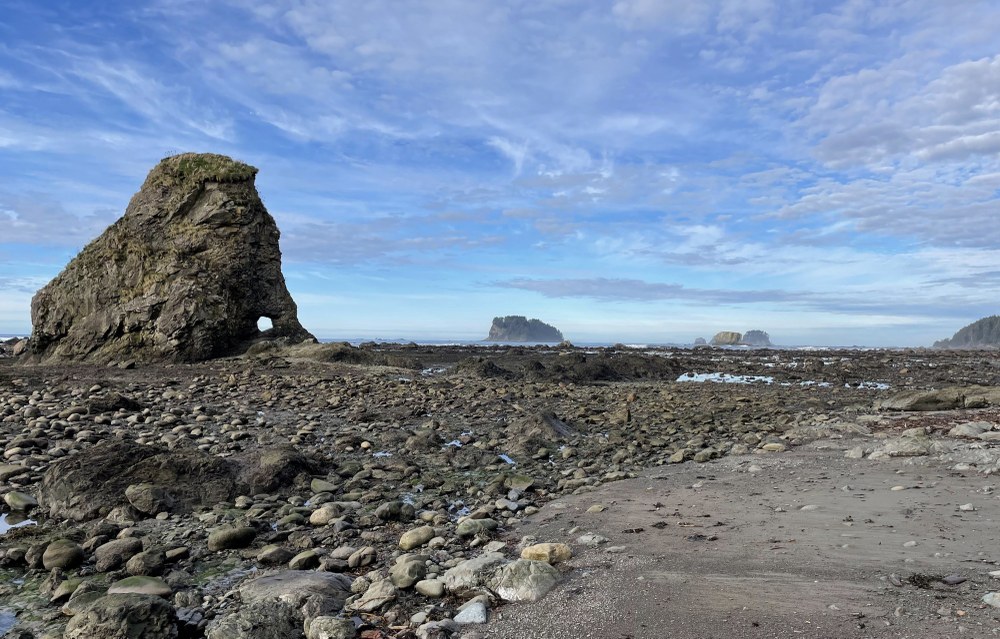
In January of 2025, I hiked about 50 miles of the Olympic Coast. The weather looked fairly dry the first week of January and the tides lined up, so I packed my bag and headed out.
This trip has several logistics puzzles to solve for. First, since it’s a one-way hike, you need a way to access the start and get home from the exit. The logical way is a car shuttle, but since I was solo, I decided to try public transportation. Second, you need to make 50 miles of progress, when there is only 8 hours of daylight, numerous minor points that are impassable at higher tides, and river fords at Goodman Creek and Ozette River that require several days of dry weather to calm down. To address this, you want a dry weather pattern (so the rivers calm down), and at least one low tide per day at a time that allows for hiking.
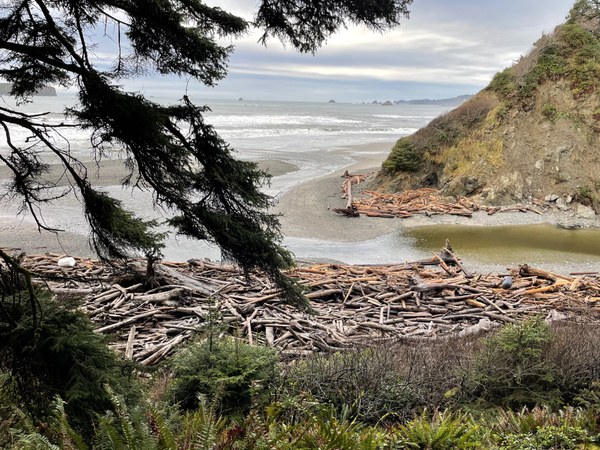 Mosquito Creek.
Day 1: Seattle to Mosquito Creek, 6 miles
To simplify logistics, and to make things more interesting, I decided to do the entire trip by public transportation.
I took the bus from my house, to the Bainbridge ferry, and then Clallam County Bus to Port Angeles and Forks. Karen, a local who shuttles fishing boats and hikers, picked me up at the bus stop and took me the last 20 miles to the trailhead, telling stories of growing up driving logging trucks, and chasing cougars away from wayward hikers. Her last comment to me was to not hesitate contacting her if I was injured because she’d have the helicopter there faster than the Coast Guard (I believed her, though I doubted my phone would work if needed).
The route starts near “Oil City” a settlement at the mouth of the Hoh, across the river from the Hoh Indian Reservation. From 1910-1935, several attempts were made to drill for oil at the local oil seeps but not much came of it. Today it’s an off grid community with a few houses.
I arrived on the foggy beach at dusk and found a good walking stick for the trip. The tide was dropping so I started hiking north to pass the small notorious point that requires a maximum 2’ tide. It’s challenging hiking on the coast with slippery rocks along the beach and steep climbs p to overland trails. Route finding is especially tricky when huge coastal trees have fallen on the trail, erasing all traces of the trail for hundreds of feet. Retrace your steps to the actual trail and try again if you get off route! I got to camp at 1am.
Highlights:
- The curious seal at the mouth of the Hoh.
- The new ladders they built to get up onto the overland trail.
- Listening to all of Karen’s wild stories growing up in Forks driving logging trucks, hunting and fishing.
- The bus from Bainbridge to Forks.
- The obstacle course of the overland trails entire hike.
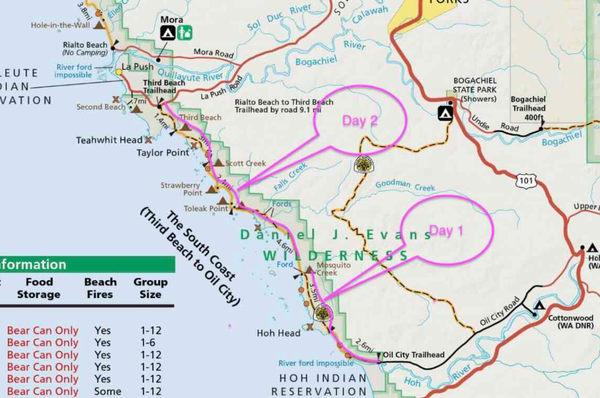
Day 2: Mosquito Creek to Rialto Beach, ~ 10 miles
I got up at 9am, dropped down to the beach (no bugs at Mosquito Creek in the winter), and made my way to Goodman Creek, which was an easy ford due to the dry weather. Then I hiked past Toleak Point, Strawberry Point, and up onto the overland trail at Scott’s Creek, eventually coming out to the highway, at dusk. At this point, I needed to either go into La Push and find someone to boat across the mouth of the Quileute, or walk 8 miles around over a bridge. I got lucky though and a pickup truck with some locals from La Push stopped in the dark, asked where I was going, and gave me a ride to Rialto Beach. I hiked up towards Hole in the Wall and camped around 8pm.
Highlights:
- The solitude of the ocean in the winter.
- Oyster catchers and eagles at Toleak.
- The Whale skull shrine at Strawberry Point that my son’s scout troop installed there over 5 years ago.
- Goodman creek intriguing fishing holes and waterfalls.
- My campfire at Hole in the Wall.
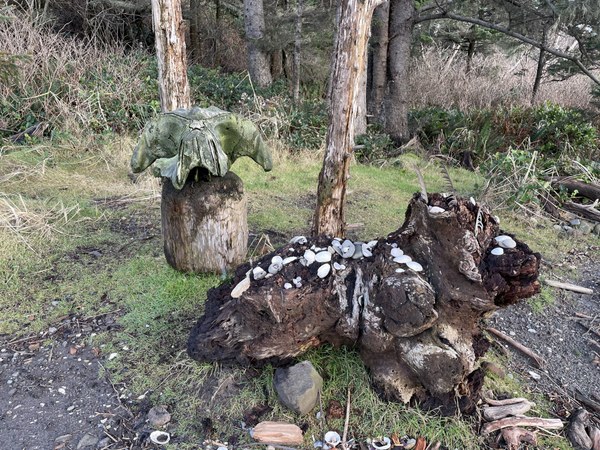 A whale skull on a stump.
Day 3: Rialto Beach to Sand Point, 17 miles
Shortly after hiking out of camp in the morning, I saw the only overnight hiker of the entire trip. He was from Seattle and was coming south from Sand Point. Heading north past the Chilean Memorial is slow going because most of the beach is rocky and you need to watch your footing. So I was startled when I heard a noise and looked up at a big sea otter staring at me. About a quarter mile earlier, I had passed a dead sea otter on the beach and it’s possible this was why it was hanging out by the headland. It seemed healthy and started moving toward the water.
Before Cedar Creek, there is a short but steep overland trail. The descent was quite exposed with very little footing for the last 15 feet and only a rope to hold onto (this is a great hike but not for everybody because the overland trails are challenging).
After Cedar Creek the beach turns mostly to sand and you can pick the pace up past the Norwegian Memorial and up to Yellowbanks. Yellowbanks requires a 5-foot tide max, so I had to wait 1.5 hours until midnight to cross. Note to self: remember to bring a trail description on these trips because finding the route around the point at Yellowbanks in the dark was a bit challenging since you needed to cut through a slot and a small tunnel to the other side.
From there it was a 2 mile hike to camp at South Sand Point at 1am.
The Chilean and Norwegian memorials are both for shipwrecks. The Norwegian bark the Prince Arthur wrecked on January 2, 1903 and the Chilean schooner Pirrie in November 1920.
Highlights:
- Sea otter!
- All the cool campsites that people have made along the way.
- Memorial markers at Chilean and Norwegian memorial.
- Sitting on a log at Yellowbanks, under a nearly full moon waiting for low tide.
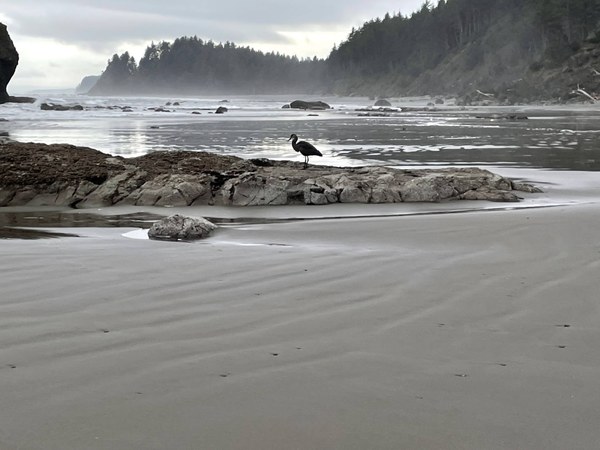 The coast near Cedar Creek.
Day 4: Sand Point to Shi Shi beach, ~11 mi
The main obstacles this day were fording the Ozette River and the overland trails leading up to Point of the Arches.
I left camp at 9:30am to tour the area around Sand Point, then hiked 3 miles north to Cape Alava. Along the way, I looked for the petroglyphs at Wedding Rocks, but couldn’t find them. I saw 4 other day hikers on this stretch doing the Ozette Triangle.
Cape Alava was really nice and just north is the old Ozette Village site that was buried 500 years ago in a landslide. Discovered by hikers in the late 60s when erosion started exposing parts of it, it became an archeology dig led by a professor at WSU. Many of the artifacts are on display at the Makah Museum in Neah Bay (world class). The dig site is right on the point and now covered with grass.
Fording the Ozette was a bit more than I expected, with a strong current up to my knees. It was low tide but further toward the waves it was sandier and I was worried there might be deep holes with the strong current. My walking stick helped.
There are two overland trails leading up to Point of the Arches. Both have some steep exposed sections and are fairly overgrown. I ended up back at the beach waiting for low tide again at 12:30am, so I made a campfire and made dinner. Just then it started raining fairly hard so I had to relocate to a small cave before rounding Point of the Arches and camping just north at Willowby Creek.
I’ve been out to Shi Shi dozens of times in the winter so camping there felt like coming home.
Highlights:
- The eagles and deer north of Ozette River.
- Ozette archaeological dig.
- Navigating the confusing overland trail and its exposure and getting around Point of the Arches at 12:30am.
- My campfire while waiting for low tide.
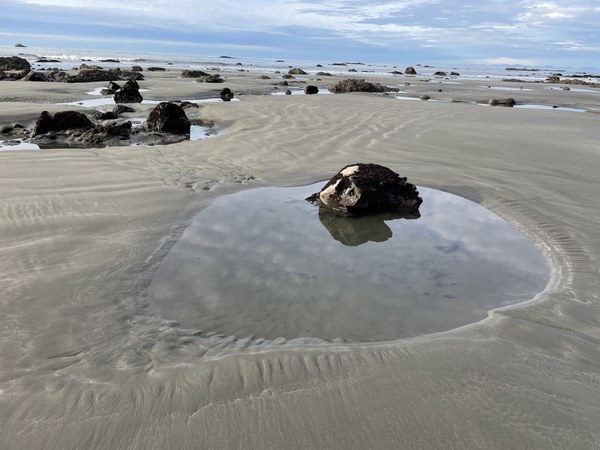 The beach near Ozette River.
Day 5: Shi Shi to Neah Bay (then Sequim), ~12 miles
The 5-mile hike out went quickly, but this was followed by another 6 miles to town to catch the bus. I was really fortunate to catch a ride for the last 3 miles from a man who was watching the waves from his car when I walked by.
My driver, Mr. Corpus, was in his mid 70s, a Vietnam vet, and native Makah. When he heard I was at Shi Shi, he said “I used to live in a cabin out at Point of the Arches.” Back in the early 70s, there were a couple dozen cabins out there that were dismantled when it was added to the Olympic Park.
He had a really nice easy going manner and told me stories of the Makah history and their interactions and defenses from Spanish explorers and privateers. Sure enough, Fort Nunez Ganoa was built at Neah Bay in 1792 (the same year that Captain Vancouver came to the Puget Sound), but it lasted only 4 months. Today there is a city park with the same name that is also a war memorial for Makah who served in the US armed forces. The Makah live at arguably one of the most interesting and strategic spots along the Pacific between Vancouver Island and the Olympics and the entrance to the Inside Passage.
A relic from the Spanish fort at Neah Bay lives on in the Ozette Potato. Brought from South America, it was planted at the fort and continues to grow in Neah Bay potato patches to this day. It is seasonally available at the PCC in Seattle.
Mr. Corpus pulled up to his home, gave me a hand made map of the battles he described, and encouraged me to stop by next time I was in town, which I intend to do.
The bus to Port Angeles took about 1.5 hours, with a transfer and a stop at the Clallam Bay Correctional Center. From there I caught the next bus to Sequim and met a friend at Jose’s Famous Salsa and Burritos, then spent the next couple nights in Sequim.
Highlights:
- Wrapping up the trip with Mr. Corpus and hearing tales of Makah history.
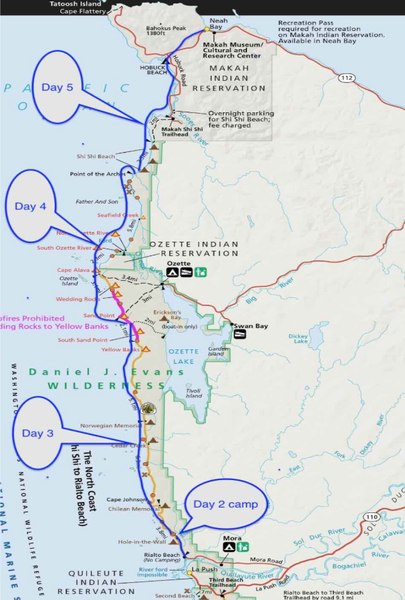
Notes
This hike is not for everybody - the overland trail's occasional exposure, slippery tread, and passage over/under so many downed trees is a challenge. Make sure you take a detailed trail description, Custom Correct map (which has the tide levels marked at each point - Green Trails do not) and current tide tables. There is not much phone coverage, so bring paper maps.
Wear boots with good ankle support. I used Hoka trail runners, which fit well, but twisting your ankle is a real possibility on slippery beach rocks. The next time I will bring better ankle support.
Making a beach fire in the winter sure improves your quality of life and could even save it. But it takes practice, patience, and time (because all the wood is wet). Bring a hatchet, and split cedar chunks which have a very straight grain, split easily, and are mostly dry on the inside. Use a lot of fire starter. Keep piling on chopped up cedar pieces. It’s a lot easier in the spring and summer when the wood is dry.
I use the USGS river flow sensor on the Hoh river to guess at the strength of the flows for the two rivers that need fording: Goodman and Ozette. When I crossed Goodman, the Hoh was at 2,500 cfm. By the time I got to the Ozette river the Hoh was at 2,000. I believe that you could get across both rivers if the Hoh flow is at 3000 or less. For information on the Hoh River, visit this USGS webpage.
Make sure you bring a tide table and know how to read it. They tend to be confusing (some are in meters, some in feet) and it’s very important to know the height of high and low tides with some precision.
Transportation
- Seattle to Bainbridge ferry.
- Bus: Clallam Transit route 123 (Bainbridge ferry terminal to Port Angeles).
- Route 14 to Forks. Route 16 to Neah Bay. Forks south to Hoh River/Oil City road. Visit this webpage for information on bus route from Forks to the Hoh.
- Karen’s shuttles: 360-244-0617 (call/text)
Add a comment
Log in to add comments.
This is an excellent report. Kudos for you for completing this in one push and in winter.
