 Lori Porter Stole
The two biggest bodily traumas I’ve experienced as a sea kayaker both occurred before my kayak got into the water.
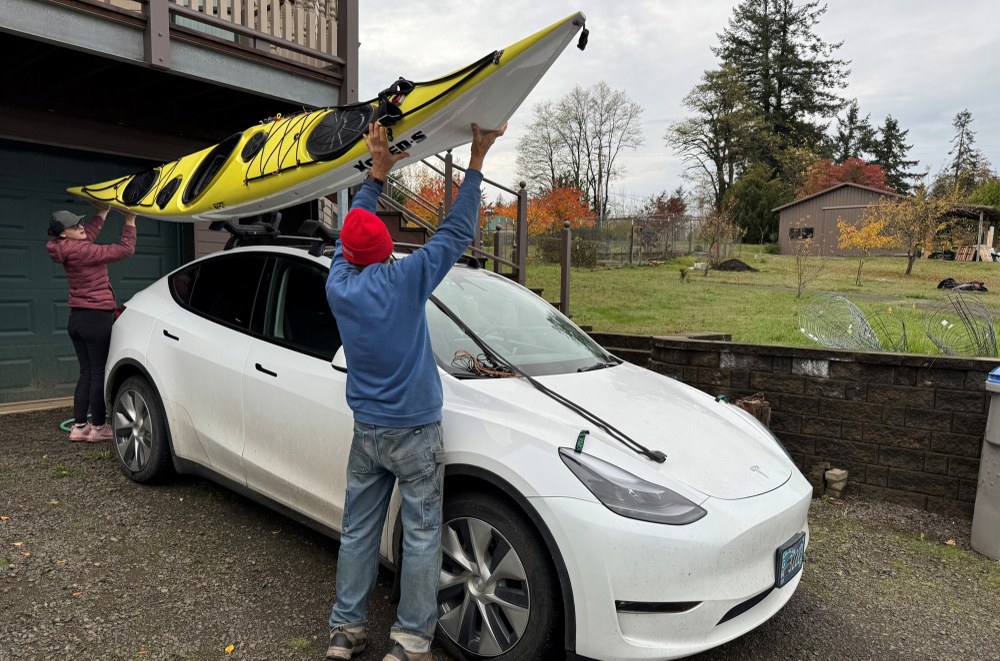
Getting a kayak to the water starts at home, when you heave that large mass up onto your vehicle’s roof rack, followed by lifting it down off the vehicle at the launch site. Getting your kayak back home requires doing all those moves again at the end of your trip when you’re tired. Luckily for me, my husband and I almost always paddle together so there are two of us to move the kayaks around (which also means two boats to load and unload).
My kayaks weigh 50-60 pounds and are between 14-18 feet long. To load the kayaks onto our car, my husband and I carry one kayak at a time from our garage to our car parked in the driveway. Maneuvering the kayak around to the desired side of the vehicle can easily result in a person walking backward while carrying the kayak.
One day, I was that person walking backward, and I tripped as my foot backed into a heavy object that was on the ground. My tailbone and head slammed into the ground, followed by the kayak. Fortunately, the kayak didn’t hurt me, nor was it damaged. My head injury didn’t worsen beyond a big lump. My tailbone, on the other hand, stayed tender for many weeks and greatly hampered my ability to get in and out of my kayak without pain. Since then, I NEVER walk backward while carrying a kayak.
My second incident took place several years later when unloading a kayak at a boat ramp. I was helping unload the kayak on the driver’s side of the car, where there was only a narrow space between the driver’s side and the ramp’s railing. The kayak obscured my view of the ground as I lifted it and walked forward, and the next thing I knew, my ankle rolled over a 6-inch drop at the edge of the concrete ramp. I crumpled to the ground along with the kayak.
Silly me! Because I had approached the driver’s side from the rear of the car, I had not seen the ground on that side of the car. Once again, the kayak fared okay in the drop (it was my husband’s boat anyhow…), but my knee and the palm of my hand both bled from scrapping the rough concrete. Miraculously, my ankle was intact. Lesson learned: always look at the ground around the car where you’ll be loading/unloading your kayaks. It only takes a split second while the boat is transitioning past your face (or otherwise obstructing your view) to run into trouble.
To learn more about types of situations that might be encountered while loading/unloading a kayak, or to learn about other situations that can result in safety incidents, ask other paddlers or check past incident reports. Additional things to consider when loading/unloading a kayak are:
- The surface on which the kayak is being unloaded/loaded might be slick, leading to slips and falls. One incident report described a scenario in which the person slipped, fell backward, then reached back during the fall and injured their wrist. Proceed with caution when the ground is slick.
- High winds can be problematic when loading/unloading kayaks. Do not attempt to move your kayak in windy conditions without a second pair of hands. Do not leave a kayak unattended on the car rack in heavy winds unless it is securely fastened. There are reports of unsecured kayaks being blown off the roof and sent rolling across the parking lot. Be prepared for a strong gust that could grab the kayak off the roof and/or out of your hands.
- Various issues can arise when loading/unloading a kayak alone. Some of these issues can be resolved with a Hullavator-type rack, which eliminates having to lift an unsupported kayak high up to the car roof. If your solo process involves getting one kayak end on the rack at a time, be sure the rack onto which you lift up the first end of the kayak has a stop such that the boat cannot slide off at the first end as you work with the other end, and consider whether the stop will work when the vehicle is on an inclined surface. You may need to find a level surface or seek an additional person.
- Some people use a step stool to help them lift the kayak up to the rack. It is essential that you use a sturdy, well-constructed step stool. Weak stools can collapse under the paddler while they manipulate the kayak, leading to injury and potential kayak damage.
- If the only person available to help load a kayak onto your roof rack is too short for the job, proceed carefully and position that person at the back of the vehicle so they don’t have to reach out over the car hood.
Loading and unloading kayaks onto a vehicle involves a variety of risks. Some of these risks can be eliminated via observation, the presence of a second person to help, the right equipment, and communication. Managing other risks requires awareness and care.
Knowing what the possible risks are allows you to mitigate them to the extent possible. If you or someone in your group does experience a loading/unloading incident that results in injury or kayak damage, please share it with the rest of the paddling community via a Mountaineers Incident Report so that everyone can learn from it (note that your anonymity will be preserved).
Add a comment
Log in to add comments.
Great article Lori. Thanks.
Excellent article Lori, thanks! Lisa J. =)))
Well articulated writing that's spot-on Lori!
Yes, definitely keep an eye on the ground to be walked. The segmented ramps with big holes with steel rod connectors are ankle grabbers. Thanks!
