 Anastasia Allison
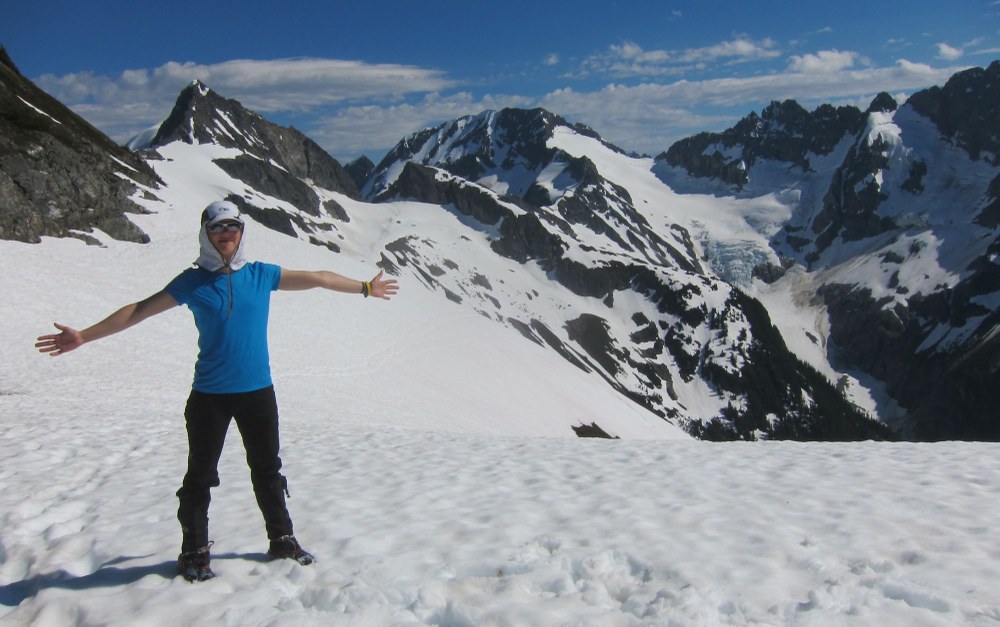
Standing at the edge of Cascade Pass, I crane my neck upward toward our first objective, a tiny pass called Cache Col. My friend Brenda and I are hiking the fabled Ptarmigan Traverse, a remote, 40+ mile alpine route through some of the most breathtaking and isolated terrain in the North Cascades. The traverse is a commitment. Once you start, there are no easy exits (either retreat or keep moving forward) and the trail’s steep traverses are cut by numerous no-fall zones.
As we strap on our heavy packs and set off, I feel a mix of anticipation and low-grade dread rumble in my stomach. We pick our way slowly up the snowfield toward the col and cross over a narrow gap in the ridge. Then, as we begin descending more steep snow, I peer into the basin below in anticipation of what I’ve been dreaming of seeing for so long…
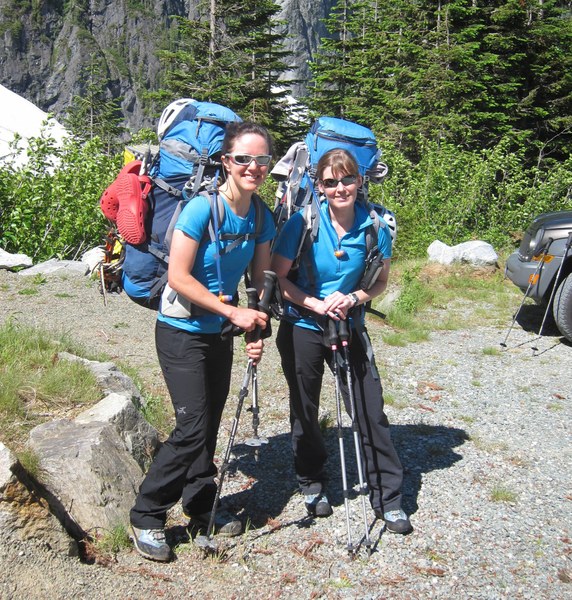 Anastasia (left) and climbing partner Brenda (right) ready to leave the Cascade Pass Trailhead with their heavy packs. Photo by Dave Gordon.
An unsolved mystery
Many years ago, I came across a photograph of a lake that made me gasp. Although a tiny body of water, it appeared to spill like an infinity pool into the endless depths of the North Cascades. The photo caption read simply: Kool-Aid Lake, North Cascades. A novice backpacker at the time, I promised myself that one day I’d gain the skills to be able to visit Kool-Aid Lake. I didn’t know why the lake mattered so much to me. I only knew that it did.
And here I finally am, gazing at Kool-Aid Lake nested in the basin below. Except I can’t see it. The lake is still buried under snow.
After years of dreaming about Kool-Aid Lake and gaining the skills to finally reach it, I feel discouraged as we continue along the traverse. The days that follow test every ounce of our endurance and resilience. A near miss with rock-fall shakes our confidence. A misstep on a slope nearly sends me sliding before I catch myself with my axe. We get socked in at Yang-Yang Lakes, our progress slowed by fog and outdated GPS gear. We struggle up glaciers and navigate with what feels, at times, like a tiny bit of luck. But we keep moving, inch by inch, step by step, until we round the last bend in the trail.
I had hoped that seeing Kool-Aid Lake would offer clues to the origin of its name. Does it look like a Kool-Aid pitcher? Does alpenglow give it a fruit-punch hue? Resembling more of a snowy thumbprint on the landscape, the lake – and its answers – remain a mystery.
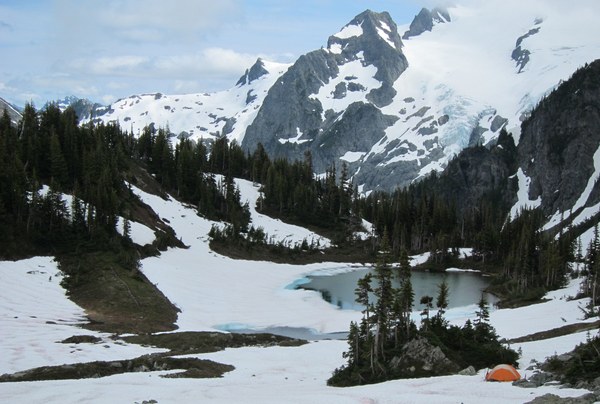 The campsite at Yang-Yang Lakes, Ptarmigan Traverse. Photo by Anastasia Allison.
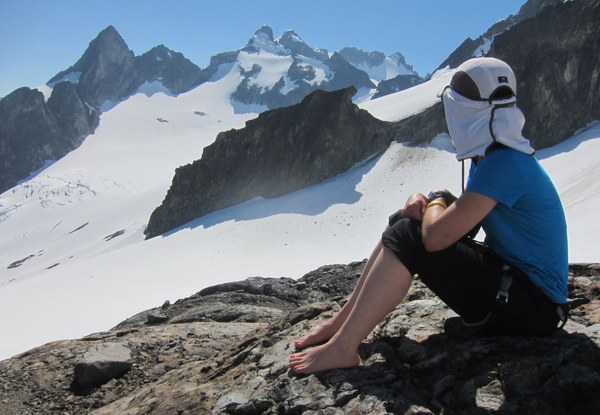 Anastasia resting on a rock near the Dana Glacier. Photo by Brenda Gordon.
A chance encounter
It’s been fourteen years since that trip, and the call of Kool-Aid Lake lingers. “One of these days,” I often joke, “I’m actually going to see Kool-Aid Lake.”
And then, I begin feeling another call: to serve my community by volunteering to play violin at a local retirement center. On my first visit to a local facility, my husband Aaron and I bring our instruments, as well as a few videos of me and my friend Rose playing in our duo, The Musical Mountaineers. (For the past eight years, Rose and I have performed unannounced serenades for nobody at over 40 different locations in the Cascade Range.)
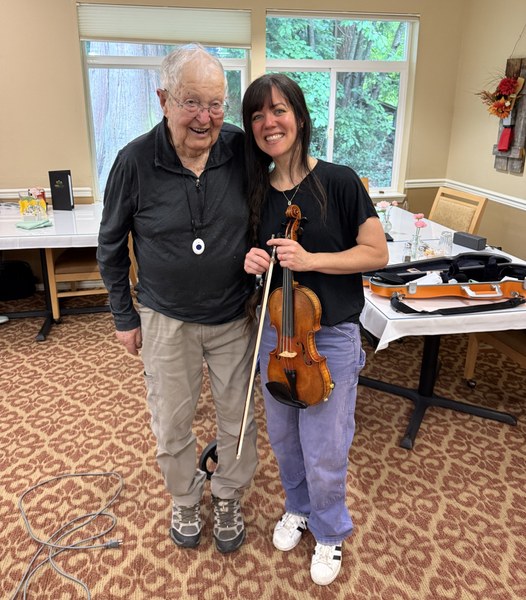 Anastasia and Jack at the retirement center. Photo courtesy of Anastasia Allison.
After our first performance, a gentleman named Jack Hansen approaches me. “Have you ever been to Cascade Pass?” he asks. “Or Cache Col?”
I blink. Those are not the kinds of questions I expect to get in a retirement home.
“Yes,” I say, one eyebrow raised at this curiously knowledgeable man, “I’ve done the Ptarmigan Traverse.”
Jack’s face lights up. “Back in the 40s… I can’t remember exactly when, but I think it was 1949… we climbed Magic Mountain, near Cache Col,” he says. “We walked down the other side and there was this little lake there — this unnamed, nothing of a lake. We sat at the lake that day and drank Kool-Aid for lunch, and then I took a piece of paper, attached it to a small stick, and wrote ‘Kool Aid Lake.’ I put the stick in the ground like a sign… and wouldn’t you know, the name stuck.”
My heart starts to pound. “You named Kool-Aid Lake?” I whisper.
Jack smiles. “I don’t think anyone else knows. It wasn’t a big deal at the time. We were just having lunch.”
I can hardly breathe. The staff at the assisted living center look curiously at me, not quite understanding my excitement. After years of wondering, I’ve solved the mystery of Kool-Aid Lake, in the most unexpected place I could have imagined, without even trying.
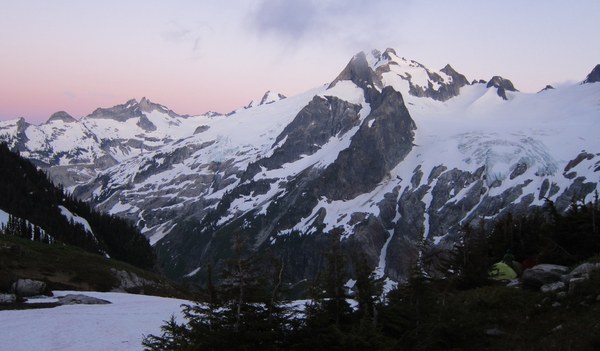 Gunsight Peak and Dome Peak from White Rock Lakes on the Ptarmigan Traverse. Photo by Anatasia Allison.
The legacies we leave
I continue to visit the retirement center each month to play music and swap mountaineering stories with Jack. Every time Jack describes an adventure, his eyes glint with the eternal youthfulness of a summit climb.
One day in September of 2025, while Aaron and I are performing for a large group at the retirement center, I decide to regale the audience with a story about how we filmed a summit serenade atop Mt. Pugh. As I excitedly describe the difficulty of hauling a violin and piano over 5,000 vertical feet, I’m met with kind but blank eyes. The story falls flat. The one person who would understand the accomplishment of such a feat isn’t in the crowd.
We play for nearly an hour. In between songs, an employee somberly approaches me to say that Jack isn’t doing well. “Maybe you can bring your violin up to his room to play a few songs when you’re done here?” they suggest. I nod eagerly.
When our set is done, we ascend a single story to Jack’s apartment. He is laying in his bed, shirtless and frail, with a huge smile on his face. “Well, what a surprise!” he exclaims loudly, his eyes beaming.
I begin playing for him. Tears stream down my face as I perform “The Ashokan Farewell” – a song that somehow always feels like both a hello and a goodbye. When I’m done, I look at him with a sly grin and say, “Do you know why I had to come up here? I just told the entire group downstairs about climbing Mt. Pugh with a violin and piano, and nobody cared. I thought to myself, Jack will care!”
He gives a hard, booming laugh that defies the fragile state of his physical body. “Your story is getting published in Mountaineer magazine,” I tell him proudly. “Everybody is going to know you were the one who named Kool-Aid Lake.”
His eyes glisten as he looks up at me. “You know what?” he says. “I’ve remembered something else about that day, too… It happened on a trip with the Everett Mountaineers.”
I smile at the coincidence. A nurse pops in to check on Jack, and I take it as our cue to let him rest. Before I leave, Jack and I share one last look at each other – the kind people share when they know they won’t ever see each other again in this lifetime. I lean over and hug him hard.
The next morning at sunrise, I carry my violin to the top of a hill near my house and record a song for Jack. I email him the recording and receive a blank email response a few hours later, but when I check the video link, it shows one view.
A few days later, Jack passes away.
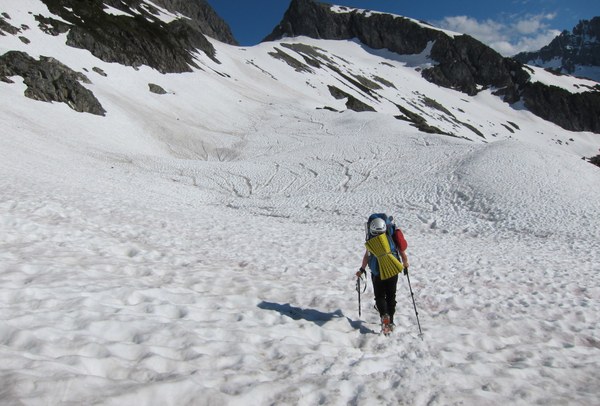 Descending to snow-covered Kool-Aid Lake. Photo by Brenda Gordon.
Living the questions now
Thinking of my connection to Kool-Aid Lake and my path to Jack, I can’t help but be reminded of the Rainer Maria Rilke quote: “Be patient toward all that is unsolved in your heart and try to love the questions themselves, like locked rooms and like books that are now written in a very foreign tongue. Do not now seek the answers, which cannot be given you because you would not be able to live them. And the point is, to live everything. Live the questions now. Perhaps you will then gradually, without noticing it, live along some distant day into the answer.”
I’ve still never seen Kool-Aid Lake in person. Many years ago, I thought I was supposed to return and see the lake unfrozen, but now I understand that was never the point. The whisper of Kool-Aid Lake wasn’t calling me back to the trail, it was asking me to listen… and to tell the story – Jack’s story – to anybody else who has the same glimmer in their eyes when they talk about their time in the mountains.
Now, when others arrive at that small, snowmelt basin on their first night of the Ptarmigan Traverse, they might also wonder at the history of the lake and discover that its name holds the memory of a kind man who once sat there with his friends and drank Kool-Aid for lunch. Maybe knowing that story will make them feel a little less alone, and a little more connected to the mysterious ways our landscapes bring us together.
Author note: While writing this story, I became curious about the first time “Kool-Aid Lake” was mentioned on a topographic map. Initially, the lake’s name was probably passed down from climber to climber, until it just became what people called the lake long after the name’s origin had been lost. The USGS online historical database shows that the lake was either not visible and/or not named on maps prior to 1963. From my research, the USGS Topo Map of the area printed in 1963 is the first time “Kool-Aid Lake” is mentioned.
This article originally appeared in our 2026: Issue 2 of Mountaineer magazine. To view the original article in magazine form and read more stories from our publication, visit our magazine archive.
