 Nomi Rachel Fuchs Montgomery
 Tess Wendel
The Sexual Harassment and Sexual Assault Prevention (SHSAP) Committee spent the last few months reviewing and updating the The Mountaineers Code of Ethics (formerly known as the Member Code of Ethics) and creating a new Behavior Standards policy. In October, The Mountaineers Board approved changes to The Mountaineers Code of Ethics and the newly developed Behavior Standards policy (which synthesizes information from the previous Prohibited Behavior policy and Mountaineers Activity Standards policy and expands on it to address areas related to sexual assault and sexual harassment).
Updates to the The Mountaineers Code of Ethics include additional and clearer language about expectations of leaders, as well as defining leaders more expansively (previously expectations of members were only included). This higher standard of behavior expectation of leaders is now mirrored in the new Behavior Standards policy. The Behavior Standards Policy provides a more comprehensive policy compared to the previous version (which was more investigation focused) and includes additional focus on the expectations of members and leaders.
Updates include:
- Increased detailed definitions related to discrimination, sexual harassment. and sexual assault
- Clearer guidance for poor behavior by Mountaineers members that happen adjacent to official Mountaineers activities
- Greater consistency in language between the new Mountaineers Code of Ethics and the Behavior Standards policies
- Reduced redundancy between individual policies
- Clarified standards around alcohol, drug use, firearms, and pets
- Dedicated section related to retaliation and defining the connection to the whistleblower policy
Why is this important?
Clear, current policies establish shared expectations for behavior, including standards that explicitly prohibit sexual harassment, sexual assault, and other forms of misconduct. By naming unacceptable behavior and defining boundaries, these policies help prevent harm before it occurs and provide guidance for appropriate conduct in both formal program settings and informal, social, or field-based environments.
Updated policies also strengthen accountability. When expectations are clearly articulated in writing, members and volunteers understand both their responsibilities and the consequences of violating community standards. This clarity allows The Mountaineers to respond to concerns consistently and fairly, support those who experience or report misconduct, and take timely action when behavior does not align with our values.
In a volunteer-led organization—where people often work closely together, sometimes in remote or high-trust settings—strong behavioral standards are especially important. Updated policies help foster a culture of respect, consent, and professionalism, reducing the risk of sexual harassment and assault and reinforce that everyone has a role in maintaining safe learning environments.
What’s next?
Updating our behavior complaint and investigative processes, so that the process is more efficient, responsive, and timely. Initial updates in 2026 will include adding a complaint category to the form (i.e. bullying, harassment, discrimination etc). This will allow staff to create better workflows based on the type of complaint as recommended by the board committee. Another update will be making significant revisions to the appeals process which is administratively burdensome and not functioning as intended.
Scheduling Bystander Training sessions. Staff and the SHSAP committee are currently working together to explore opportunities to schedule bystander training sessions. While the particular trainer/organization has not yet been identified, please sign up here to indicate interest and stay informed about when the sessions are scheduled. If you are a committee leader and want to host a session for your committee leaders, please add that in the notes field.
How you can help!
- Click the links above and read the new policies! There is helpful information for addressing complaints and feedback. These are resources for everyone.
- If you are on a committee, please share and promote the new policies and ask leaders to share the links within their individual committee leadership.
- If you are involved with leading activities or courses, please incorporate the behavior expectations into your kick-off welcome presentation to participants.
- Get more involved. Reach out to Amanda Piro to join the SHSA Prevention Collaborative on BaseCamp.
To learn more about the history the SHSAP Committee, please check out: Sexual Harassment & Sexual Assault Prevention Committee Recommendations — The Mountaineers
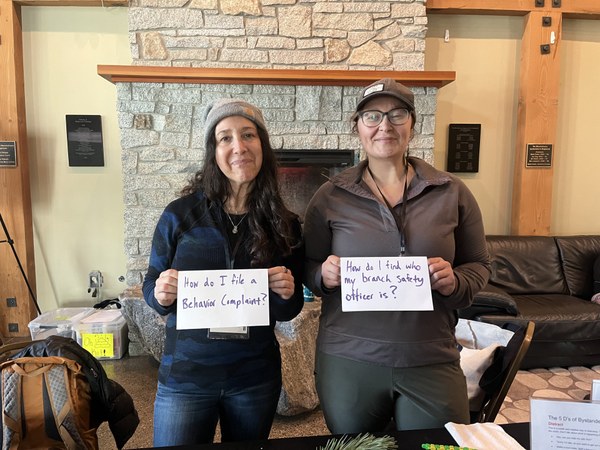 Nomi Rachel Fuchs Montgomery and Tess Wendel representing the SHSAP Committee during a Mountaineers event.