 Andy Cahn
On the last day of what had been an unsuccessful expedition deep into the Canadian Rockies to look for fossils in 1909, Charles Doolittle Walcott found one small, unusual fossil in a pile of avalanche debris. About half an inch long, Walcott called it a lace crab because of its delicate, lace-like appearance and identified it as an odd trilobite. (It has since been identified as Marrella splendens and is neither a trilobite nor a crustacean.)
The following year, Walcott returned to the debris pile and discovered a fossil bed 400 feet up the slope rich in exquisitely preserved Cambrian fossils. (Prior to the Cambrian period, most organisms were very simple, composed either of a single cell or a colony of cells. The Cambrian period represents the emergence of complex organisms and is critical to understanding the evolution of life on Earth). His site, known as the Burgess Shale, became the most famous fossil bed in the world. Due to its extraordinary value to the scientific community, the fossil bed is closed to the public and can only be visited on special tours. I’ve wanted to visit the Burgess Shale since high school, and finally realized that dream on a Mountaineers Global Adventure in the summer of 2025.
Driving toward the past
The first two days of the trip were spent driving to Yoho National Park, site of the Burgess Shale. Along the way, we toured Osoyoos (Canada's only desert), explored the thick mineral deposits at Spotted Lake, and marveled at weird animals inhabiting the bizarre “Log Barn 1912” attraction near Enderby.
It would have been a shame to drive all the way to Yoho and not revel in its grandeur, so for two days, we enjoyed Yoho’s best trails. Our first hike was the Iceline trail, a stunning traverse along a bench sandwiched between treeline and a series of cliffs and glaciers. Our second hike started at Emerald Lake and took us high into the mountains, over Burgess and Yoho Passes. Finally, the day of the Burgess Shale arrived. Despite the weather forecast for rain showers, everyone was excited.
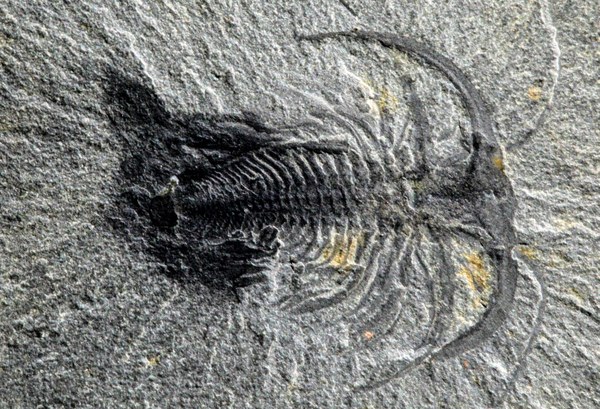 Marrella splendens. Photo courtesy of the Smithsonian's Department of Paleobiology.
Digging through history
On first meeting our guide, Misha, I estimated they were 25. When I learned they’d been guiding professionally for 27 years, I was forced to consider two possibilities: either they started guiding prenatally, or I would have made a horrible paleontologist as I am terrible at estimating age.
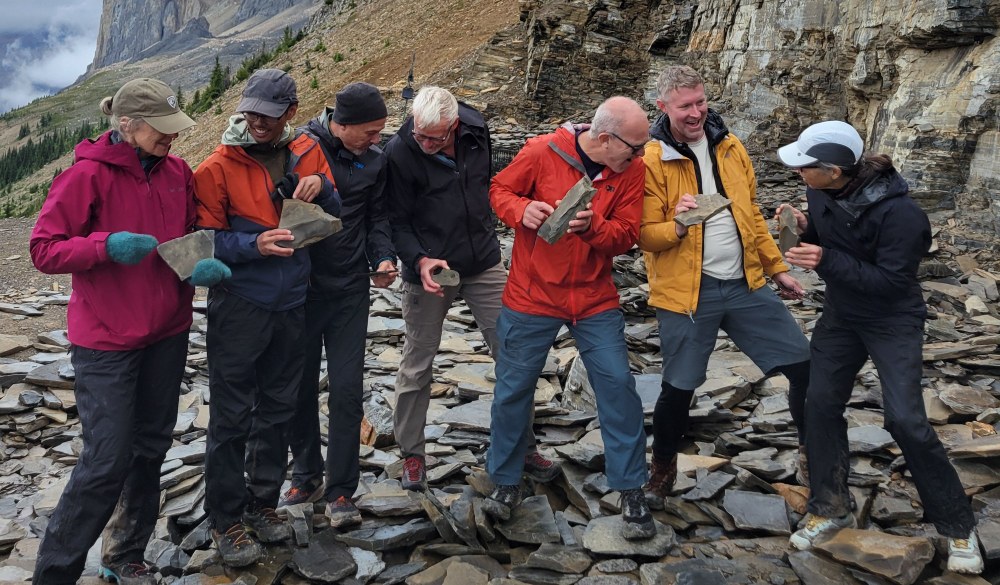
Eager to see the fossils, the group barely noticed the rain as we hiked the long and arduous route to Walcott's quarry. The quarry itself is surprisingly small, only about 150 feet long and 30 feet wide. We were turned loose for about an hour to rummage, with just a few simple rules: don't split, crack, or break any rocks; don't use poles (or anything similar) that could scratch the rocks; and don't keep anything.
Almost immediately, we found fossils. Lots of fossils. Having learned my lesson, I kept the age estimations to our expert guide. Misha taught us to identify what we saw – which included Vauxia, Ottoia, Paterina, and Dirophora – and informed us that our fossils were more than 500 million years old.
Before we knew it, our hour of discovery was over. We attempted a “summit selfie,” but everyone was too engrossed in each other’s discoveries to look at the camera.
This article originally appeared in our 2026: Issue 1 of Mountaineer magazine. To view the original article in magazine form and read more stories from our publication, visit our magazine archive.
