 Charles Bookman
Beyond Crystal Mountain ski area, Highway 410 winds past Mount Rainier’s Sunrise area, then jogs over Cayuse Pass before switch-backing over blasted cliffs to reach Chinook Pass and its flowery gem, Tipsoo Lake. Here in 1949, Associate Justice of the U.S. Supreme Court William O. Douglas was riding his horse on the Pacific Crest Trail when the horse shied, lost its footing, and rolled over him. The horse was all right, but the Justice broke 23 ribs and suffered a punctured lung.
Justice Douglas was on his home turf. Raised in Yakima, he spent his teenage years roaming nearby mountains like Kloochman’s Rock and Mount Aix and fishing the area’s many lakes. After attending Whitman College, heading east for law school, becoming a successful professor of business law, and chairing the newly formed Securities and Exchange Commission in the 1930s, Douglas was nominated by President Franklin Roosevelt in 1939 to the U.S. Supreme Court.
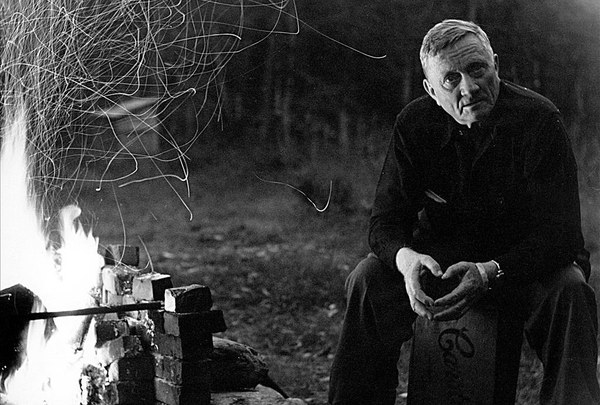 Douglas telling campfire stories. Photo courtesy of the Yakima Valley Museum.
Washington’s Conservation Justice
As the longest-serving Supreme Court Justice, William O. Douglas oversaw the Ninth Circuit and served on the Supreme Court from 1939 until 1975. For most of that time, he maintained a home in Goose Prairie, near Bumping Lake. In the summer, when the Court was out of session but still required to render occasional decisions on petitions, the Justice would nail his decision to a tree near the highway where reporters would collect and report it using the nearest phone at Whistlin’ Jack’s Outpost and Lodge on Highway 410.
Justice Douglas was a staunch defender of the environment. In a famous case before the Court, Sierra Club v. Morton (1971), he famously argued that natural resources such as trees, lakes, and wildlife should have standing to sue for their own protection. And in 1956, after local boosters proposed routing Highway 101 along Washington’s Olympic Coast, the Justice led conservationists on a march from Lake Ozette to Rialto Beach to publicize the beauty of the remote Olympic Coast and the need to protect it. (Congress eventually designated the area as Wilderness in 1988.)
During Douglas’ lifetime, the area between Mount Rainier and Yakima was not as high on the Wilderness priority list as the Enchantments, Alpine Lakes, and the North Cascades. Cougar Lakes, Mount Aix, and other mountains and lakes cherished by the “Wilderness Justice” languished under the radar screen of the Wilderness movement. Douglas, however, kept his eye out for road construction and logging east of Chinook Pass. After his death in 1980, conservationists pressed the case for Wilderness protection, and in 1984, Congress honored Washington’s conservation Justice by designating the area east of Chinook Pass as the William O. Douglas Wilderness.
In addition to leveraging his judicial standing to defend Washington’s natural places, Justice Douglas also defended the rights of Native Americans, who were largely excluded from early Wilderness preservation efforts. Of 47 cases where Native American rights were clear and contested, the Justice ruled in favor of honoring treaty rights in 39 of them. Conservationists and public lands advocates today continue to work to change the narrative around Wilderness and uplift the history, culture, and stewardship of Native peoples, who have lived on and cared for our cherished public lands since time immemorial.
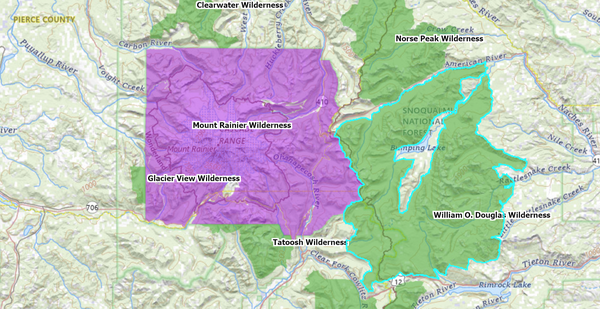 A map of the William O. Douglas Wilderness (outlined in blue) and surrounding Wilderness areas. Map courtesy of Charles Bookman.
The Wilderness
The William O. Douglas Wilderness Area encompasses 169,081 acres located between U.S. Route 12 and State Route 410, and is jointly administered by the Okanogan-Wenatchee National Forest and the Gifford Pinchot National Forest. On the westside, the Wilderness borders Mount Rainier National Park. Norse Peak Wilderness lies to the north, and Goat Rocks Wilderness to the south. The Pacific Crest Trail runs for 25 miles along the Cascade Range crest within the Wilderness’ boundaries, where you can find scattered peaks, sharp ridges, steep slopes, and hundreds of small lakes and potholes.
Much of the Wilderness drains into the Naches River. Mount Aix (7,766’) is its apex. On a clear day from Mount Aix, you can see Mount Adams, Mount St. Helens, the Goat Rocks, Mount Rainier, and the Stuart Range. As much as 120 inches of precipitation falls on the western side of the Wilderness per year, while the eastern side may get as little as 20 inches.
The Wilderness abounds with popular destinations for Mountaineers programs. Near the cascade crest, hikers enjoy ridge walks and forested lakes. Farther east stretch ponderosa pine forests, bare ridges, and often exposed basalt. The forest thins to the south and east, where there are over 250 lakes, ponds, and pools – good fishing wherever you go! Anywhere in the Wilderness, you might encounter herds of elk and mule deer that call this country home, as well as fishers, foxes, mountain goats, and grouse.
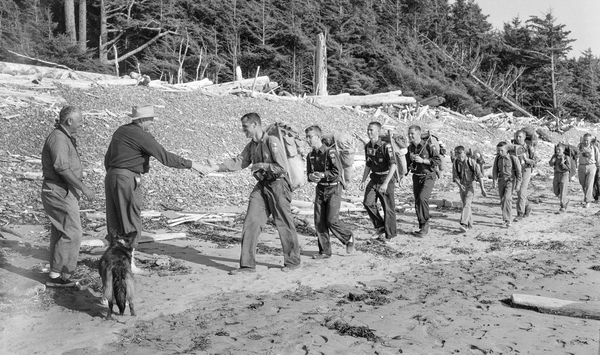 Justice Douglas welcomes hikers on the 1956 Olympic Coast conservation march. Photo courtesy of the Museum of History and Industry, Seattle Post-Intelligencer collection.
Hiking the William O. Douglas Wilderness
Just as William O. Douglas found, there is much to explore in the Cougar Lakes and surrounding peaks of the William O. Douglas Wilderness.
Popular hikes include Naches Loop, a half-day hike perfect for jaw dropping views of Mount Rainier, as well as wildflowers in the spring and summer; Mount Aix, a 12-mile, out-and-back hike with expansive views of Rainier, Adams, and Stuart; and the Pacific Crest Trail, which can lead you to nearby destinations such as American Ridge and Dewey Lake.
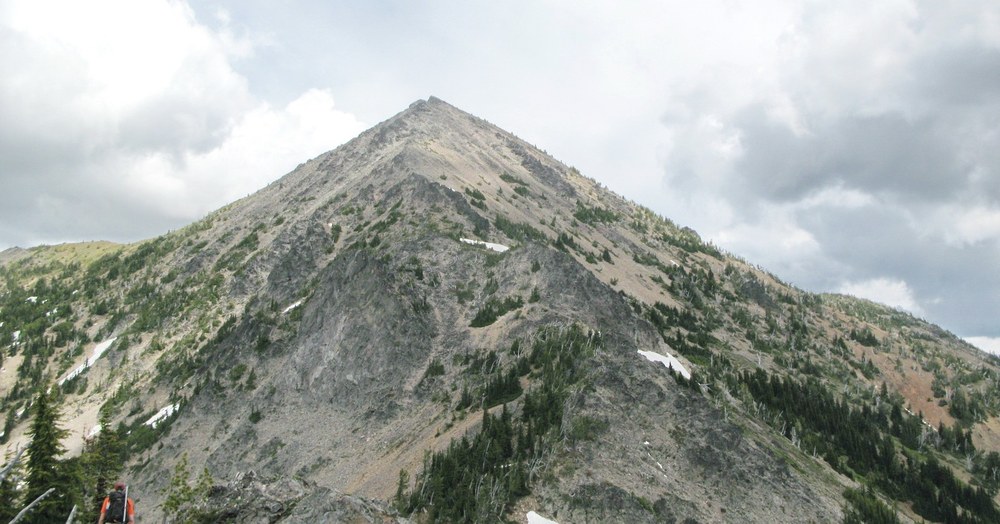
Once with a Mountaineers group, I scrambled a hulking massif next door to Mount Aix called Mount Bismarck (7,585'). The roundtrip hike is about sixteen miles and, with all the bumps on the approach ridge, involves about 6,000 vertical feet of ascent. We summited without serious difficulty around 1:45pm. Looking west from the summit, we could see a squall line of showers heading our way. The rain caught us about five hundred feet below the summit with plenty of exposed open ridge still to traverse. (Not a great place to weather a lightning storm!) We dropped off the ridge to the south on easy slopes, then hunkered down. I counted lightning bolts: two miles away… one mile away… As soon as the lightning passed over, we headed back onto the ridge where walking would be easier. Hailstones littered the ground. We made double time for an hour or so until reaching the safety of the trees.
A Wilderness for everyone
Justice Douglas mythologized his experiences in the Wilderness in the memoir, Of Men and Mountains, which tells of a time when a teenager could disappear over the horizon with some beans and flour and bacon, and a fishing pole. From such modest beginnings sprang a titanic legal mind who defended the rights of nature as well as every human’s right to experience solitude within it.
This article originally appeared in our 2026: Issue 1 of Mountaineer magazine. To view the original article in magazine form and read more stories from our publication, visit our magazine archive.
