Trip Report
Field Trip Mt Rainer - Naches Peak Loop
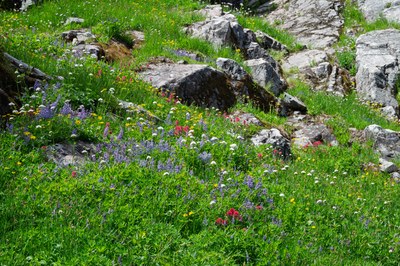
The Naches Peak loop was gorgeous on this July day, full of subalpine flowers, birds, and geology. We stopped often to check out details and had a wonderful time.
 Thomas Bancroft
- Sun, Jul 27, 2025
- Field Trip Mt Rainer - Naches Peak Loop
- Dewey Lake, Naches Peak Loop & Pacific Crest Trail
- Naturalist
- Successful
- Road suitable for all vehicles
-
The trail was dusty, relatively wide, and well-maintained. It was busy with people on this Sunday, but it was not a problem to find good places to let people pass.
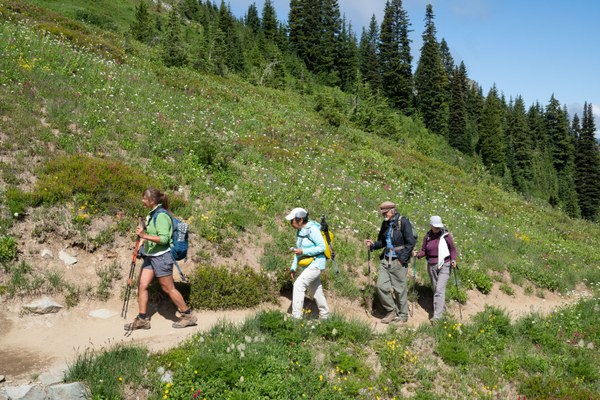
We found many outstanding things along the trail. Some required careful examination and lots of discussion. It was wonderful to have everyone work as a team, exploring, finding, identifying, and sharing.
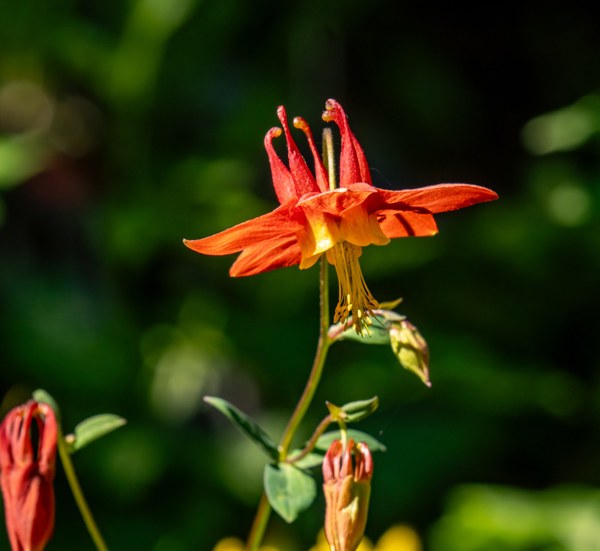
Photo by Jeff Brennan
Trip Report - Naches Peak Loop 27 July 2025
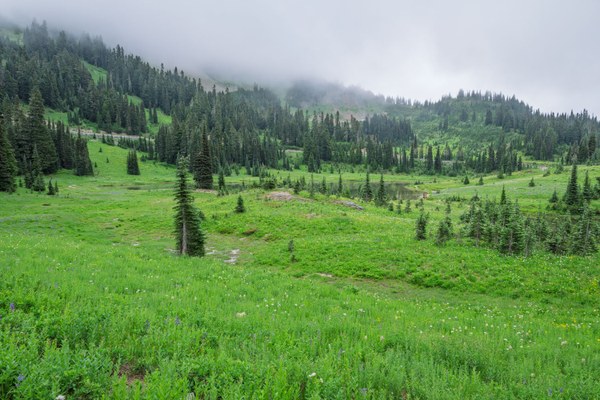
The fog was heavy but starting to rise from Tipsoo Lake. The trail to Chinook Pass looked down on the flat waters of the tarn. Flowers dotted the meadow, and the vegetation showed rich shades of green. Clouds blocked the view of the cirque above these tarns. A glacier during the Pleistocene slid off Naches Peak to carve the depression across SR 410 and Tipsoo Lake. The weight gouged out these meadows and wetlands. The rocks here are from the Ohanapecosh Formation. The magma solidified some 28 to 36 million years ago. It is mind-boggling that geologists think this volcanic activity happened at sea level or even below sea level. Uplift since then has raised these ridges, and Naches Peak itself is 6,452 feet above sea level.
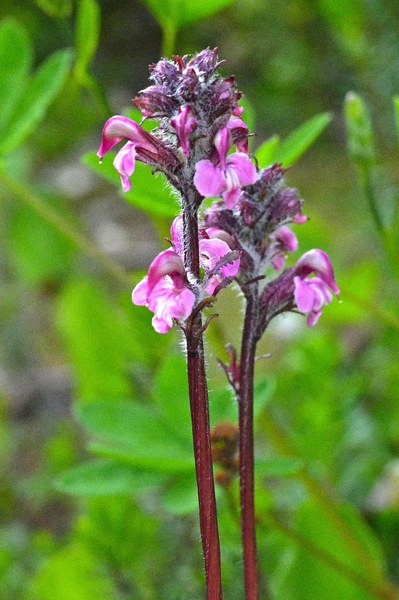
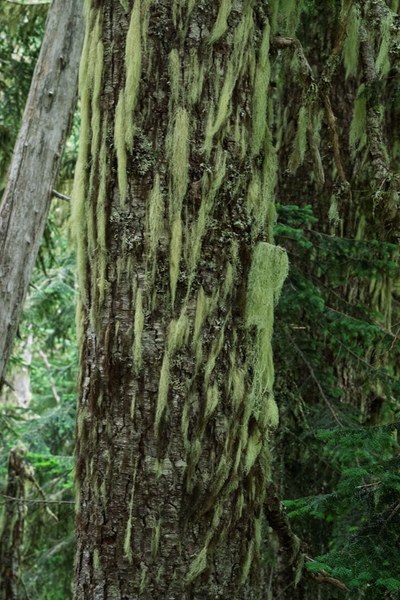
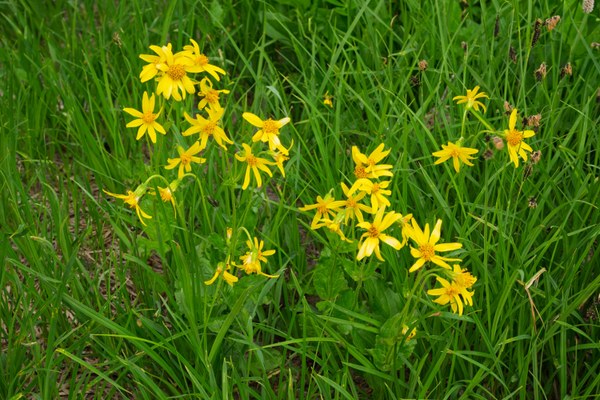
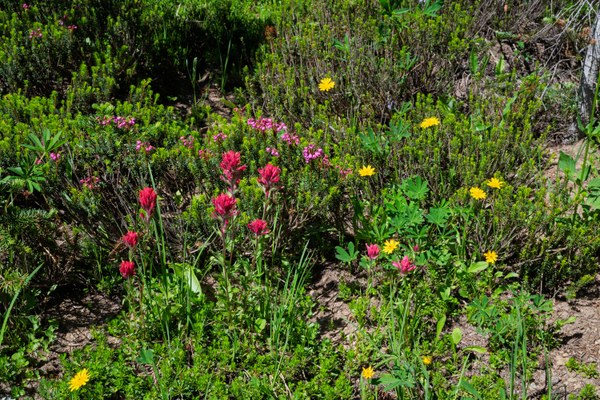
The trail wound through a grove of Mountain Hemlocks, through meadows dotted with avalanche lilies, subalpine lupines, magenta paintbrushes, and Sitka valerians. As our path met with the Pacific Crest Trail, I stopped to wait for everyone to catch up and scraped a line in the dirt. “Stand on your left foot, right here,” I said while pointing at my toes. “Then step onto this trail with your right foot.” Everyone looked puzzled, brows furrowed, lips formed questions. “That way you can, say you started your hike on the Pacific Crest Trail on the right foot!” The moans said it all.
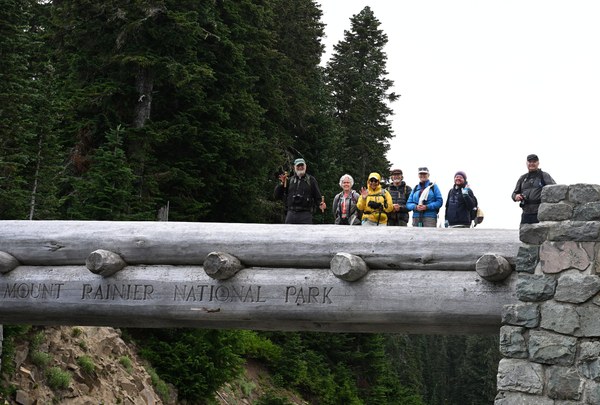
The trail crosses SR 410 right at the high point at Chinook Pass. The Park and Forest Services used large blocks of Ohanapecosh granodiorite and massive timbers to build the bridge, which gave us a spectacular view down the valley to the east. The U-shape indicated the valley had been carved by Pleistocene ice. Mountain hemlocks, subalpine firs, and flowers bordered the trail as we entered the William O. Douglas Wilderness. The Supreme Court justice was a champion of the environment and wilderness protection. I wish we had more like him on the Court today.
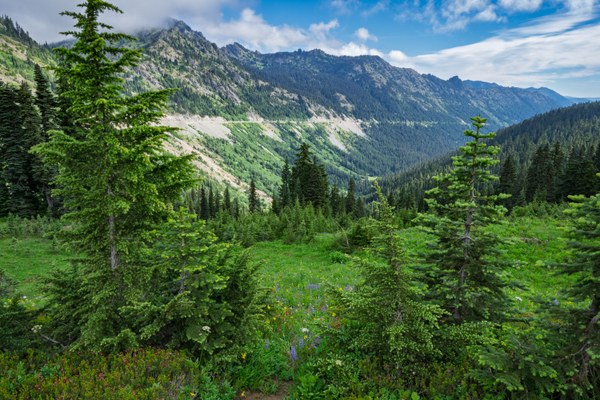
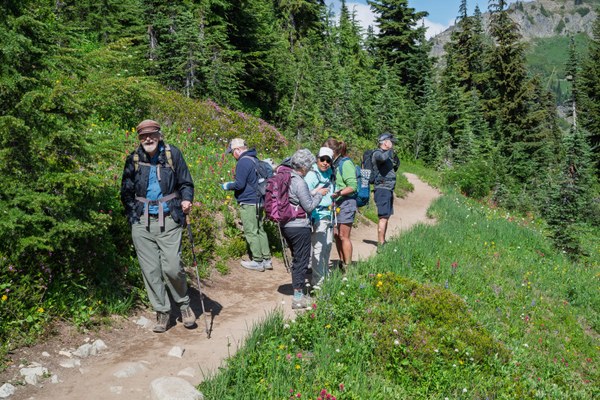
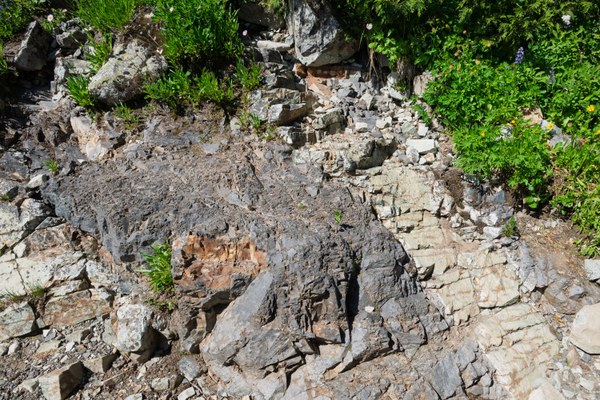
Around one corner, not far from the Pass, was a key find. Nick Zentner, a professor at Central Washington University, had just posted a video about this trail a week earlier. He was looking for a spot where molten rock had pushed through a crack in the Ohanapecosh Formation and then slowly cooled into granite. I gathered our group around the rocks and turned to Richard Burt. He understands the geology better than I do. I jumped for joy when he signed up for this trip. Around 14 million years ago, magma began pushing up from the center of the Earth, contributing to the uplift in this area. It is unclear if it ever broke through the surface as a volcano. The parts underground cooled slowly, allowing crystals to grow and form granite. A finger of the Tatoosh Pluton was right in front of us. This finger is known as a “dike” and was about a foot across. The Tatoosh Mountains on the south side of the park are where the overlaying material has eroded, exposing the pluton. I stood in awe as Richard explained all this and wondered how many times, I’d walked past this spot in the last decade without noticing it.
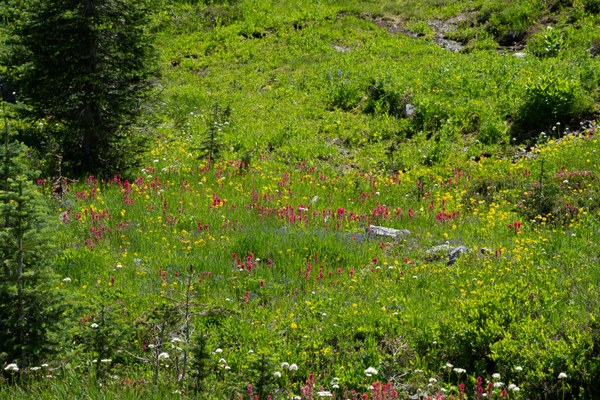
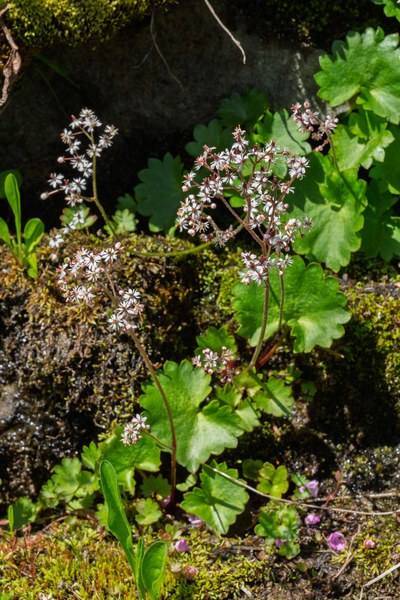
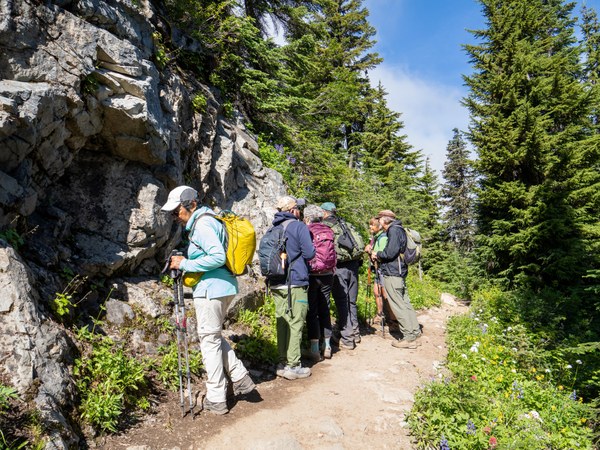
The trail worked along the east side of Naches Peak, moving in and out of meadows, past open areas, along the edge of mountain hemlock groves that waved back and forth in the light breeze. Water seeped out of places in the hills, providing ideal conditions for water-dependent species. I waited for Cristy Del Alma to catch up; she had been keeping our plant list for the day, and I’d hoped she’d confirm my identification. She walked up, calmly said, “Oh, good, brook saxifrage.” Open areas were full of Arnica, pasqueflowers, paintbrush, and lupines.
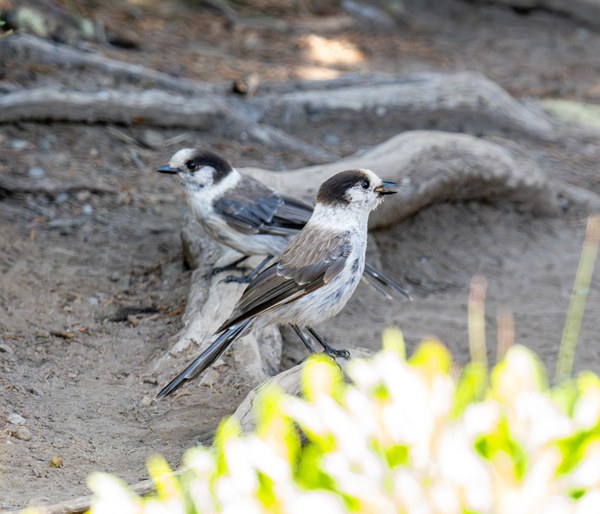
Several birds flitted from mountain hemlock clump to other clumps, never giving us much of a chance to see them. Laura Brou had been tracking our birds. Chipping sparrows and several dark-eyed juncos were busy finding something to eat. We’d heard Clark’s nutcrackers, Steller’s, and Canada jays and seen a few robins. Laura’s and Cristy’s keen ears were picking up things I’d missed, including waxwings, two warbler species, pine siskins, and western tanagers. I’d not brought my binoculars, trying to save on weight, and was now feeling naked. It was terrific that Laura could keep the bird list for our hike.
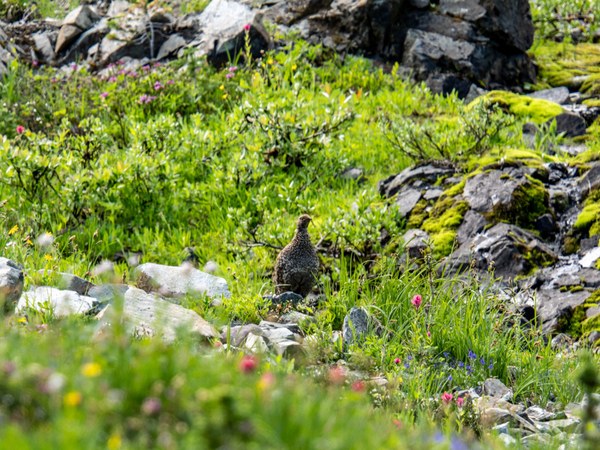
Jeff Brennan was a little way ahead and waved me to come. He pointed across the meadow on the uphill side. “Is that a grouse?” His directions were perfect, and I spotted a dark object on a rock just where the slope twisted left and began to rise more steeply. I used my camera, getting a photo and then blowing it up ten or more times on the back screen. The enlarged photo was grainy and lacked detail, but the shape was a grouse standing on a rock. Sooty grouse are the species in this habitat, and Laura and Cristy heard one drumming in another place. The find was a remarkable spot. He showed the bird to other groups that passed. It was great fun.
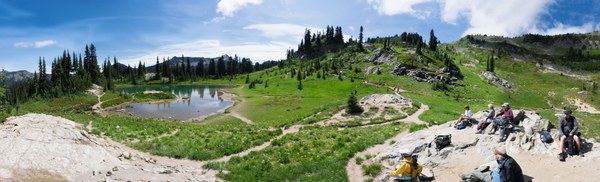 It was about time for a mid-morning snack, and my goal was a rock outcrop on the downhill side of a small tarn. The panorama was spectacular, revealing the geology of this landscape. We sat on exposed rock, well weathered by many hikers who had used this same place for a short rest. I was unsure about these rocks; Zentner had come to this place to look for a granite outcrop from the Tatoosh Pluton. Was that what we sat upon, possibly harder rocks than the Ohanapecosh granodiorite? I ran my hands across the rocks, unsure of how to convey my thoughts and wishing we could teleport Nick Zentner in for a few minutes. I looked at my watch and apologized to the group that I had set the wrong time for Zentner to meet us here. Everyone chuckled. We all wished he was coming.
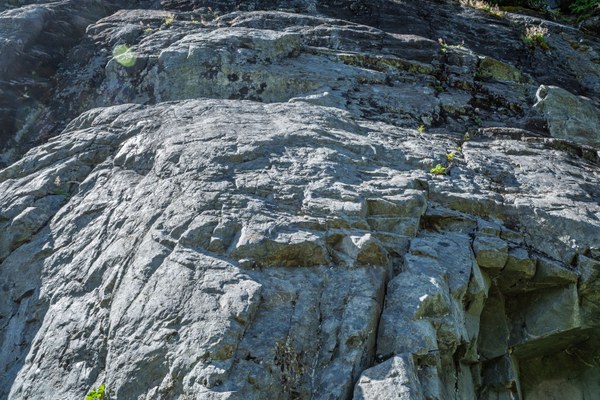
A small, shallow tarn covered an acre in front of us. The slope above showed the signs that a glacier had formed there, carving the tarn before hitting the harder rocks where we sat. Behind us, to the north, another depression in the ridge showed where a glacier there had formed and went down the slope behind us, carving rocks as it went, never forming a tarn presumably because it never hit rocks too hard to be carved. So much had taken place here in the last 20 or more millennia, and now we had all these flowers. As we hiked past the rock face, Richard pointed out the scrape marks in the rocks that showed where ice had slid across them, any rocks embedded in the ice would act like a razor blade drawn across a wooden table. I stood for a few seconds, trying to fathom the force that had pushed down on those igneous rocks.
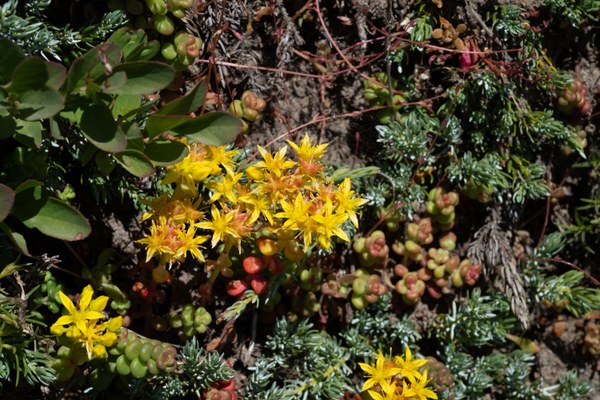
After we passed where the Pacific Crest Trail turned east to drop to Dewey Lake, we left the William O. Douglas Wilderness to reenter Mount Rainier National Park. Yellow sedum grew on rock outcrops that the trail hugged close. A succulent kind of flower that always seems to grab my attention. I’d yet to figure out why it draws me so much. Is it the texture and indication that it can survive harsher conditions, places with little moisture, and then it gives us that beautiful five-petal yellow flower?
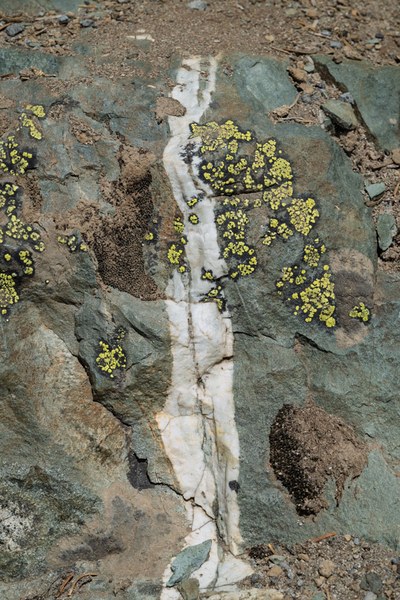
A white line, an inch or two wide, that ran vertically through the rocks made me stop. The yellow map lichens beside it were gorgeous, but it was the white rock that fascinated me, quartz. Richard walked up beside me, and I stepped aside with a slight glance at him, a nod from each of us said more than I hoped. He leaned in, running his fingers down the quartz vein and explained. Tectonic forces are powerful and will crack even the most complex rock. These cracks fill with seepage, and that water is often high in silica. The silica precipitates out when the pressure and heat lessen, forming these quartz veins. It is a crystallization process. I smiled and had to touch the rocks again, causing a few people to step back slightly. This information was new to me. It is why I lead: to learn from others.
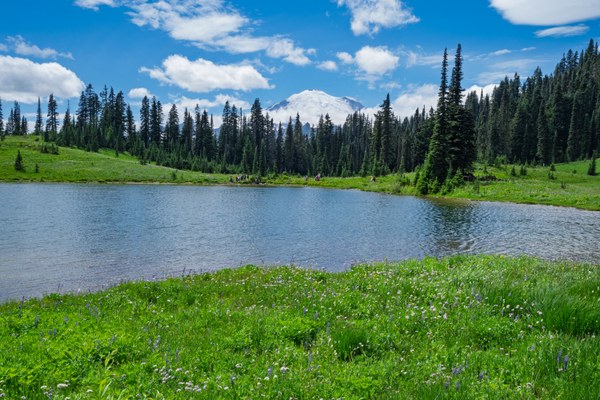
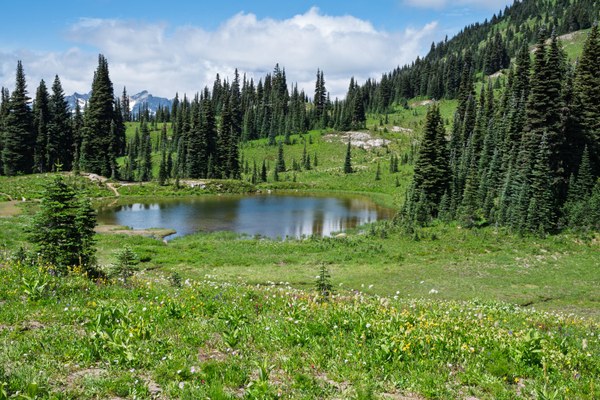 A small tarn on the westside of Naches Peak and the subalpine meadow loaded with flowers.
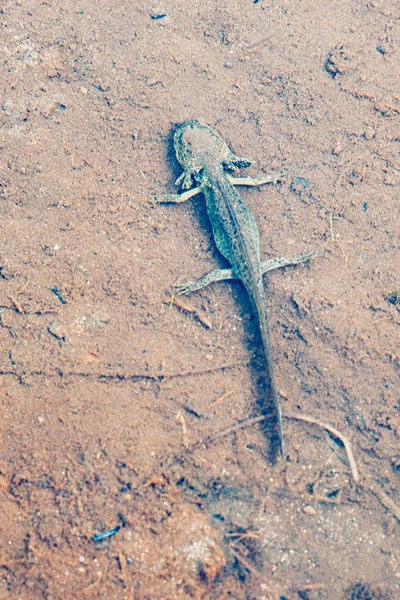
A rock outcrop on the south side of Naches Peak should have given us a view of Mount Rainier, but clouds obscured it. The view across the flower-dominated meadow and a small tarn was still gorgeous. The trail dropped down to the bank above the tarn. Two salamanders lay on the bottom, a dozen feet out; their shape was precise in the water. Both had gills and appeared to be about half a foot long. Back in Seattle, I checked on the species. These are northwestern salamanders, Ambystoma gracile, and in these high elevation tarns, they maintain gills when sexually mature. The Washington Department of Fish and Wildlife requests that observations be shared, so I submitted our sighting and a photo. Populations of this species are considered secure in Washington by NatureServe, but climate change and introduced trout threaten them.
This Timelapse, about 40 seconds long, is based on twenty minutes of time while we enjoyed our lunch.
A log on a small knoll along the west side of Naches Peak was perfect for lunch. We spread out, looking west toward Mount Rainier. Clouds moved left to right across the summit, which was primarily obscured. The concept of prevailing winds off the Pacific, bringing moist air to the west slope of the Cascades, was happening right in front of us. I set my camera on a tripod and began taking images that would allow me to create a slow-motion video of the clouds. The question, hot and center, was whether we would see the summit!
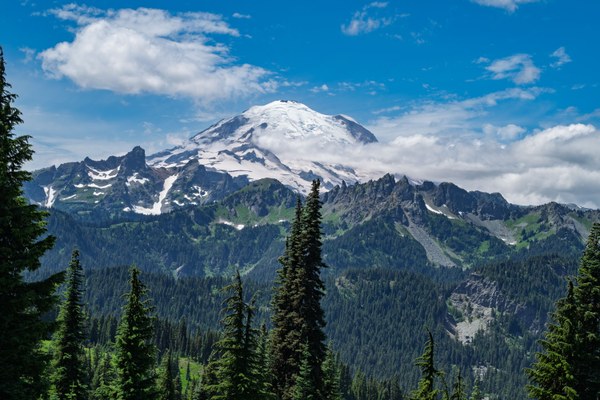
As we started down the trail toward Tipsoo Lake, the clouds parted from Mount Rainier, giving us a beautiful view of the volcano. Closer to us and a little to the left were the Cowlitz Chimneys; the highest one rising into the blue along the volcano's southern flank. In front of the chimneys and a little to the right was Governor’s Ridge. I pointed to the Cowlitz Chimneys so everyone might notice them. Geologists now think these might be remnant plugs from where the molten rock that created the Ohanapecosh Formation, where we’d been hiking all day, came to the surface. The activity was 28 to 36 million years ago. Incredibly, it was thought to have happened at sea level or even below sea level. Yet now the highest of the Cowlitz Chimneys is 7605 feet. The uplift since then has raised the Cascades. Mount Rainier, which is only 500,000 years old, is built on the base of previous volcanic activity.
The trail wound down the west side, giving us beautiful views of subalpine meadows in bloom and the mountain rising into the sky. We closed the hike by taking the trail around the backside of Tipsoo Lake, where we had a beautiful view of the volcano over the subalpine firs and the subalpine tarn.
Plant List for Naches Peak Loop Trail 27 July 2025 |
||||
| List developed by Cristy Del Alma and Patrice Carroll with help of everyone. | ||||
| Family | Common Family | Scientific Name | Common Name | |
| Ferns | ||||
| Dryopteridaceae | Ferns | Polystichum munitum | western swordfern | |
| Gymnosperms | ||||
| Cupressaceae | Cypress | Callitropsis nootkatensis | Nootka cypress, yellow cypress | |
| Cupressaceae | Cypress | Juniperus communis | common juniper | |
| Pinaceae | Pine | Abies lasiocarpa | subalpine fir, Rocky Mountain fir | |
| Pinaceae | Pine | Tsuga mertensiana | mountain hemlock | |
| Dicots | ||||
| Apiaceae | Parsley | Ligusticum grayi | Gray's licorice-root | |
| Asteraceae | Sunflower | Achillea millefolium | yarrow, gordaldo | |
| Asteraceae | Sunflower | Agoseris glauca | pale agoseris, false dandelion | |
| Asteraceae | Sunflower | Anaphalis margaritacea | pearly everlasting, western pearly everlasting | |
| Asteraceae | Sunflower | Antennaria alpina | alpine pussytoes, alpine catsfoot | |
| Asteraceae | Sunflower | Arnica latifolia | broadleaf arnica | |
| Asteraceae | Sunflower | Cirsium edule | edible thistle | |
| Asteraceae | Sunflower | Erigeron glacialis | subalpine fleabane | |
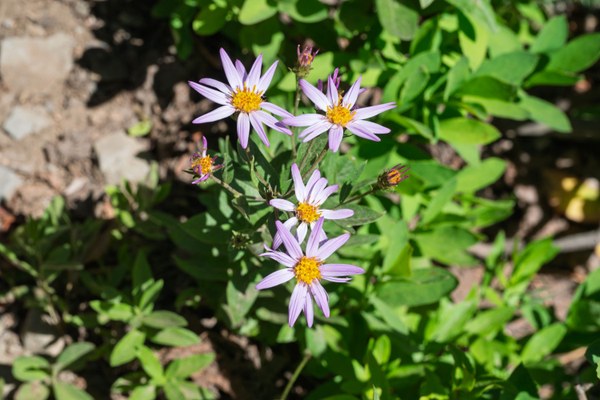
| Asteraceae | Sunflower | Eucephalus ledophyllus | Cascade aster | |
| Asteraceae | Sunflower | Hieracium albiflorum | white hawkweed, white-flowered hawkweed | |
| Asteraceae | Sunflower | Nothocalais alpestris | alpine false dandelion, smooth mountain dandelion | |
| Asteraceae | Sunflower | Rainiera stricta | rainiera, false silverback | |
| Asteraceae | Sunflower | Senecio triangularis | arrowleaf groundsel, arrowleaf butterweed | |
| Campanulaceae | Harebell | Campanula rotundifolia | harebell, bluebell-of-Scotland | |
| Crassulaceae | Stonecrop | Sedum oreganum | Oregon stonecrop | |
| Ericaceae | Heath | Cassiope mertensiana | white mountain heather, western moss heather | |
| Ericaceae | Heath | Phyllodoce empetriformis | pink mountain-heather, pink mountain-heath | |
| Ericaceae | Heath | Rhododendron albiflorum | white rhododendron | |
| Ericaceae | Heath | Vaccinium deliciosum | Cascades blueberry, blueleaf huckleberry | |
| Ericaceae | Heath | Vaccinium membranaceum | black huckleberry, thin-leaved huckleberry | |
| Ericaceae | Heath | Vaccinium scoparium | grouse whortleberry, grouseberry | |
| Fabaceae | Pea | Lupinus arcticus | arctic lupine | |
| Grossulariaceae | Currant | Ribes acerifolium | maple-leaf currant | |
| Onagraceae | Evening-Primrose | Chamaenerion angustifolium | fireweed | |
| Polemoniaceae | Phlox | Phlox diffusa | spreading phlox | |
| Polygonaceae | Buckwheat | Bistorta bistortoides | American bistort, western bistort | |
| Montiaceae | Claytonia | Claytonia cordifolia | heartleaf springbeauty | |
| Montiaceae | Claytonia | Montia linearis | narrowleaf miner's-lettuce, narrow-leaved montia | |
| Ranunculaceae | Buttercup | Aquilegia formosa | crimson columbine, western columbine | |
| Ranunculaceae | Buttercup | Delphinium menziesii | Menzies' larkspur | |
| Ranunculaceae | Buttercup | Pulsatilla occidentalis | western pasqueflower | |
| Rosaceae | Rose | Luetkea pectinata | partridgefoot, lutkea | |
| Rosaceae | Rose | Potentilla flabellifolia | fan-leaf cinquefoil, high mountain cinquefoil | |
| Rosaceae | Rose | Rubus lasiococcus | dwarf bramble, roughfruit berry | |
| Rosaceae | Rose | Sorbus sitchensis | Sitka mountain ash | |
| Rosaceae | Rose | Spiraea splendens | rosy spiraea, mountain spiraea | |
| Saxifragaceae | Saxifrage | Heuchera glabra | smooth alumroot, alpine alumroot | |
| Saxifragaceae | Saxifrage | Leptarrhena pyrolifolia | leatherleaf saxifrage, fireleaf leptarrhena | |
| Saxifragaceae | Saxifrage | Micranthes ferruginea | rusty saxifrage | |
| Saxifragaceae | Saxifrage | Micranthes odontoloma | brook saxifrage, stream saxifrage | |
| Saxifragaceae | Saxifrage | Micranthes tolmiei | Tolmie's saxifrage | |
| Saxifragaceae | Saxifrage | Pectiantia pentandra | fivestamen miterwort | |
| Orobanchaceae | Broomrape | Castilleja miniata | scarlet Indian paintbrush, giant red Indian paintbrush | |
| Orobanchaceae | Broomrape | Castilleja parviflora | mountain Indian paintbrush, magenta paintbrush | |
| Phrymaceae | Monkey Flower | Erythranthe lewisii | purple monkey-flower, Lewis' monkeyflower | |
| Orobanchaceae | Broomrape | Pedicularis bracteosa | bracted lousewort | |
| Scrophulariaceae | Figwort | Pedicularis ornithorhyncha | bird's-beak lousewort, ducksbill lousewort | |
| Orobanchaceae | Broomrape | Pedicularis racemosa | sickletop lousewort, leafy lousewort | |
| Plantaginaceae | Beardstonque | Penstemon serrulatus | serrulate penstemon, Cascade penstemon | |
| Plantaginaceae | Beardstonque | Veronica cusickii | Cusick's speedwell | |
| Violaceae | Violet | Viola palustris | marsh violet, alpine marsh violet | |
| Monocots | ||||
| Cyperaceae | Sedge | Carex spectabilis | showy sedge | |
| Liliaceae | Lily | Erythronium montanum | white avalanche lily, avalanche lily | |
| Liliaceae | Lily | Lilium columbianum | Columbia tiger lily, Columbian lily | |
| Liliaceae | Lily | Veratrum viride | green false hellebore, Indian poke | |
| Liliaceae | Lily | Xerophyllum tenax | beargrass, squaw grass | |
| Lichens | ||||
| Lichens | Lichens | Alectoria sarmentosa | witch's hair lichen | |
Birdlist created by Laura Brou
Observations
-
Number observed: 2Remove
-
Number observed: 1Remove
-
Number observed: 2Remove
-
Number observed: 2Remove
-
Number observed: 1Remove
-
Number observed: 2Remove
-
Number observed: 1Remove
-
Number observed: 3Remove
-
Number observed: 4Remove
-
Number observed: 1Remove
-
Number observed: 5Remove
-
Number observed: 1Remove
-
Number observed: 2Remove
-
Number observed: 31Remove
-
Number observed: 4Remove
-
Number observed: 14Remove
-
Number observed: 1Remove
-
Number observed: 1Remove
-
Western Tanager
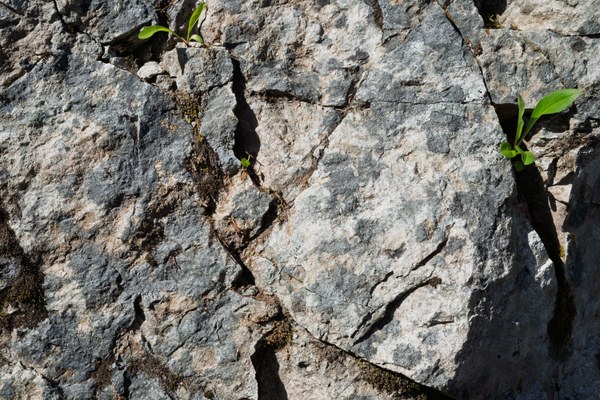
Breccia is the term used by geologists for when magma incorporates already solidified rocks into a flow.
Details
Saw 1; heard 1