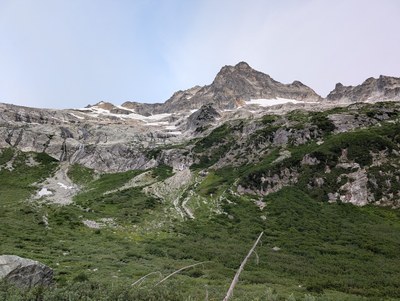
Trip Report
Basic Glacier Climb - Mount Logan/Douglas Glacier
Incredibly challenging and remote climb on a seldomly traveled route. Five star glacier route and scenery in the heart of the North Cascades and a one star, incredibly tedious bushwacking approach, resulting in a three star average for the route!
 Paul Wade
- Fri, Jul 25, 2025 — Sun, Jul 27, 2025
- Basic Glacier Climb - Mount Logan/Douglas Glacier
- Mount Logan/Douglas Glacier
- Climbing
- Successful
-

- Road suitable for all vehicles
-
- Fischer Creek Approach Trail in pretty good shape with some blowdowns, brush and occasional washed out sections along the way.
- Abundant water sources throughout the trip, minimizing the need to carry a lot of water.
- Good log crossing of Fischer Creek at 3900 feet, before the confluence with the creek draining the Douglas Glacier.
- First mile of off trail travel to the Douglas basin is open forest then relentlessly dense slide alder bushwacking for another mile to basecamp.
- Challenging, hard to protect 4th to low 5th class gulley to access the rock slabs leading to the Douglas Glacier.
- Douglas Glacier with open crevasses but overall straightforward route finding.
- Summit 3rd and 4th class scramble shared with the Banded Glacier route.
- Banded Glacier very broken up with a crevasse band and blue ice spanning most of the width of the glacier. Small ramp of passable snow on the climber's left side.
- Climber's trail from the Banded Glacier lower lake is very steep and faint, making it difficult to follow.
Our team of 5 climbers - Chris, Irina, Zacch, Phoebe and myself, tackled the seldomly climbed Douglas Glacier route on Mount Logan over a full value 3 day trip.
Leaving from the Easy Pass TH, we made good time up and over the pass and down the Fischer Creek valley to the point where we left the main trail to hike up to the Douglas glacier basin. There was a good log crossing over Fischer Creek at 3900 feet elevation, shortly before the confluence with the Douglas Glacier creek.
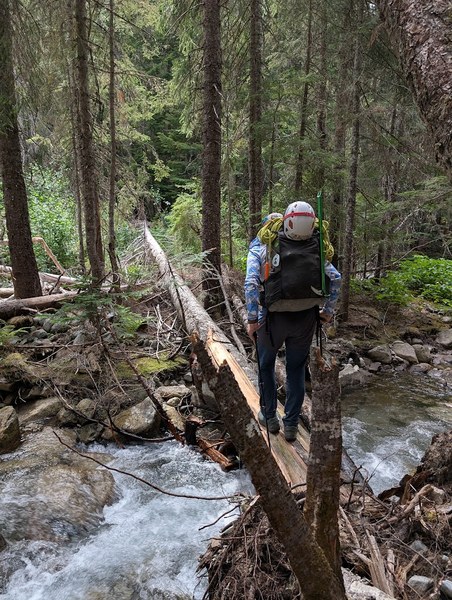
After crossing the creek, we traveled cross country through open forest for about 1.5 miles, staying close to and on the east side of the Douglas Glacier creek. Eventually, the forest ended at the base of a giant avalanche slide path, where an endless thicket of slide alder had grown in for about the last mile to the Douglas Glacier basin, where we would camp. In more than 20 years of climbing, this is the longest and most relentless amount of bushwacking I've experienced. It was a combination of very dense slide alder, closely spaced cedars, devil's club, logs and boulders. We followed dry creek beds, walked in the creek and crossed boulder fields when we could but, mostly, we just plowed our way through using just stubborn determination and hard-headedness. It took more than 3 hours to cover this last mile to the basin, where we found some flat ground to set up camp.
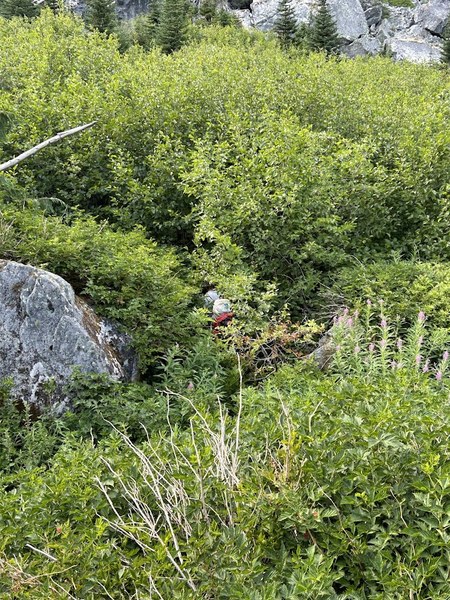
None of us looked forward to repeating that extreme bushwack on the descent, so we agreed to alter our trip plan and summit the next day with a carryover and descend via the Banded Glacier route.
The next day, we set out early to climb the Douglas Glacier. We identified a gulley on the west side of the basin that looked to provide access to the upper rock slabs leading to the base of the glacier. We followed a dry creek bed across the basin and scrambled a scree field to the base.
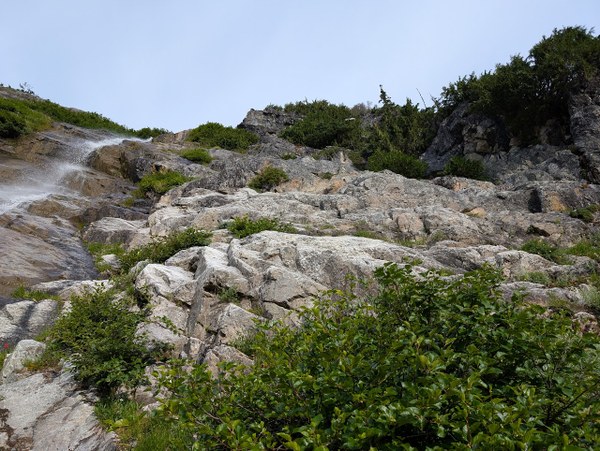
The gulley started out as 3rd class climbing but quickly turned to 4th and low 5th class climbing for a short distance. With limited options for placing pro, I climbed past the difficult section and anchored a hand line from a tree to protect the rest of the team. We used one more hand line to reach the top of the gulley, crossed above a waterfall and reached the glacier polished slabs. We scrambled slabs for another 1500 vertical feet before reaching the toe of the Douglas Glacier, where we roped up.
There were numerous crevasses opened up on the glacier, but route finding was generally straight forward.
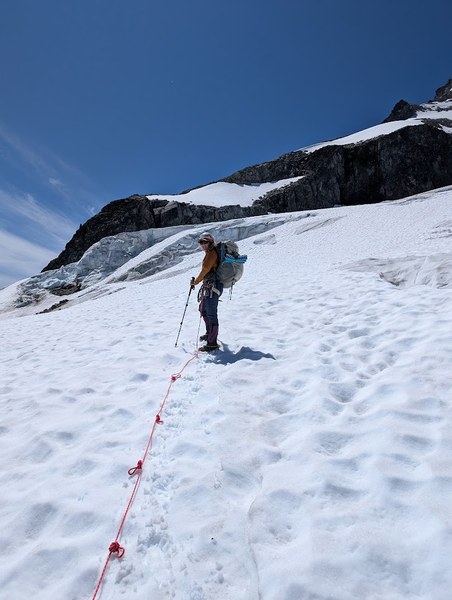
We followed the glacier up to a saddle on the NE ridge of Logan where it meets the Banded glacier. From there, the routes merge and we climbed another 200 vertical feet on the Banded glacier until we regained the NE ridge higher up. From there, it was a little over 300 vertical feet of 3rd and 4th class scrambling to the summit.
After re-roping up, we began our descent down the Banded glacier. The glacier was heavily broken up in places with a lot of blue ice exposed. Since we hadn't ascended the route, route finding was challenging. There was a band of crevasses and exposed ice spanning most of the glacier about midway down. We ended up down traversing through a section of ice to regain snow below this band. Later, once off the glacier, we could see a small ramp of intact snow on the far climber's left that bypassed this crevasse band.
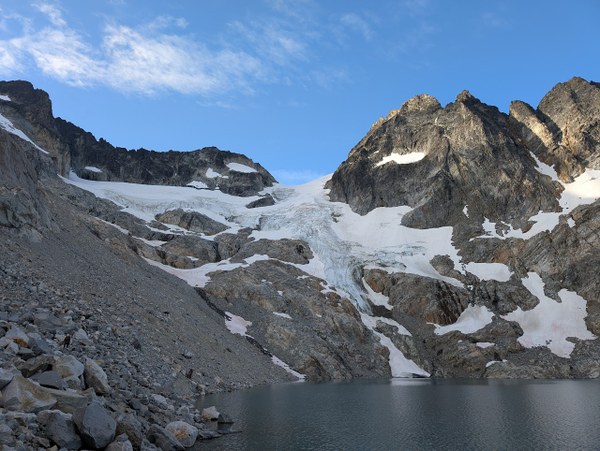
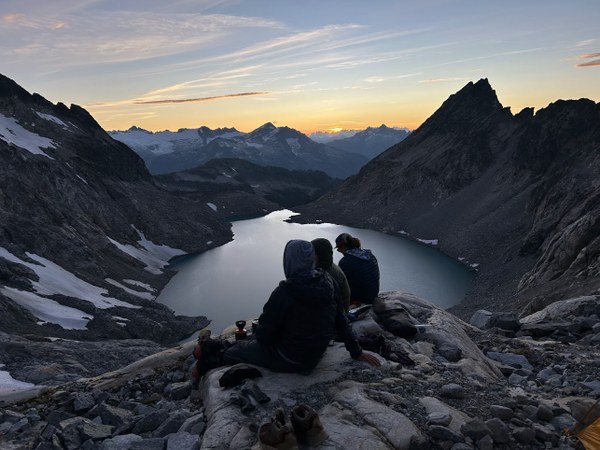
After a long day with a lot of vertical gain, route finding challenges, climbing and descending two glaciers, and significant scrambling, we determined that we might not make it to the lower lake camp before dark, so we decided to camp at the upper lake. We had done the climb as a carryover, so we had everything we needed to camp. We found some flat slabs and enjoyed a spectacular sunset.
On our final day, we packed up early and began our descent of the Banded Glacier route. From midway down the upper lake, we climbed a fan of scree up to the notch in the north ridge, descended a small glacier on the other side, then followed slabs and another long gulley 1800 vertical feet down to the lower lake camp. From the lower lake, there was a faint, hard to follow, steep climber's trail that dropped another 1400 vertical feet down until reconnecting with the Fischer Creek trail. Once on the Fischer Creek trail, we switched back into trail runners and started the 7-8 mile hike back, climbing another 3000 vertical feet back to Easy Pass, before descending the same amount back down to the trailhead.
Thanks to having a great team, who kept positive attitudes despite the non-stop challenges and obstacles on this trip, we were able to adapt on the fly and complete this epic climb while still having a great time together. Given the limited beta, numerous obstacles, wide variety of skills needed, and time consuming nature of the climbing, I would not consider this a typical basic climb and think it fits more as an intermediate climb in its current state.