Trip Report
Basic Glacier Climb - Mount Baker/Coleman Glacier
Successful summit of Mount Baker via the Coleman-Deming route with the Everett Mountaineers as the graduation climb for BCC. Camped at Black Buttes (7,150 ft) after a whiteout approach on Saturday; summited Sunday morning in clear, cold conditions with firm snow and minimal wind. Glacier travel was straightforward on excellent firm snow; total time from camp to summit was 5 hours.
 Dmytro Gaivoronsky
- Sat, Jun 14, 2025 — Sun, Jun 15, 2025
- Basic Glacier Climb - Mount Baker/Coleman Glacier
- Mount Baker/Coleman Glacier
- Climbing
- Successful
-

- Road rough but passable
-
The Heliotrope Ridge Trail was completely snow-free up to ~5,000 ft due to accelerated melt. Above that, patchy snow remained firm and well-traveled. Flowing water was easily accessible near Hogsback (~5,700 ft), eliminating the need to melt snow on the approach.
We transitioned to mountaineering boots at 5,700 ft and began glacier travel shortly thereafter. From Hogsback to Black Buttes camp (7,150 ft), the Coleman Glacier was in good condition but showed signs of seasonal change. Thin crevasse lines were visible across the bootpack; while we remained unroped on the approach, we reassessed and roped up for all glacier travel on summit day.
The climb via the Coleman-Deming route had firm, supportive snow with no postholing. We stayed well left of the Colfax seracs and witnessed an active ice/rock fall around 4 a.m., highlighting the importance of route choice. The Roman Wall had multiple usable boot paths and was in good condition for step-kicking.
Seasonal warming is accelerating snowmelt and crevasse development; conditions will likely become more hazardous in the coming weeks, especially near serac zones and on the upper glacier.
(GPX track for this climb is available at the Peakbagger and Strava).
A successful weekend summit of Mount Baker via the Coleman-Deming (CD) route with the Everett branch of the Mountaineers. Our original objective was Colfax Peak, but recent trip reports noted newly opened crevasses along the standard route, prompting us to shift our objective to Baker. Saturday brought whiteout conditions, but Sunday rewarded us with clear skies, crisp temps, and minimal wind—an overall excellent climb.
This was my third trip to Mount Baker’s glaciers, having practiced on Easton and summiting Sherman Peak via Squak in the preceding weeks. With a better sense of the route conditions and required gear, I was able to streamline my pack weight to 33 lbs before food, water, and rope. Based on recent beta from SummitPost and Peakbagger, I opted to approach in backpacking boots (Lowa Renegade) and strap my mountaineering boots to the pack. Final pack weight at the trailhead was 44 lbs with all supplies and boots attached, though there's still room to refine.
Saturday — Approach to Camp
Our group met at the Heliotrope Ridge Trailhead (3,670 ft) at 9 a.m. After a short debrief, we began the approach toward Black Buttes camp. Recent reports had indicated snow around mile two, but the trail was completely snow-free up up ~5,000 ft due to accelerated melt. Even above that, patchy snow remained well-tracked and firm. I switched to mountaineering boots only around 5,700 ft at 3 miles as we ascended past Hogsback and onto the Coleman Glacier.
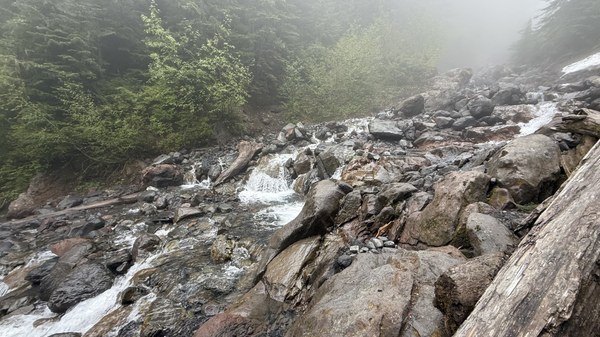
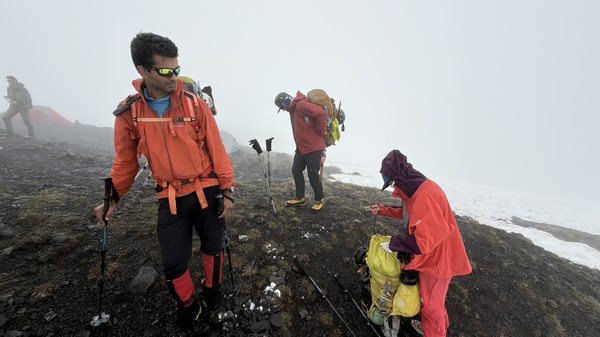
Whiteout conditions persisted throughout the approach, with temps in the low 40s. It was a calm, slightly surreal experience—“like walking inside a ping-pong ball”, as teammate puts it. We passed several teams descending from the summit who reported clear skies above 7,500 ft. A party returning from Colfax mentioned a newly opened crevasse on their route, validating our decision to pivot to Baker. With this being a graduation climb for Basic students, most of us needed miles on glacier more than technical complexity of the route.
We arrived at Black Buttes camp (7,150 ft) in the afternoon and settled in by 7 p.m. after the usual rituals of snow melting and dinner.
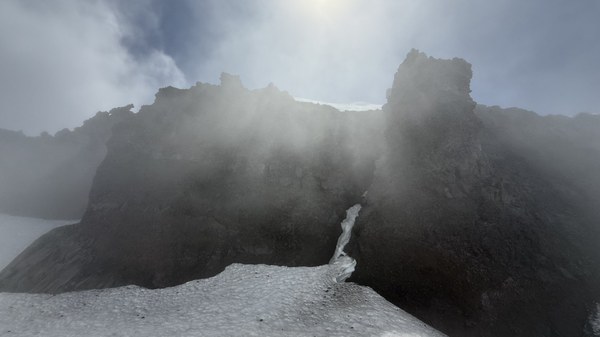
Sunday — Summit Day
Alarms went off early, and we had boots on snow by 2 a.m. As we roped up, we saw several other groups beginning their climb from Hogsback and nearby camps, all heading up the CD route. Overnight skies had cleared, and temps hovered in the low 30s at camp, dropping to ~25°F during the ascent and ~15°F windchill near the summit.
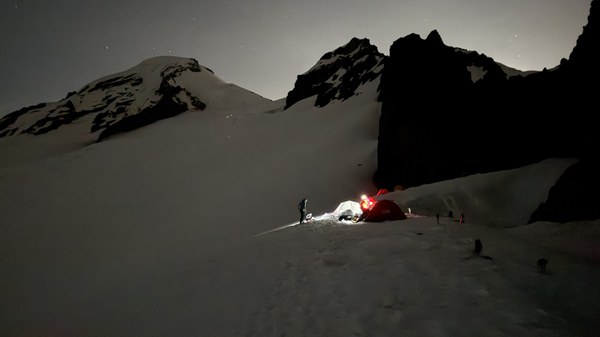
Snow conditions were nearly perfect: firm and supportive all the way to the top, with zero postholing. We climbed in two rope teams of four, staying well left of the Colfax seracs along the right edge of the route. Around 4 a.m., we witnessed an ice/rock fall off the northern seracs—a sobering reminder of the mountain’s hazards.
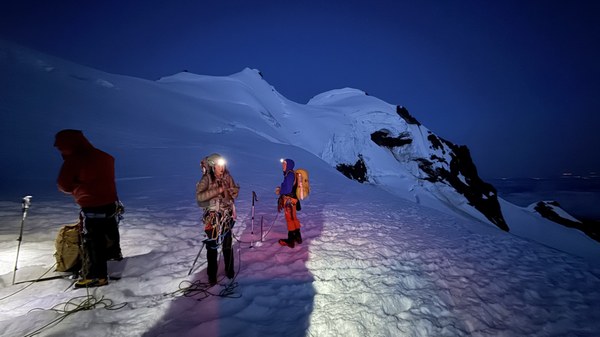
The Roman Wall presented a minor bottleneck, with multiple teams navigating slight variations in the main boot path around 10,500 ft. None appeared to struggle significantly, regardless of their chosen line. We intentionally chose a couple of slightly steeper sections to practice step-kicking and low-dagger axe technique on hard snow.
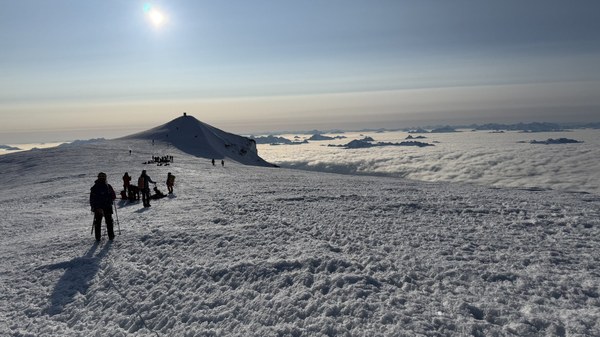
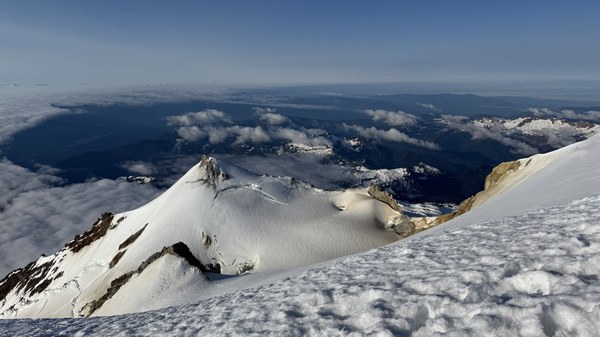
We reached the summit at 6:52 a.m. after a 5-hour climb. Following a short break with incredible views, we began the descent. The sun was intense by the time we reached camp, but the snow held up surprisingly well. Even during our final descent around noon, we avoided postholing and were treated to classic PNW corn for most of the way down.
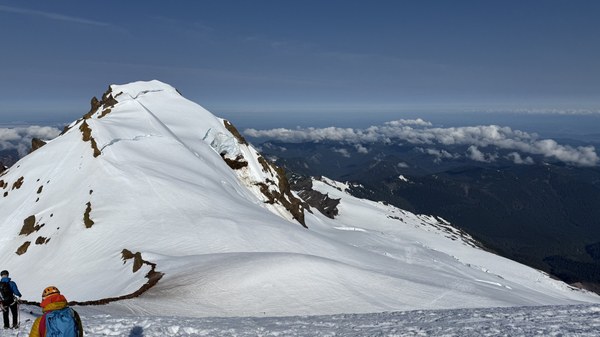
We returned to the trailhead by 3 p.m., closing out this very satisfying climb.