Trip Report
Basic Glacier Climb - Little Tahoma/East Shoulder
This was a 2-day climb that utilized the Meany Crest camp within the Little Tahoma Alpine Zone.
 Carolyn Graham
- Fri, Jul 4, 2025 — Sat, Jul 5, 2025
- Basic Glacier Climb - Little Tahoma/East Shoulder
- Meany Crest
- Climbing
- Successful
-

- Road suitable for all vehicles
-
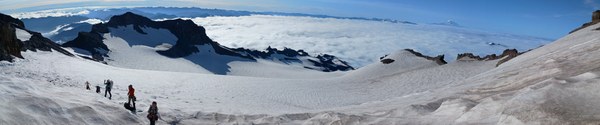
View from the bottom of the steep snow on Little Tahoma.
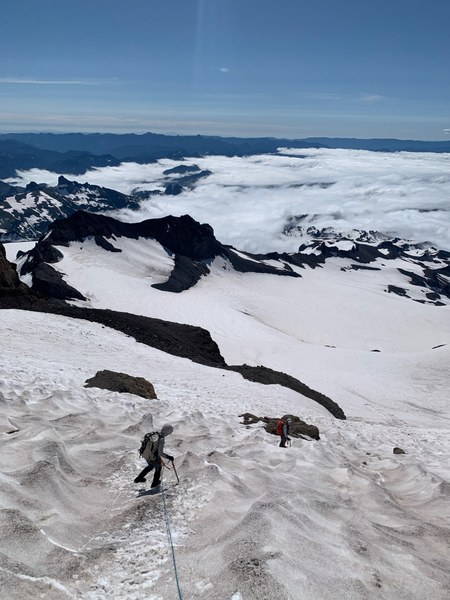
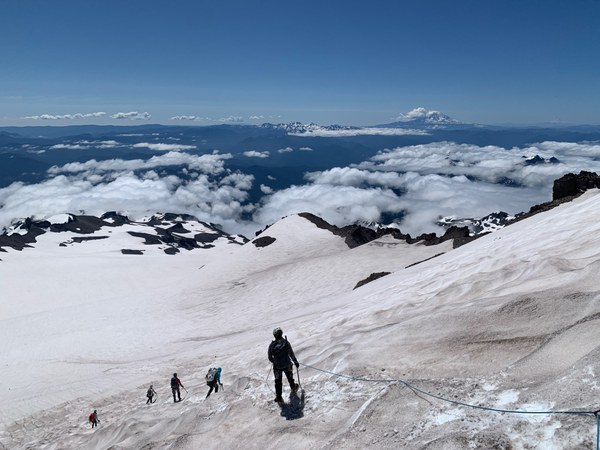
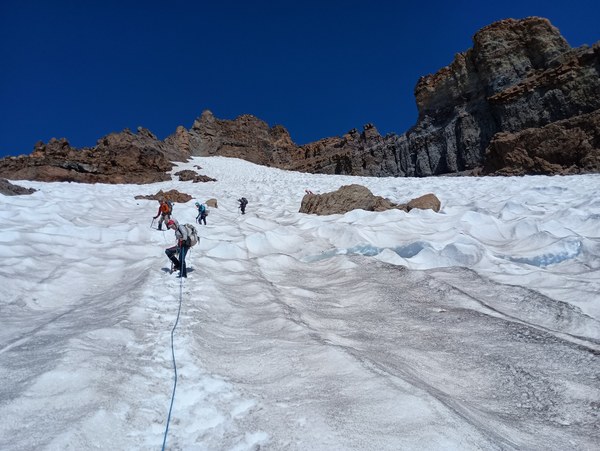
Descending the steep snow.
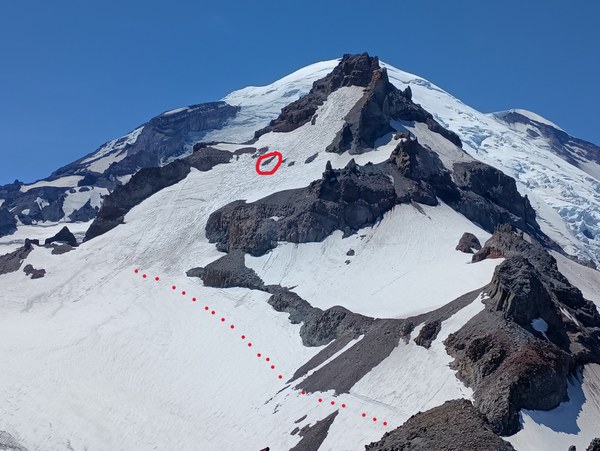
View of our route from the summit of Whitman Crest.
July 4-5, 2025
Primary objective: Little Tahoma via E Shoulder (turned around)
Secondary objectives: Meany Crest (achieved), Whitman Crest (achieved)
Party Size: 6
Gear carried on climb: 2x40m ropes, 6 pickets, 1 BD Venom with hammer (for pounding pickets in), 3 cordalettes, 4 cams
Everyone: ice axe, crampons, mountaineering boots, helmets, standard glacier gear
Gear Used on climb: all of it except the cordalettes and cams
Day 1 (Friday July 4, 2025)
8:30 AM - Met at White River Wilderness Information Center (ranger station) and obtained climbing permit (there was no line of any significance to wait in, leader had purchased an overnight reservation for Little Tahoma Alpine Zone in advance at Recraction.gov). Then we sorted/transferred gear at the RS parking lot.
10 AM – started hiking from Summerland TH
Around noon: stopped at Summerland group shelter for longer break (it was lunch time)
It was cross country travel on a mix of snow and rock from Summerland to camp. Snow firm but we managed to select a route that did not require crampons (used ice axes and helmets and gloves). Travel on snow-free rock ribs was preferred on ascent.
Dropped packs at saddle and tagged Meany Crest.
3:20 PM – arrived at Meany Crest 7500’ camp, which was snow free. The best camp spot was protected by a couple large boulders and rock walls. We managed to fit 2 bivy sacks and 4 small tents in that area. The obvious water source coming off the toe of the Frying Pan glacier was available nearby.
Day 2 (Saturday July 5, 2025) – overnight freezing elevation was forecasted for 11.5k
2:25 AM – alarms set for this time
4 AM – started ascending Frying Pan glacier (roped-up), no boot path to follow in snow. Used 260 degree bearing per Basic Climb’s Guide route description.
7 AM – departed 9k rock notch (took a break here first, stayed roped up)
7:45 AM at base of steep snow (9500’).
Steep snow above was very textured with mogul sized suncups. For lower portion, the angle looked moderate and there were no objective hazards in the fall line. If you slipped on a mogul step, you’d land in a suncup where you’d stop. There appeared to be a bench and some rock islands higher up where the angle steepened, per the topo lines and Gaia slope shading. From the bottom of the steep snow to the rock islands, we stayed roped up with spacing per glacier travel mode. Rope arrangement was 2 teams of 3p on 40m ropes, with first person tied in 13.3m from end, with 13.3 spacing between each person. First person carried 13.3m (in coils or in backpack).
About half way to the rock island the slope steepened. Leader for first team placed at least 4 pickets at 26m spacing to get everyone to next flat-ish spot. At this reset location, leader of first rope team took all 6 pickets and used these to get both teams to a rock island at about 10,200’. There was a bergschrund starting to open not far below the rock island. The team ascended to the left of the bergschrund. This presumed snow bridge (looked solid) was protected with pickets. The rock island the team rested on was on the right side of the ascent line.
9 AM – second team arrived at rock island and discussed the conditions and whether to continue. Everyone wanted to continue.
The snow at this point was starting to soften a bit on top, but the top crust was still very hard. Driving the spike of the axe into snow for self-belay was still not feasible most of the time. Pick of ice axe in low dagger position had been used for balance getting up the large steps in the suncups. Looking down from the rock island, the grade allowed for a mostly face-out descent with flat footed cramponing (if you had the skills to do this). The suncups mitigated how far you would fall if you slipped.
Everyone in the group was comfortable continuing. The leader headed up from the rock island with 6 pickets, placing pickets at 26m, spacing. The snow above also had large suncups the size of moguls, but the grade soon changed such that the suncups did not provide sufficient flatness to mitigate a slip. The leader found a sufficiently flat suncup where everyone could easily and comfortably stop in one place. There was more discussion on whether to continue. It was 10 AM the leader made the decision that the team would turn around here (location corresponded to the 10,280’ contour elevation in Caltopo, based on gpx track, which was about half way up the steep snow based on our view later that day from the summit of Whitman Crest).
On descent pickets were again placed through the 2 steeper sections, which included protecting the bergschrund. The snow was still firm and not plunge step-able, but possible to descend facing out flat footing with crampons. It was possible (with effort) to get the spike of the axe into the snow to allow for a measure of self-belay on the steep suncup steps.
Most of the pickets on ascent and descent required being pounded in with the hammer the leader carried for this purpose.
Summary for steep snow:
7:45 AM to 10 AM - ascended from 9500’ to about 10,200’ (700’)
10 AM to 11:30 AM – descended from 10,200 to 9500’
12 noon – arrived at 9000’ notch where we crossed paths with 3 climbers who had departed from the trailhead earlier that day, intending to climb Little Tahoma (the steep snow may have been soft enough by this point to climb most or all if it without protection; we did not have the benefit of a second night at Meany Crest camp to utilize this timing)
12-12:45 took a longer break at 9000’ notch and decided to climb Whitman Crest on the way back to camp. Other participants were encouraged to take the lead navigating the team to Whitman Crest and from Whitman Crest back to camp.
2:15 PM - arrived at summit of Whitman Crest where we had spectacular view of Little Tahoma and the steep snow we’d ascended earlier in the day.
4 PM - arrived back at camp and packed up
4:45 PM – departed camp
7:45 PM arrived at TH
This is a beautiful area that felt very remote. After leaving the Summerland shelter, we saw nobody other than the 3 climbers we crossed paths with at the 9000’ notch. There was no climbers’ path to the Meany Crest camp. There was no boot path in the snow from camp to the 9000’ notch or from the 9000’ notch leading up the steep snow toward the summit of Little Tahoma.
Weather forecast for July 4 was for mostly sunny conditions, dry. The July 5 weather forecast was for sunny conditions, dry.
Actual Weather: July 5 there were high clouds when we arrived at Summerland. Cloud deck lowered and we were in the clouds when we arrived at camp and through the evening. July 5 the stars were out when the we awoke to get ready to climb. We enjoyed 100% sunny conditions throughout our climbing day. From the Whitman Glacier we could see a morning cloud layer below us - the summits of Adams, Hood and other high points were poking above the clouds. As we were descending from camp toward Summerland, a layer of high clouds had moved in, partially obscuring Mt Rainier.
Trip stats per Garmin watch gpx imported into Caltopo: 17 miles, 7000’ gain