Trip Report
Alpine Scramble - Chutla, Eagle & Wahpenayo Peaks
Fun technical rock, a bit of bushwhacking, and a lot of fall colors. A great way to spend an early fall weekend.
 Emma Meersman
- Sun, Sep 28, 2025
- Alpine Scramble - Chutla, Eagle & Wahpenayo Peaks
- Chutla, Eagle & Wahpenayo Peaks
- Scrambling
- Successful
-

- Road suitable for all vehicles
-
Lovely trail up to the Eagle/Chutla saddle. There are a few branching routes up to the top of Eagle so it was helpful to have seen images of the correct path beforehand. The ridge up to Chutla requires a bit of patience and liberal use of veggie belays.
Getting from the Eagle/Chutla ridge over to the saddle before Wahpenayo was the biggest routefinding challenge of the day. We traversed an unstable talus field below cliffs with risk of rockfall. The route requires traveling below those cliffs but we could have dropped lower to move more efficiently on the talus.
The climber's trail up the ridge to Wahpenayo was fairly easy to follow, though we encountered some steep/loose terrain as well as some slippery pine needles on a few exposed moves.
No water on the trail apart from a trickle on the trail at 4400'. Smoke rolled in right as we summited Wahpenayo (our last peak). Throughout the day, we found a few late-season blueberries for trail snacks. We also saw a bear far below us from the summit of Wahpenayo.
Our group of six started from the Longmire parking lot just after 7:30am. We traveled at an efficient pace (including quick breaks for food and water) until reaching the end of the maintained trail at the Eagle/Chutla saddle around 9:30am.
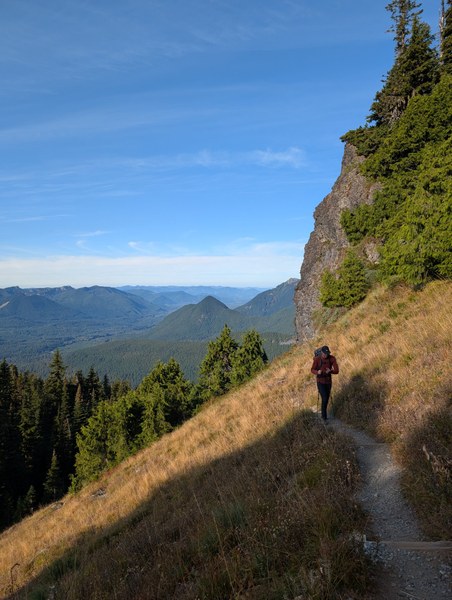
From here, we donned our helmets and headed toward Eagle. It was helpful to have researched pictures and videos of the ascent route instead of relying solely on GPX tracks. There is a gully towards the beginning of the route that appears to be well-trafficked. Instead of ascending this, we cut to the left, dropped down about ten feet, and found the actual trail.
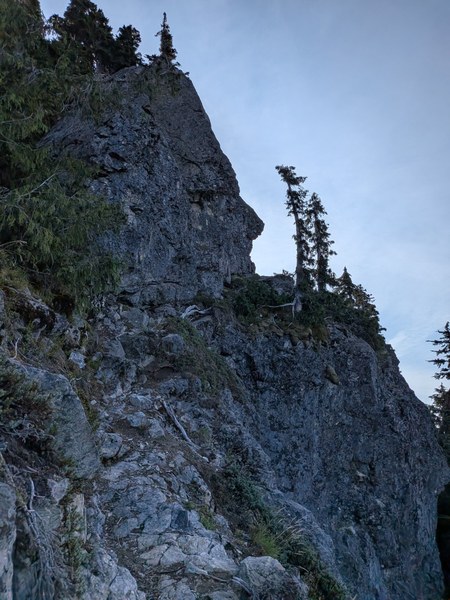
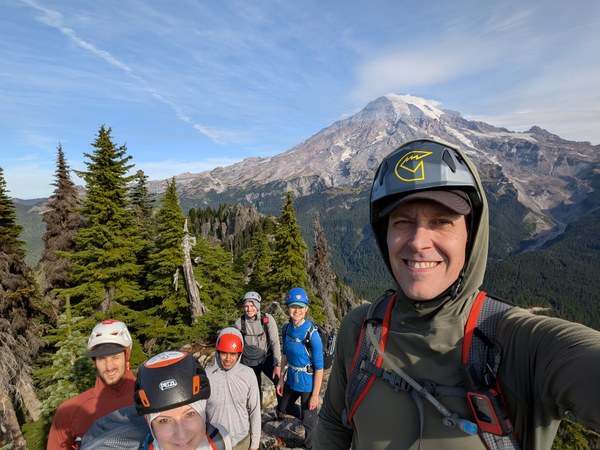
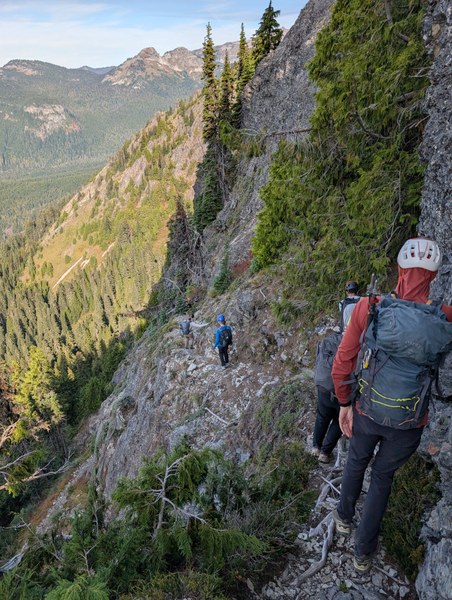
The route involves sustained class 3 rock scrambling while ascending diagonally on a ledge. The crux move is a step on the ledge where it is difficult to see optimal hand and foot placements. This was slightly harder on the descent and it helped to coach one another through it. We reached the summit of Eagle just after 10am and took a quick break for photos. We were back at the saddle around 10:30am and continued on the ridge towards Chutla.
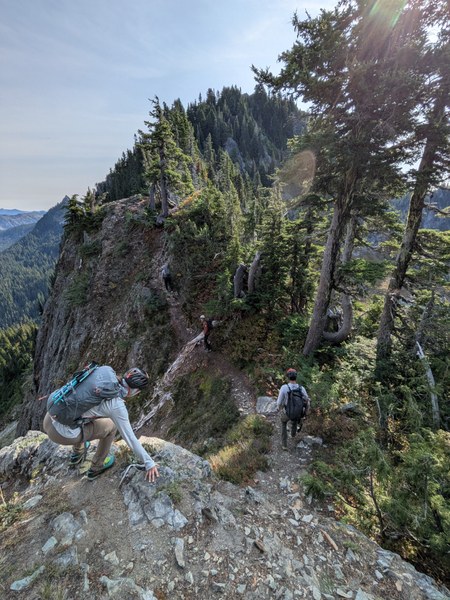
The approach to Chutla was fairly straightforward, though slightly more technical than expected. There wasn't much exposure but there were a few places where we needed to ascend steep sections of rock or roots. We left the summit of Chutla around 11:15 and descended part of the ridge until leaving it for the traverse to the Wahpenayo trail.
We left the ridge at the same place as described in other reports, though we had trouble finding a clear climber's trail until we left the trees. We emerged into a heather meadow around 5600' and descended a faint trail until starting to traverse towards Wahpenayo around 5400'. We knew that we needed to continue traversing at approximately that elevation in order to meet up with the Wahpenayo climber's trail. This involved crossing a loose talus field and sidehilling on more heather. It was difficult to see any tracks on the talus field, which was located below a series of cliffs. This was a risky part of the route due to rockfall danger and unstable footing.
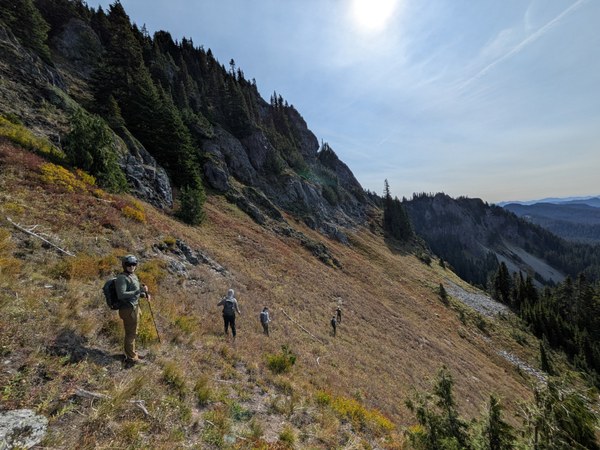
We finally found the Wahpenayo climber's trail around 5400' and climbed up to the saddle at 5600'. From that point, we followed the trail SE along the ridge to Wahpenayo. The route turns sharply to the NE at 6100' for the last part of the ascent to Wahpenayo. This part of the ridge is fairly technical and involves some class 3 scrambling (ascending and descending along the ridge) before the true summit. We also encountered some slippery pine needles covering the rock on some of these moves, which added another dimension of risk.
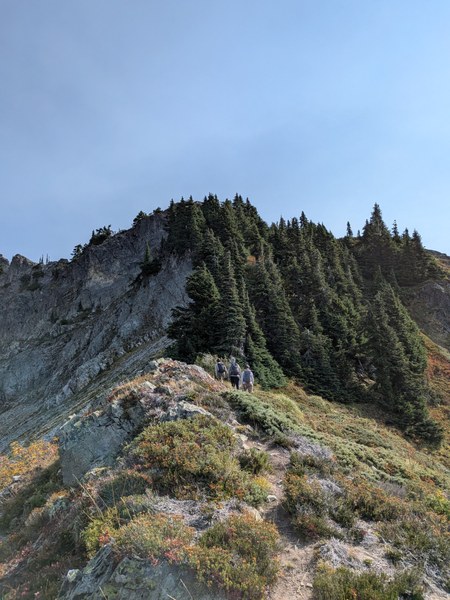
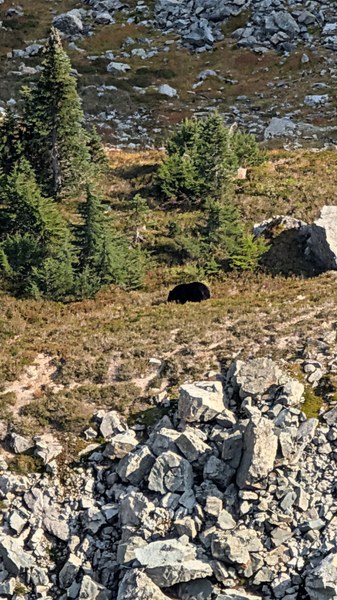
We reached the Wahpenayo summit by 1:45pm. The forecast had mentioned a chance of smoke beginning at 1pm and we were starting to smell it. We took a nice break at the summit, saw a bear in the heather fields far below, and started our descent. It was easy to locate the climber's trail leading back to the junction with the Eagle Peak trail at 5000'. Here we removed our helmets and rested before the final push back to the cars.
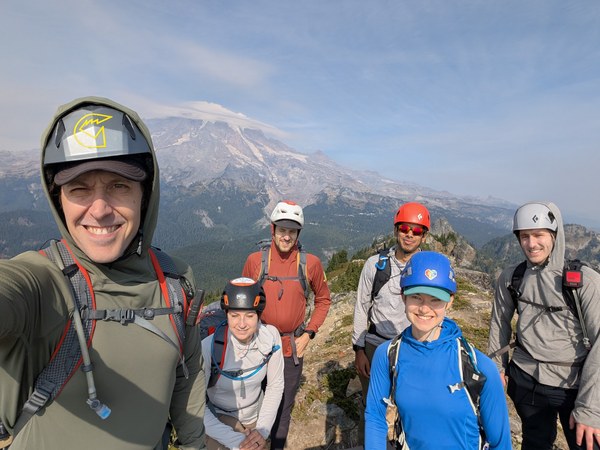
Total trip stats were 9 hours car to car, 10.8 miles, ~4400' elevation gain, and three fun peaks.