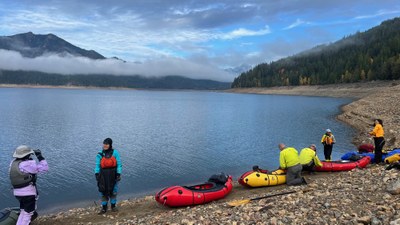
Field trip: Introduction to Flatwater Packrafting
Flatwater Packrafting Course: experience trip - Little Kachess Lake
The final outing of the Introduction to Flatwater Packrafting Course will provide students the opportunity to do an overnight packrafting trip and learn new skills related to hiking and paddling with a loaded boat.
Contacts

- Sat, Oct 4, 2025 — Sun, Oct 5, 2025
- Seattle Packrafting Committee
- Packrafting
- Adults
- Class 0 Still Water, Class I River
- Moderate
- Mileage: 6.0 nm
- Elevation Gain: 200 ft
- FULL (6 capacity)
- FULL (3 capacity)
- Mon, Jun 16, 2025 at 6:00 PM
- Thu, Sep 25, 2025 at 6:00 PM
- Cancellation & Refund Policy
- iCal Google
new SKILLS PRACTICE
HIKING WHILE CARRYING A PACKRAFT AND OVERNIGHT GEAR
Hike several miles on trail to a launch. This is why the packraft was invented. This is what makes packrafting unique and the key to extending routes into the remote backcountry - the ability to hike, camp, and paddle across bodies of water.
TURNING OVER A LOADED BOAT IN DEEP WATER
In open water that is choppy and windy it is easy to get flipped over while an unfortunate distance has been created to your nearest team mate. It is imperative to practice holding onto one's boat when capsizing and to be able to right one's boat by oneself while it is heavily laden.
topping off a boat with air in deep water unassisted
Paddlers often can get separated long distances in open water, particularly in windy and choppy conditions. Boats often develop a small leak. If a boat has a slow leak this is imperative that you can add air while securely seated in your boat.
drafting in open water
In open water in windy and choppy conditions often there are large distances needed to cover. Paddling as a group and efficiently using the group's energy is critical. Much like breaking trail in deep snow, the lead burns the most calories and we take turns in the lead and rest while drafting.
lining boats
We will practice lining one's boat along a shore or over a mud flat. Lining is needed in certain situations where paddling is not possible and a loaded boat is too heavy to carry for any distance.
REFRESHER OF paddling and rescue skills
We encourage everyone to practice the basic paddling strokes: an efficient forward stroke, back paddle, draw, and scull, as well as the basic rescue roles: self rescue in deep water, partner assist, paddling with two paddles, boat bumping, and towing a tired swimmer.
TBD. Location may change based on conditions.
Badges
students will earn:
 Flatwater Packrafting
Little Kachess Lake
-
Green Trails Kachess Lake No. 208
USGS Stampede Pass
USGS Kachess Lake - See full route/place details.
Required Equipment
In addition to all of the Flatwater Packrafting Course required equipment participants must bring the following extra pieces of gear:
- Large backpack capable of carrying your boat, paddle, PFD, and camping gear
- Camping gear light enough to carry
- Hiking shoes. Shoes that you can also use boating are recommended
- One 4 meter piece of webbing or thin rope (5mm or 6mm)
- One non-locking carabiner
- Drinking water for 36 hours or water filter
- Food for 36 hours to include 2 lunches, dinner, breakfast