Trip Report
Stewardship - Church Creek–Satsop Lakes
Overdue grass- and brush-cutting, and log-outs of a few downed trees, completed the work this year to make this historic trail free of obstructions from the Satsop Lake side on the west to the Church Creek side on the east.
 Mike Forsyth
- Sun, Sep 28, 2025
- Stewardship - Church Creek–Satsop Lakes
- Church Creek–Satsop Lakes
- Stewardship
- Successful
-

- Road recommended for high clearance only
-
Forest Service Road 2372 has been washed out and closed southeast of the Church Creek trailhead since 2023. On our scouting trip in August 2025, we verified that the other end of FR 2372, from FR 2270 along the east side of Lake Wynoochee is passable to the trailhead from the west, in a pickup truck or SUV. It's five miles from Wynoochee Valley Road on FR 2270, a good gravel road, to the intersection with a right turn onto FR 2372. The roughest spot is a waterbar at the very beginning.
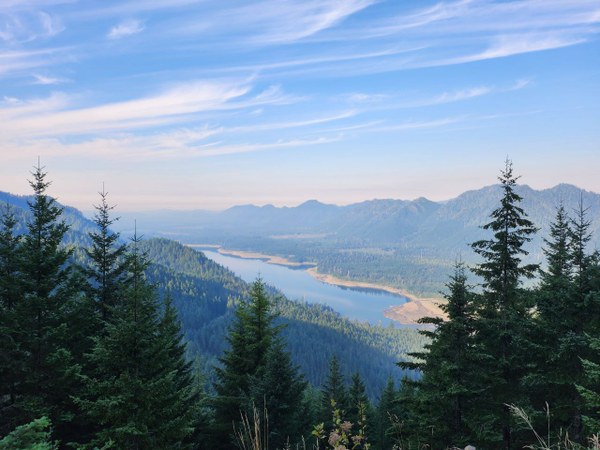
Wynoochee Valley from Forest Road 2372. (c) 2025 by Forsyth This is a high elevation road, with some impressive views. There are also rockfaces with potential rockfall. It's another five miles and 30 minutes on 2372 to the trailhead, at the bottom of a long downhill, just before a sharp turn to the right. The trailhead parking lot is small and not marked.
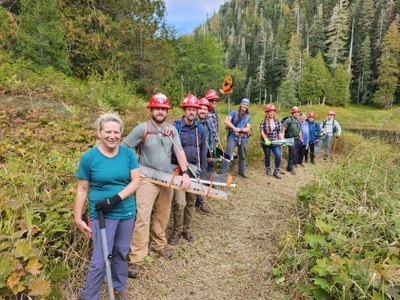
A pair of Olympia Mountaineers stewards scouted the west side of the Church Creek Trail from the Satsop Lake (Forest Service Road 2372) trailhead on August 25. We returned as a party of fifteen on September 28, with tools and a to-do list.
For a little bit, at its high point, FR 2372 is a bench traversing a tall rockface. Just beyond that, are some pull-offs and dispersed campsites. We noticed one was occupied. A few hundred yards down the road, we saw a two young men with shotguns walking the edge of the road. We asked what was in season and where they would be hunting. Grouse, we were told, and nowhere near the Church Creek Trail. Hearing that, we figured we were safe and drove on. Likewise safe, for the moment, were the two grouse crossing the road right in front of us as soon as we had driven out of their sight.
About a third of a mile in from the trailhead, the trail emerges from the woods, and overlooks Satsop Lake, a small pond. The trail originally went through the grass uphill from the pond, and then along the edge of the woods, passing by a few open picnic sites and campsites, then curving back to a high gravel point by the lake. Old sawed billets in the high grass indicate long-ago trail maintenance work along here. The trail became overgrown with high grass. Meanwhile, an anglers' social path developed along the edge of the lake shore. Apparently, this drew traffic away from the higher trail, which became completely overgrown and disused. The lake level rises periodically, putting the anglers' path a few feet underwater. With the approval of the Forest Service, we set out to re-establish the trail along its original route, higher than the shore-hugging path.
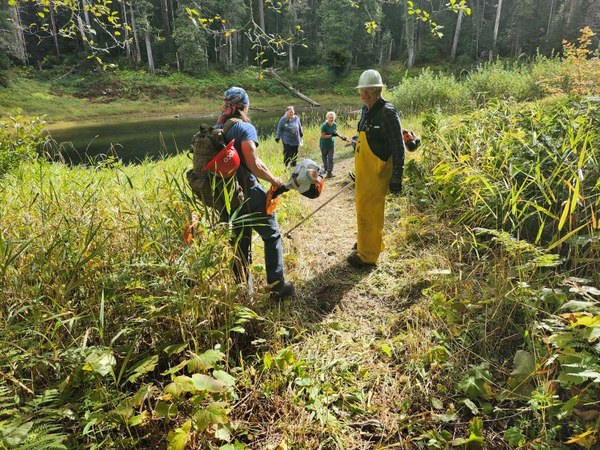
We flagged the intended route with green flourescent tape. A group of three Mountaineers, with a power trimmer and two grass whips (golf-club style blade on a stick; some folks call it a sling blade), started hacking a route through a quarter mile of waist- to chest-high grass, still dripping with morning dew.
The rest of us continued up, with two crosscut saw parties intending to buck trees that had fallen and were obstructing the trail on our August 25 reconnoiter, and a group with a power disc cutter and loppers, intending to cut back brush on the upper section of the west side of the trail. We found that a vigilante trail maintainer with a chainsaw had already bucked the larger trees. We cut and removed some smaller logs, which was of some educational value for sawyers-in-training.
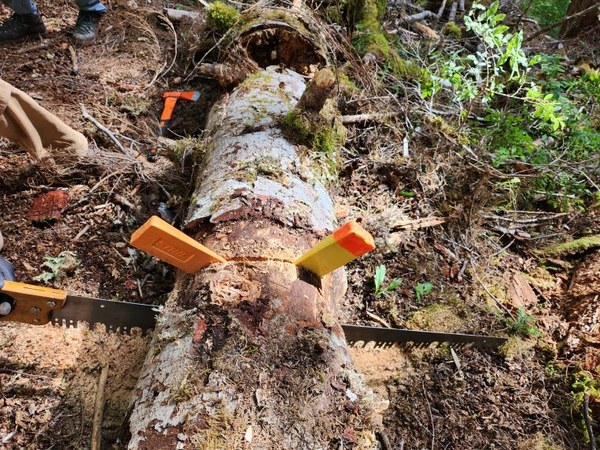
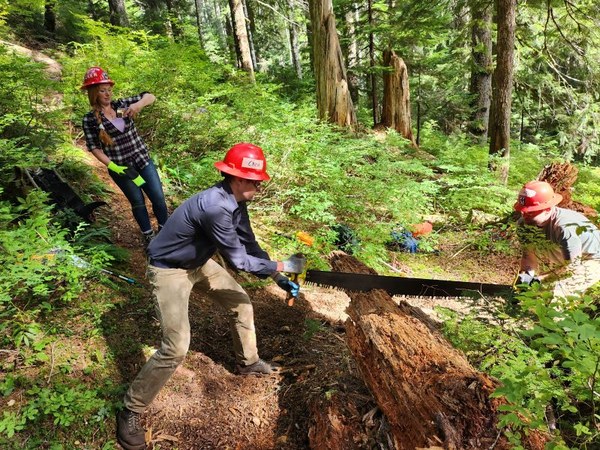
A pair of sawyers worked on the log in the above photo. Before starting to saw, using an axe, the bark was scraped away from the area for the cut. This is important with "step-over" logs, because dirt and tiny stones from boot soles wreck saw blades. When the D-handle saw blade was more than halfway through, wedges were driven at "ten o'clock and two o'clock" to keep the kerf (cut made by the saw blade) open. The auxiliary handle, used by the second sawyer, has been removed prior to finishing the cut.
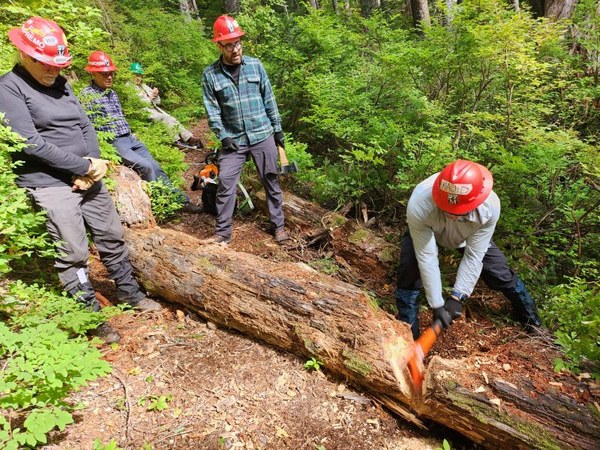
Higher up the trail, we put the handles on the two-person crosscut saw to cut a log encroaching on the trail, which was quickly dispatched. Sometimes logs are too rotten to saw well. The best tools for these are an axe or a Pulaski, an axe-hoe combination named after its inventor, Edward Crockett Pulaski, a Forest Service hero in the great fire of 1910. James is holding a Pulaski in the photo below. Note that bystanders all wear eye protection.
The brush cutting team worked its way over the divide, and went down the east side about a quarter mile to see how our rebuild of a switchback and the associated drainage were holding up (they were holding up well).
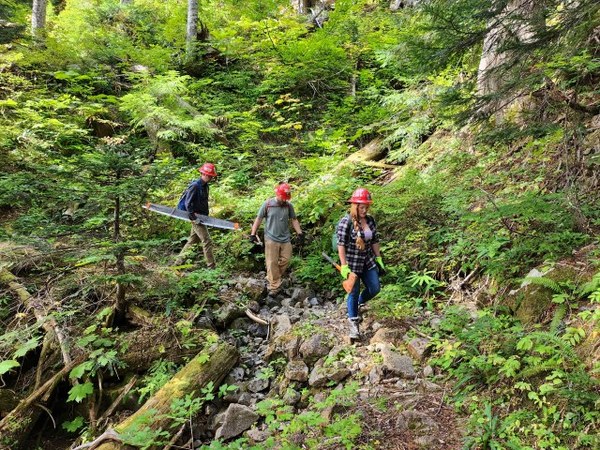
The upper part of the trail contours around gullies of feeder streams and overlooks a steep gorge. Like the east side, the topography has a lot of vertical.
The three groups who had gone up the the trail were delighted and impressed on our return to the lake to find a path at least four feet wide cut through the high grass. We are hoping it gets some traffic to help keep it open. At the trailhead, we put our tools back in the truck and enjoyed some snacks and rehydrating drinks. We had a clear and sunny day for our work, but a bit of drizzle began to fall, hastening us on our way home.
After this and our previous work in August on the east side, the Church Creek Trail is now free of obstructions from the Satsop Lake trailhead on the west to the Church Creek trailhead in the Skokomish drainage on the east.