Trip Report
Stewardship - Church Creek–Satsop Lakes
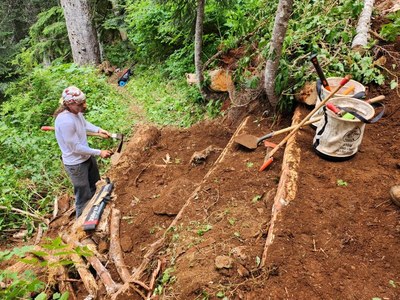
East side of Church Creek Trail: rebuilding a switchback turn.
 Mike Forsyth
- Mon, Aug 4, 2025 — Tue, Aug 5, 2025
- Stewardship - Church Creek–Satsop Lakes
- Church Creek–Satsop Lakes
- Stewardship
- Successful
-

- Road recommended for high clearance only
-
Last year, section of Forest Service Road 23 through the clearcut, previously gravel, was paved. New pavement is still in excellent condition. Other pavement, from Govey Road to just past intersection with FS 2353 (Brown & LeBar campgrounds) is in good condition. Beyond intersection with FS 2353, FS 23 has been re-gravelled and graded, and is in very good condition, mostly allowing speed of up to 30 mph, with a lookout for a few potholes. FS 2361 is in good condition from FS 23 intersection to Church Creek spur 2361-600. That spur has about 27 waterbars in two miles, requiring slow speed and cautious driving. We had three adults in a Subaru Outback and had no ground clearance problems. East end trailhead parking lot has a sinkhole about a foot in diameter and is otherwise in good condition.
Years ago, the Olympic National Forest office of the US Forest Service asked the Olympia Mountaineers Conservation and Stewardship Committee to take on maintenance of the Church Creek-Satsop Lake Trail #871. This is a historic route connecting the Skokomish watershed draining into Puget Sound with the Satsop-Wynoochee watershed flowing into the Pacific Ocean. This trail had fallen into disuse and much work was needed to re-open it.
The Olympia Branch has adopted this trail, and we try to maintain it and keep it unobstructed. This is challenging. The trailhead is a fifty mile drive from our usual meeting place in West Olympia. The last ten miles is on gravel forest roads, and the last 2.2 miles requires high clearance vehicles (SUVs, pickup trucks, etc.). The drive takes about an hour and a half each way. The east side of the trail has a climb of about 1,500 vertical feet in about two miles to the divide between the Skokomish and Wynoochee basins. Cell phone coverage is a half hour drive from the trailhead. Due to the steep terrain, radio and satellite communications are not reliable, so this is not the place to skimp on the Ten Essentials.
Stewards carry an adequate day pack along with a big tool (the Forest Service shovel, their stand-by Pulaski axe-mattock, a grub hoe and other long-handled tools each weigh about five pounds), and something smaller such as loppers or a Corona saw. Depending on the task, we may also carry one or two crosscut saws with accessories. If we will be cutting heavy logs and moving the sections, we will probably bring a peavey, a long wood-handled lever with a point and a hook, weighing about ten pounds, or a rope come-along, a lever-handled winch with 100’ of rope, weighing seventeen pounds, and some rigging. Thus burdened, the stewards typically take two to two and a half hours to get up to work sites near the top of the divide. Typically, we meet up at 7:00 a.m., stop for more participants along the way, drive to the trailhead, do introductions, sign volunteer forms, have a safety orientation and tool talk. We are lucky to be hiking by 10:00. It’s noon and lunch time by the time we get to the job site. The hike down is usually at least an hour, and the drive back to West Olympia meet-up site is an hour and a half, so turn-around time will be between 2:30 and 3:30 pm, which does not leave much working time on site.
We scouted the trail in late May, and identified more work than we could get done in half an afternoon. We planned a trip with an optional second day. Participants could sign up for Monday and Tuesday, or just for Monday. We would camp overnight at a dispersed campsite on the side of the forest road just before the trailhead. We could leave tools cached near the work site, and not have to carry them down Monday afternoon or back up Tuesday morning. We would avoid the delays of the meet-up and drive to the trailhead. Tuesday’s crew would all be briefed and oriented from the day before.
Monday arrived with five people signed up. Four of us (leader Mike Forsyth, assistant leader Sandy Clark, Brandon Beams and new member James Walker) assembled at Haggen’s and caravanned to the trailhead. We stopped at the fish hatchery parking lot and were joined by Caleb England. Brandon and James were driving home together at the end of the day, and did not have a vehicle suitable for the last 2.2 miles of road. We drove to a trailhead near the Church Creek turn-off, parked their car there and shuttled them up to the trailhead.
We had five members. The Mountaineers’ minimum safe party size is three. Lacking sufficient numbers for a second party, we all stayed and worked together. The trailhead is 1,870’ elevation. The first half-mile of the Church Creek trail is a path cut into the steep south side of the Church Creek gorge and angling uphill, parallel to the creek to the first switchback at 2,040’. About half way along this stretch, a falling dead tree had wiped out a short stretch of the trail.
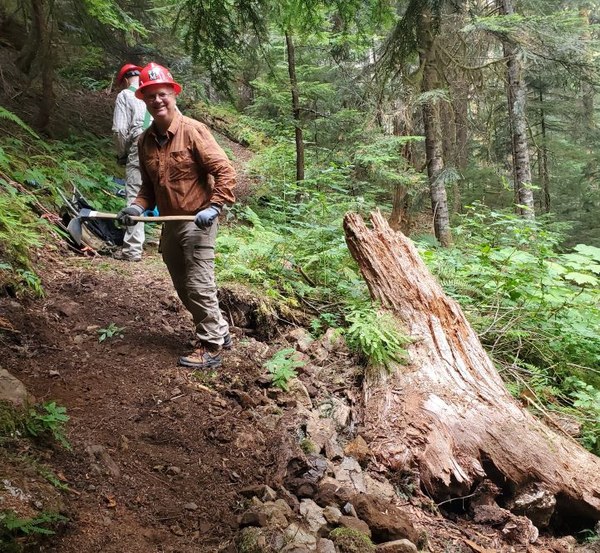
We went to work with hoe, shovel and Pulaski, hacking more treadway out of the hillside, and carrying rocks in canvas buckets to build the trail out. We quickly finished, and headed up toward our next work site at 3,100’.
Around 2,900’, the trail joins the route of a decommissioned Forest Service road over a height of land resembling a mountain pass. A basalt rock face looms over one side of the trail. It is a long stretch of ground with open sky, covered with whatever wildflowers are in bloom.
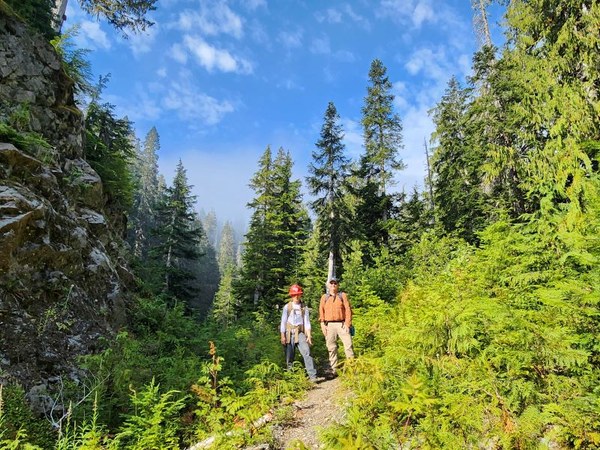
The trail leaves the roadway via a short set of rock stairs on the left into the woods on the uphill side and ascends a series of switchbacks. There are stretches here where “trail creep” is a real problem. The treadway, or bench, was cut into a hillside to construct the trail. Erosion and gravity start to fill the uphill or inside corner of the treadway, diminishing the flat tread area. Brush, especially prickly stuff like devil’s club, blackberry and nettles, growing on the uphill side encroaches on the trail and pushes hikers to the outside, and their foot traffic wears down the outside corner of the treadway. If we had a large enough sign-up, we would have put a re-benching crew to work here for a few hours. This area, at about 3,000’ elevation, will have to wait for another work project. Also, on this day, Caleb, Brandon and James went over the divide at 3,250’, and scouted about 0.3 miles down the west side. They found it could use some brushing, but the trail was open and usable. These are items for another project.
The highest switchback turn on the east side is at about 3,100’ elevation. We identified this as a problem area on a 2023 scouting trip. A tree of about 18” diameter had fallen across the “elbow” of the switchback, cutting off the designed turn. Hikers were using a living tree of about 8” diameter to hoist themselves up and down and around the corner. This was causing erosion on the steep slope, exposing the roots of the tree, and likely would result in the death of the tree and destabilization of the bank.
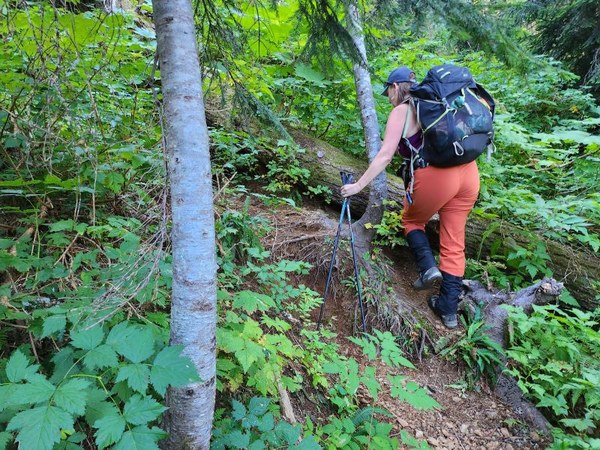
On a 2024 trip, an Olympia trail crew cut the log blocking the trail, and de-barked and moved a section of it to a position uphill of the two living trees in the photo above. The plan was to use it as a curb log for grading of the upper approach to the switchback turn on the next work project.
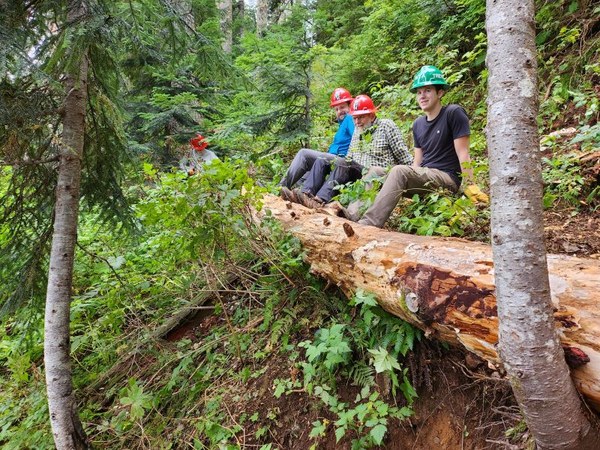
Scouting the trail in May, 2025, we found this log still in place. However, returning with the work party in August, we found that the log had been freshly cut with a chain saw, and the pieces moved aside. This re-opened a bare, steep slope which we had deliberately blocked. Recent human (and apparently bicycle) tracks showed that users were scrambling between the two trees and endangering the roots of both.
This log had been a major component in our plan for rebuilding this switchback turn. We had to assess available materials in the area, and make a new plan on the fly. We cleared out the project area and piled the brush, including lots of devil’s club, in the eroding area between the trees, with some branches on top, to discourage short-cutting. With a D-handled crosscut saw and helper handle, we sawed off a section of the 18” fallen log to widen the lower approach to the turn, and used the section as a curb log for the lower approach. We found some other suitable logs and moved them into place. Brandon and James obligingly agreed to stay long enough to finish all the work requiring the use of the crosscut saw and the rope come-along, so we could carry those heavy items out that day and put them away. At 3:30, we cached several long tools, a few small ones and two canvas buckets near the site, and headed down the trail.
The trip downhill to camp took about an hour. After snacks and re-hydrating drinks, Sandy shuttled Brandon and James back to their vehicle and returned to camp. Just below the trailhead parking lot, there is a flat area beside the road, probably cleared as a staging area for logging operations long ago. We found more than enough level ground to park three pickup trucks. Sandy put up a tent behind his. Mike put up an REI tent-like extension back from the truck cap and tailgate. Caleb opted for a bivvy sack in the back bed of his truck. A recent addition to the stewardship committee’s trove of gear is a free-standing handwashing station, with a water tank in its base, a foot pump and a sink bowl, just the ticket for washing up for dinner after a day of playing in the dirt.
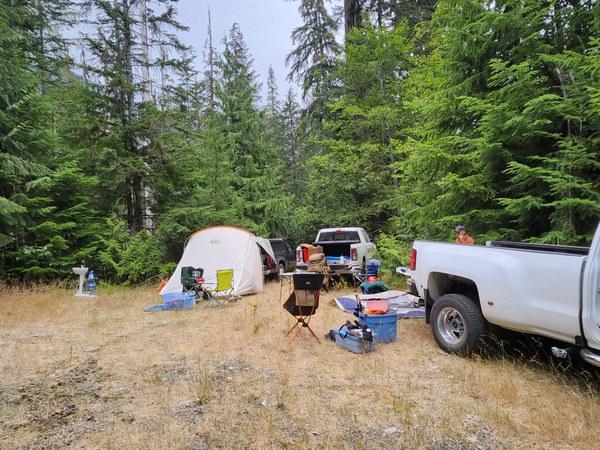
With a fire ban in effect and the smell of the Bear Gulch fire in the air, we had no cheery campfire. But we did cook up rotini with marinara sauce and vegetarian chili on our Coleman stoves, and rehydrated with herbal tea. We had a pleasant evening of conversation before turning in.
After a quiet night, we all arose early enough to break camp after breakfast, and moved our vehicles from the campsite to the trailhead parking area. Carrying a lot less weight in tools, we hiked from camp to the 3,100’ work site in two hours, which was 30 minutes shorter than the day before.
The broad outlines of the new switchback turn had been laid out the day before. We built the turn with four steps going around the steep bank with the two trees. The section of the 18” log as our curb log along the bottom. The riser for the bottom step was made from rocks. The risers for the next three steps were made from downed trees of about 8” diameter.
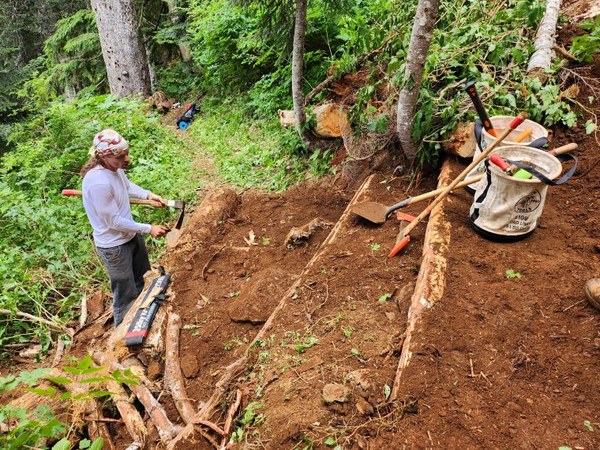
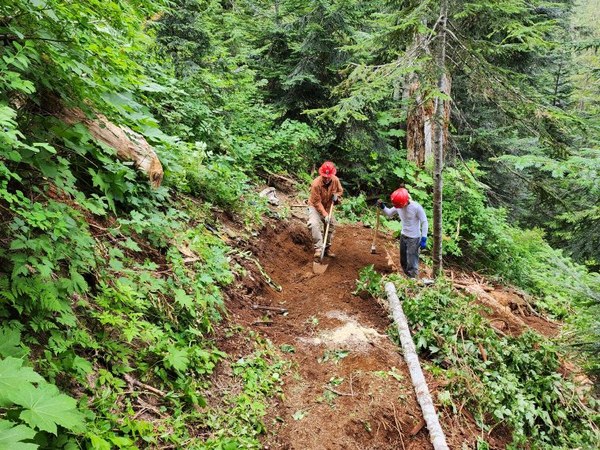
The next step was moving earth and loose rocks, and lots of it. We dug back into the hillside behind the upper approach to widen the treadway. Water from rain and snowmelt runs down the hillside behind the upper approach. To keep it from running across the trail and cutting erosion channels, we dug a drainage ditch between the treadway and the hillside, to carry the water off the trail, at the outside corner of the turn. This dirt was moved to the steps as fill. Three men with a shovel, a grub hoe and a Pulaski can move quite a bit in a few hours.
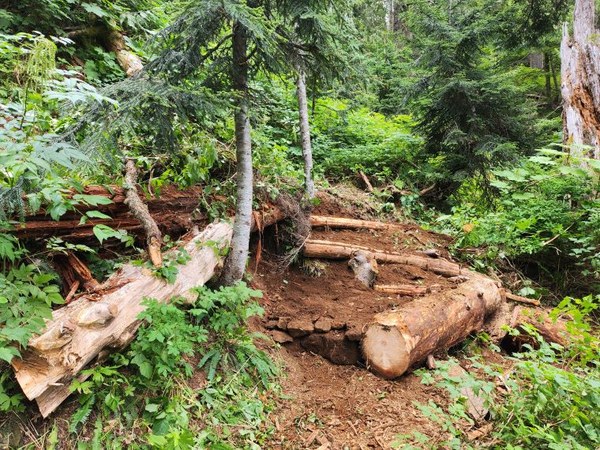
Sandy brushed out the trail below the lower approach. We tamped down the dirt filling the stair treads and reinforced the log risers by driving in lengths of re-bar. We packed up about 3:00 p.m. and carried down the tools which had been cached overnight. We are looking forward to seeing how our work holds up to traffic and to the coming winter. Our two-day plan gave us more working time on site, and less time commuting and orienting and tool-talking. For the east side of Church Creek Trail, this seems to be the most efficient way to work.