Trip Report
Mount Stuart/North Ridge
Climbed the North Ridge Direct over a leisurely three day window on Labor Day weekend.
 Karl Eckhardt
- Sat, Aug 30, 2025 — Mon, Sep 1, 2025
- Mount Stuart/North Ridge
- Climbing
- Successful
-

- Road suitable for all vehicles
-
- Water easily found under the Stuart Glacier & at the base of the route; none on route or at the summit.
- Route to the base can be traveled snow free, no snow on descent.
- Gear was doubles 0.2 -2, 3, 4, 10 single draws, 3 doubles, single set of nuts and a 70m rope. Fixed number 4 was still in the fist crack of the gendarme; 2nd #4 I'd heard reports of was not there.
- We camped at base of the route, there are several bivy sites/large rocks that can be used.
- The notch bivy supports ~5ish folks. These were the only really decent ones we saw. There are others but they're not great and are few and far between from what we saw.
After doing This, My Friend (go climb it - it's great) we set our sights on a bigger prize. We'd originally discussed doing Stuart's West Ridge, but having just bagged a stout alpine 5.9/5.10- we were feeling a bit more ambitious and shifted our sights to the North Ridge Direct.
The plan was to take a more leisurely pace and aim for a 2-3 day window: hiking in on day 1, ideally summiting day 2, and hiking out day 3. This would necessitate carrying heavy packs, but greatly increased our margins (which ended up being very beneficial for a variety of reasons).
We set out on Saturday, leaving the parking lot in the early afternoon and soon had our first sight of the prize across the Ingalls Creek Valley about an hour later.
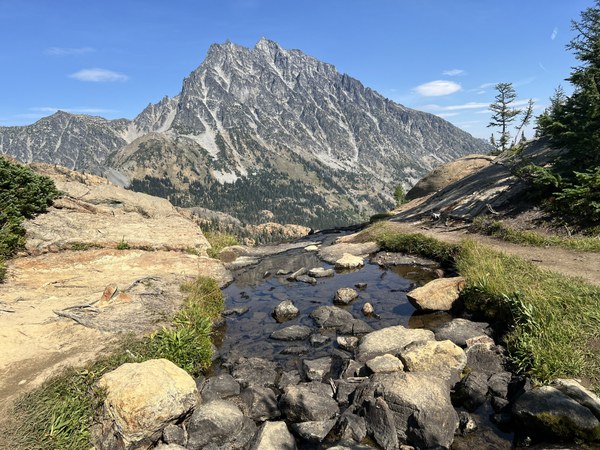
We reached Ingalls Lake in a little over 2 hours and refilled water before traversing to Stuart Pass. Departing Stuart Pass, the climb to the West Ridge and up to Goat Pass really took it out of us. In hindsight, doing this high-vert approach with heavy packs in mid-afternoon when temperatures were 80+ and pushing towards 90...it's not entirely surprising we were a bit gassed. Both of us registered close to 5k' vert tracking this approach, but it looks closer to 4k+ when I map it out in CalTopo. Suffice to say, it's a lot.
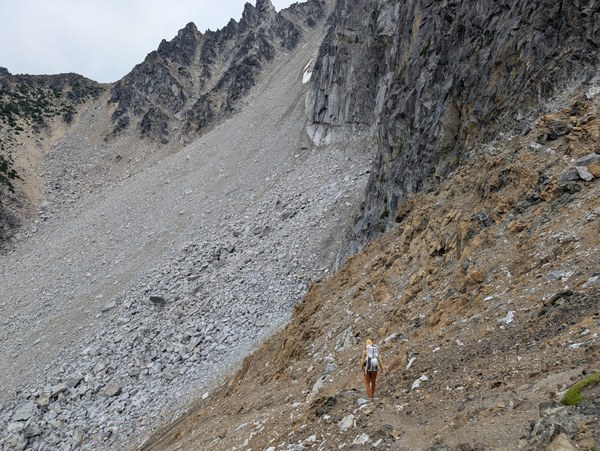
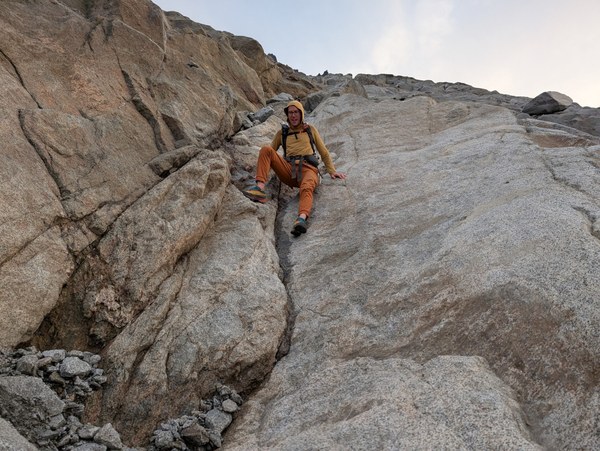
The gully up to Goat Pass looks like absolute garbage from a distance, but on closer inspection it's actually pretty typical Cascade fare. The backside however, is actually absolute garbage. After surfing down dirt, sand, scree and lord knows what other debris we were down underneath the Stuart Glacier. Both of us found the route finding from Goat Pass to the base of the climb much less straightforward than we'd assumed it would be. Not hard per se, but certainly not obvious. There has to be a better way than we found, as our solution involved downclimbing a bunch of old glacial slabs.
After taking a short dinner break, we rolled into camp with time to set up our bivy and enjoy the evening light safe and secure in the knowledge that there was only one other party we'd encountered coming in, and we were in for an efficient and early start.
That...didn't last. Our 'first light' start was pre-empted by a group of 6 (climbing as 3 sets of two) and another group of three who had rolled into camp after we went to bed, putting us 5th in line. Sigh. We hunkered down at the base and chatted with the folks we'd come in with the prior day, with another party of two and a soloist joining us over the course of the morning. They were thankfully great company and helped pass the ensuing 3+ hour wait as enjoyably as one can. Yes...you read that right. 3+ hours. It might be worth mentioning at this point that the route really punishes inefficiency.
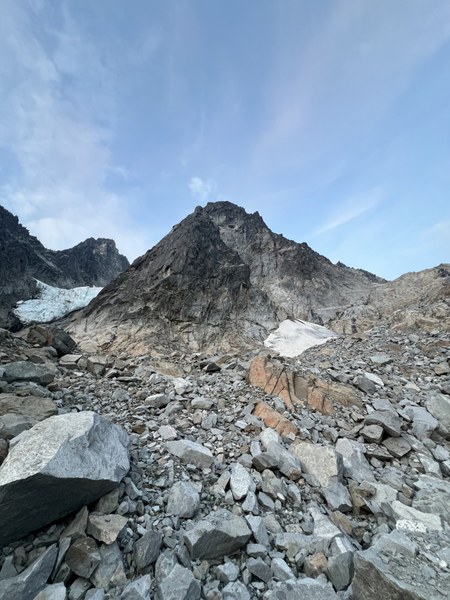
Somewhere between 9 and 10AM we were finally on our way. The first pitch features a 5.8 thrutch that's an absolute bear with a large pack on. Given our lengthy delay, we opted against our original plan to haul the packs on this pitch and just went for it. After a good faith effort to avoid any shenanigans, I dropped my pack underneath me on a sling and grunted through it. At least we'd saved ourselves (and everyone behind us) the hauling time. Linking the first two pitches we successfully bypassed one of the parties and got the nod from the next to leapfrog ahead of them on the next pitch.
Pitch 3 is the clear crux of the climb in my opinion, and an excellent pitch of climbing in its own right. I thought it deserved every ounce of the 5.9 plus grade. With 7 people now behind us, and my lead I was very thankful to fire it. This was the one spot on the lower half that we hauled the packs, and I'd recommend doing so unless you're extremely solid at the grade and/or climbing with a very light pack.
From here, most route descriptions describe it as '4th/low-5th' to the notch. While fair - the terrain is much more engaging than most "low 5th" Cascade terrain that's usually simuled. It frequently featured mid-5th moves/sequences and was much stouter than other routes I've seen with similar descriptions. We ended up pitching out a decent chunk of this terrain given the continued traffic jam, rope drag (exhibit A why I wouldn't climb this with a 70m single rope again), and the more engaging climbing than expected.
All things considered we made the notch in ~6 hours, not unreasonably off our estimate. The lengthy morning delay however left us awkwardly in no-mans land...early enough that we'd be left with a lot of time on our hands, but late enough that we were unlikely to make the summit bivys before dark. Little did we know, we would be VERY grateful for this later on. In the meantime we enjoyed a leisurely evening, the comforts gained by hauling heavy overnight packs, and a stellar sunset.
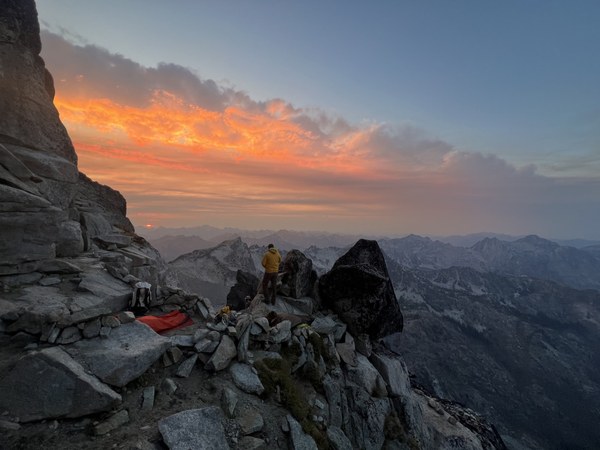
Somewhere around 1AM I woke up to the sound of the Ice Cliff Glacier calving. Having been through this drill the prior night I rolled over and tried to go back to sleep. But it calved again, and again, and again. It took an unreasonably long amount of time for my sleep addled brain to figure out that a glacier doesn't calve every few minutes, much less multiple times a minute. I finally poked my head out of my bivy and was rewarded immediately with a bright flash of lightning and immediate crack of thunder letting me know the storm was right over our heads. Right about the same time, it started snowing/sleeting sideways. So much for three days of clear skies NOAA.
This was about the time the panic set in. We were stuck at the notch bivy in a thunderstorm - on exposed and highly conductive granite while the storm soaked the rock around us. Retreat at this point would have been a frightening endeavor in its own right, and we figured the best place for us on the ridge was likely the relatively more sheltered location of the notch bivy. At least there we had a lot of more attractive real-estate above us for the lightning to find first, and I was in no hurry to step out onto the ridge proper and establish myself as the local high-point. As we lay in our bivies waiting out the storm, my annoyance with the traffic jam that morning shifted to gratitude recognizing it had prevented us from summiting and bivying at the tippy top of a 9400' lightning rod as planned.
Thankfully the storm passed relatively quickly and a stiff wind dried the rock putting us back in action by morning. The storm had badly rattled us and the combination of poor sleep and shaken nerves definitely took a toll. We were far from 100% when we started up the following morning, and it took us a few tries to suss our way through the first few pitches past the notch. The multiple route finding errors ultimately hurt our egos more than our time plan, but definitely not how we'd hoped to start the day. After the false start, we hit the ridge proper and began to hit a cleaner stride.
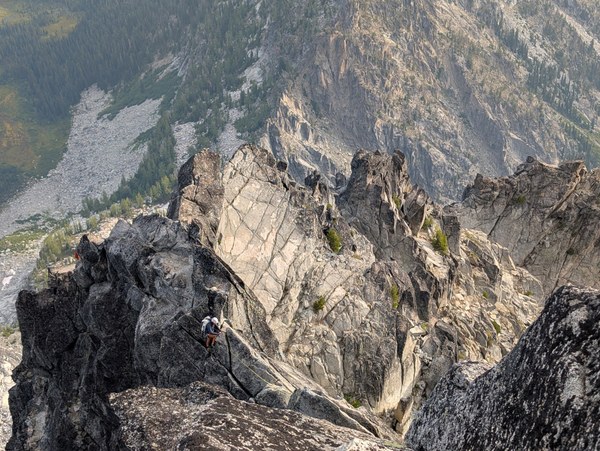
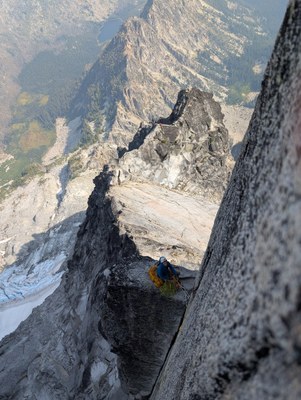
Having learned from our prior day, we shortened the rope and were able to link several solid simul blocks up the ridge proper to the Great Gendarme. The enormity of the route hadn't really set in on day one, but as the ridge narrows and the exposure increases you really get a sense of just how massive it is. You can put in an entire 70m rope length on a pitch, and it just disappears into the mass of rock above you.
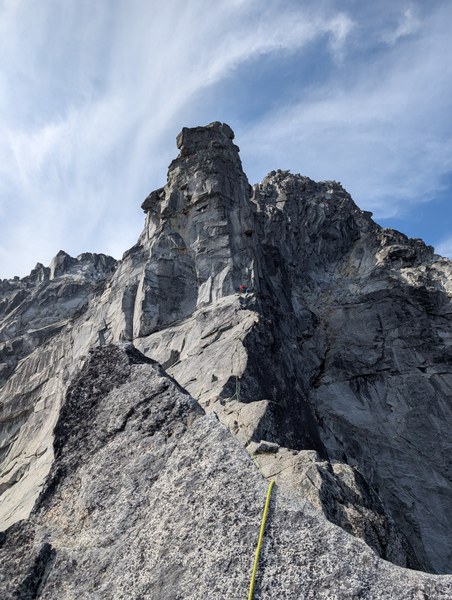
After a short snack, I cruised up the awesome first pitch layback/corner crack of the gendarme. It's definitely solid 5.9 and you certainly feel the 2300' of climbing and 8K' altitude, but it is surprisingly unsustained. There are multiple good rests and it eats gear which made it much more approachable than I'd expected. After hauling packs, pitch two went just as quickly. Certainly awkward but no where near what I'd made it out to be as it proved to be bomber fists and easily takes a #4 that you can hop up as you go. The exposure on this pitch is mind bending though. You traverse out right off a pedestal and put what feels like 1000' of air under your feet before heading up the crack - it's WILD.
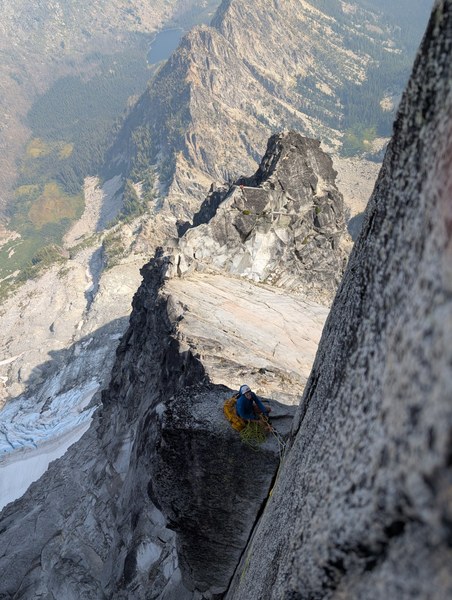
We'd elected to climb the second pitch without packs and then haul...the kicker is you have to exit pretty well straight up to do this vs. the more straightforward right exit. This necessitated a balancy exploratory sequence to cut right above the traditional exit and some shenanigans to transfer the packs through this sequence that ended up burning a decent amount of time. I'd have been pretty chagrined by this if I hadn't seen the guides ahead of us have a time of it as well.
The hard climbing was done, but the climb itself still had close to 600' to go. The route really just keeps on going, and going, and going, and going. Finally in our rhythm we pitched out the last 5.8 section and simuled the remaining terrain up to the summit.
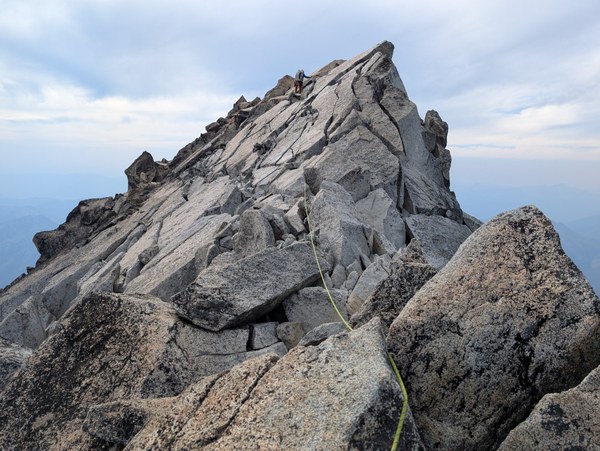
The descent was fairly straightforward coming off the south side. Despite initially missing the transition into the Cascadian, we made good time and were back at Ingalls Creek in a bit under three hours. Then started the long slog up to Longs Pass - which felt like forever - but we continued to make good time and were at the pass a little under an hour later as dusk descended. We cruised out the remaining miles by headlamp and were able to make it into Cle Elum in time to grab a bite before heading home.
Key Takeaways:
- Fitness is critical. This is a HUGE route, and making sure you have enough in the tank to confidently pull crux pitches after ~2300 feet of climbing and at 8k'+ is no joke.
- Route finding is not always straightforward, and many paths are frequently trod (even wrong ones). Even climbing with someone who had previously climbed the route (albeit ~10 years ago) we made 3-4 key errors that cost time.
- Much of the route is described as 4th/low-5th. Our experience is it's definitely not your typical Cascade 'low-5th' as there's a lot of mid-5th thrown in. Confidence simuling terrain that includes the occasional 5.5-5.7 move/sequence is important for efficiency. You can pitch it out - and we often did - but keep in mind you're climbing ~3000' and the extra transition time adds up quickly and easily compounds to burn hours worth of time.
- I would not use a 70m single rope again. It isn't practical to simul with that much rope out given how much the route wanders, and we were constantly forced into early belays by rope drag (and still had lots of slack to pull through the system to boot). Once we were wise to this, we still had to significantly shorten the rope forcing someone to climb with a bunch of coils. I would climb it with a shorter single rope + tag line for hauling, or more likely a doubled twin, to solve the above.
- Doing the route with heavy overnight packs was rough (especially the lower half when carrying close to 6L of water), but afforded wide margins that came in very handy. There was a comfort to being unhurried & knowing when the storm hit we were well equipped. Were I to do it again, I think I'd do it in more of a fast/light style with lighter packs and shorter timetable. That said, I suspect there are A LOT of unplanned bivies on this route and the good bivy sites are few and far between. I'd be really confident in your ability to punch it if you go fast & light.