Trip Report
Field Trip Mt Rainer - Emmons Moraine Trail
The trail to Emmons Moraine and then the moraine itself provides a perfect place to ponder the geology of Washington and look for flowers, trees, and lots of other things.
 Thomas Bancroft
- Thu, Jul 24, 2025
- Field Trip Mt Rainer - Emmons Moraine Trail
- Glacier Basin (Mount Rainier)
- Naturalist
- Successful
-

- Road suitable for all vehicles
-
The trail is wide and easy to hike except for the short section that climbs the lateral moraine near Emmons Glacier. This brief, 60-100 foot climb, is along a narrow trail that swithes back and forth. Poles are recommended for this section.
Emmons Moraine Trip Report
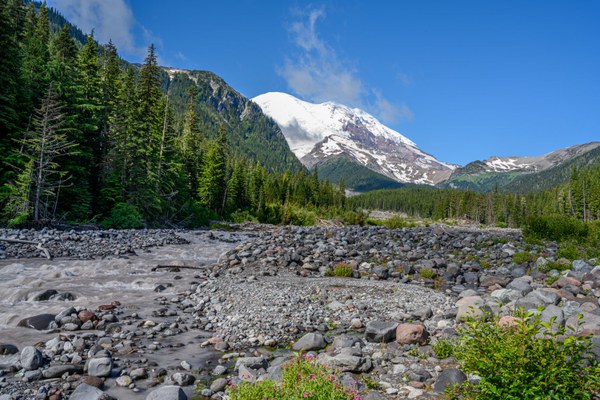
Rocks clanged and banged as they rolled through the rushing gray-floured water. The White River, still another 40 feet away, was loud but far enough that it would allow us to talk about the valley and our view. Mount Rainier rose to the west, its peak glistening white in the cloudless sky.
“You can now tell your friends that you have hiked the Wonderland Trail,” I said, pausing for the chuckles. “I’ll give you a chance to walk across the bridge so you can listen and feel the force of the water,” I continued, as I pointed at the log bridge the Park Service had installed. It was 9:45 AM, and the water was six inches below the bottom of the log. “Water levels rise during the day as the temperature warms, increasing melt from Emmons Glacier,” I continued. “Two years ago, my friend crossed the bridge in late afternoon and said the water was bouncing over the top, kind of scary. These crossings would be dangerous without these logs.” A loud bang came from the torrent, probably a large rock rolling along.
This crossing was the orientation point for our hike on the Glacier Basin Trail and then the Emmons Glacier Moraine. The day would focus on flowers, trees, geology, and other natural features we could identify. The ten Mountaineers were eagerly looking and pointing at all kinds of things as I gathered everyone together to explain the geology.
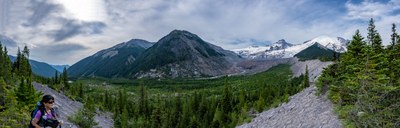
“Mount Rainier is 500,000 years old,” I said while pointing west. “Goat Island Mountain, to the south, is 20 to 30 million years old, built during the first phase of Cascade uplift. The bottom part is the Ohanapecosh Formation, and the top is the Stevens Formation.” Turning north, “The top of that ridge is known as Yakima Park, and the Sunrise Visitor Center is up there. See the top half of the wall, which is andesite columns laid down in one of the first lava flows from the newly rising Mount Rainier. That is the Burroughs Mountain and Sourdough Ridge flow. The underlying rocks, the bottom half of the ridge, are Ohanapecosh.”
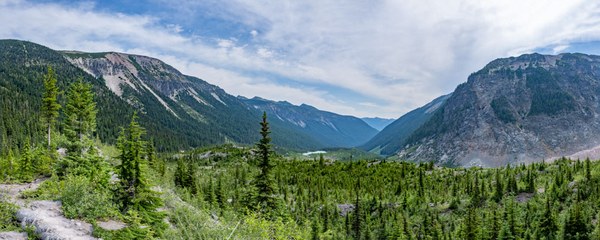
I stopped for a few seconds to let them absorb these facts. “So, why didn’t this valley fill with molten rock?” I asked.
“Ice,” someone said
“Glaciers,” another commented.
“Yes,” I said, “During the Pleistocene, several major phases of huge alpine glaciers formed, and at one point the Emmons Glacier went as far as Greenwater, which you passed through driving here. When the lava flowed about 500,000 years ago, the ice would have been at least as high as the edge of Yakima Park,” as I pointed up to the rim.
“Walk the bridge if you like, and then we will head up the trail,” I said. Donna Rooke and Cristy Del Alma were co-leading, and David Frey, a leader from Olympia and a Park Service Volunteer, would also help with identifying plants. The three began identifying plants. Lewis’s monkey flower, pearly everlasting, and a few others were between rocks or in wet spots. Green alders lined the higher washed area, waiting for the next flood to take them back out.
As we headed back toward the Glacier Basin Trail, I pointed to the rock and dirt rubble as we climbed out of the river bottom. That is debris from the Osceola Mudflow that happened 5,600 years ago. It came crashing down the valley as a wall of churning, crashing mixture of water, ice, mud, and rocks, much like concrete, maybe 500 feet high and traveling at fifty miles an hour. It went all the way to Puget Sound. We all stopped on the trail to absorb those thoughts. Someone says, “How fast can you run?” Several chuckled.
The Trail
It is about a mile from the Climber’s Parking lot to the turn-off for Emmons Moraine. The trail is wide with some rocks and meanders through mid-elevation coniferous forests. It gave us a chance to talk about succession. Only large Douglas firs were growing here, no small ones. That species is intolerant of shade and needs open areas to germinate. The live ones had to be at least 500 years old and probably much older. It suggested the last significant disturbance happened sometime before that. Western hemlocks and Pacific silver firs were large too, and those species would eventually replace all the Douglas firs if a significant disturbance didn’t wipe out the forest.
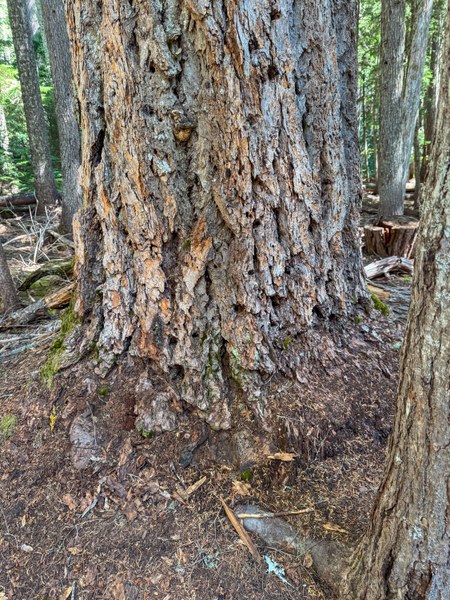
I put both my palms flat on the three-foot diameter trunk of a gigantic Douglas fir along the trail. “I try always to absorb her wisdom as I pass,” I said, “She has seen so much of this planet over her seven or eight centuries of life.”
“How’s that working?” Donna chuckled.
“I keep hoping,” I added.
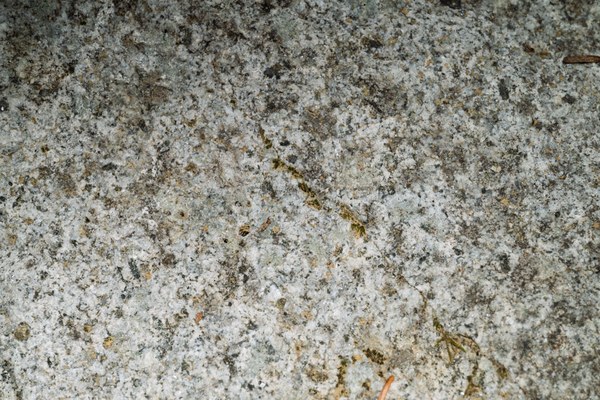
Our progress was slow; at best, it might take us an hour to reach the turn-off, but it was close to two before we arrived at that point. Large granodiorite boulders from the Ohanapecosh stuck into the trail, allowing us to look at the crystals that form when magma dries slowly. As the elevation climbed, Englemann spruce, Alaska yellow cedar, and mountain hemlocks added to the tree diversity.
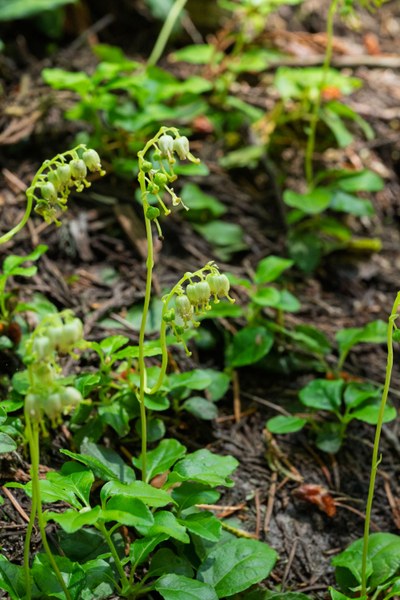
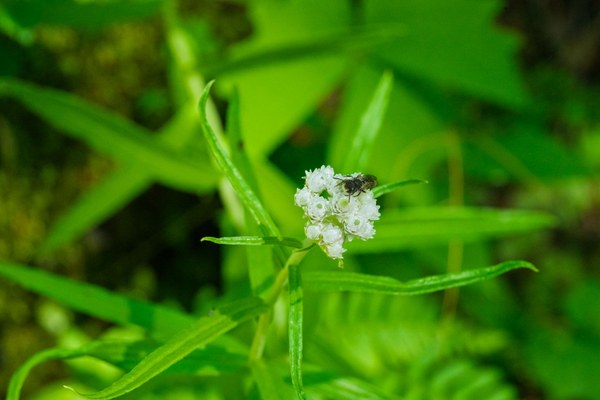 Pearly Everlasting with a Leafcutter bee.
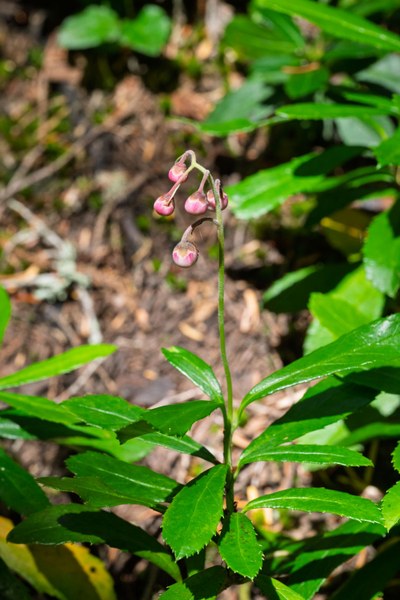
Twinflowers, broadleaf arnica, and thimbleberry lined parts of the trail. We stopped to look at pinedrops, their straight, colored stalks sticking up. Donna had everyone look closely at one beside the trail, seeing the tiny pinkish flowers as she explained this is a plant parasite, associating with mycorrhizal fungus. It has very little to no chlorophyll and does not conduct photosynthesis. A gnome-plant had us all get on our knees to look at this tiny reddish-pink plant just poking through the ground—a rare plant of the Pacific Northwest and the first sighting for this leader.
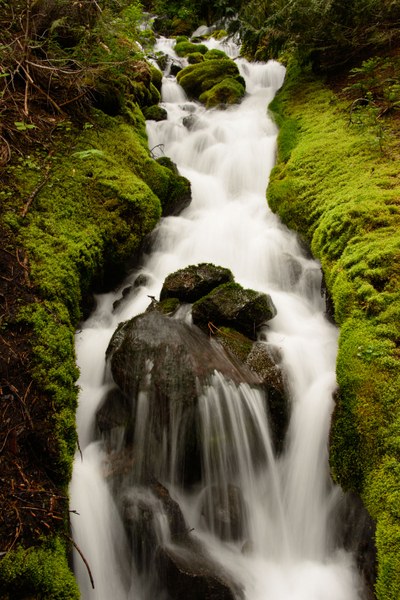
A wet area, where a slide had happened decades ago, had more flowers, including pearly everlasting, two species of monkey flowers, arnica, cow-parsnip, and several others. A couple of small streams tumbled down the steep slope, bringing with them a cool “air-conditioned” breeze as we studied the mosses along the edge. A slender bog orchid with its greenish flowers was a hit with everyone.
The Moraine
An opening to the southwest allowed us to look across the Inter Fork of the White River to the lateral moraine of Emmons Glacier and then up to Mt. Rainier and Little Tahoma Peak. “We will cross that bridge and then climb those switchbacks to the moraine. There are some nice places on the moraine for us to have lunch and talk about the geology,” I said while pointing. Two people were coming down the switchbacks. The Inter Fork had eroded a steep side of the 60- or 70-foot-high moraine of loose sand, gravel, and rocks. The Park Service had carved a narrow trail up the side.
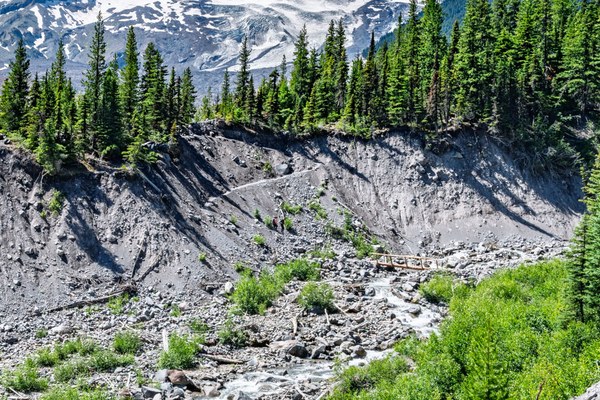
Just before the bridge, I explained that I am afraid of heights, and I climbed this trail by watching my toes, keeping an eye on the trail, using my pole for balance, and taking very short steps. I went first, and Donna came from behind. She is a scrambler, backpacker, and mountain climber, and could give reassurance and guidance. As I approached the last obstacle, someone said, “bear.” A bear was working through the alders and stream bed, heading down along the Inter Fork. No way was I going to take my eyes off the trail to look, and I hoped it might still be around when I finally made it to the top. I had a brief glimpse of its tail as it disappeared into the alders.
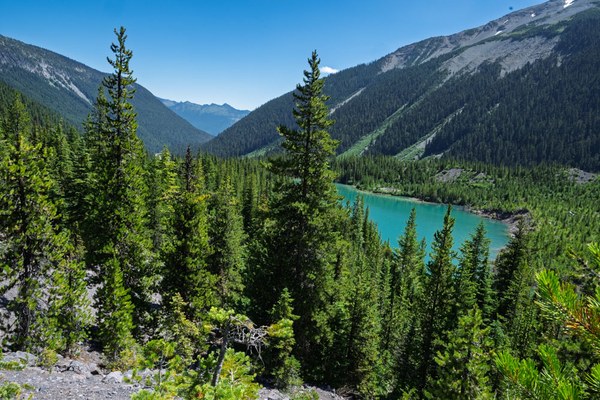 A large ice chunk left by the Emmons Glacier as it began receeding created this Kettle Lake.
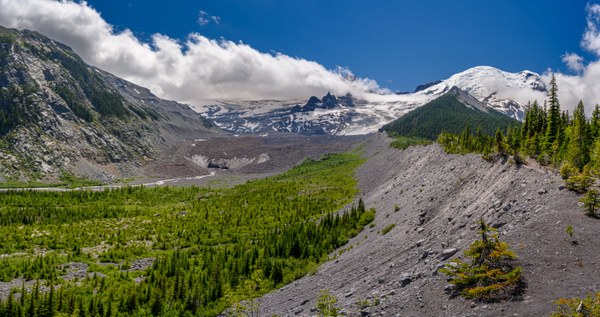
Our lunch spot on the moraine allowed us to look from the summit, down Emmons Glacier to its current terminus, and then past our perch to where it extended during the Little Ice Age. From about 1200 to the late 1800s, the Earth was slightly cooler than it was in the late twentieth century, and glaciers all over the world expanded. A turquoise lake sat just on the upside of the terminal moraine where the glacier still sat in the late 1800s. Apparently, a large chunk of ice was left there as the glacier pulled back, probably covered by rocks and rubble, slowing its melt, and it formed the kettle lake we could admire. The height of our perch above the river and the scrape along Goat Island Mountain indicated the thickness of the ice in the 1800s. It was mind-bending for sure.
And then there was the Osceola Mudflow. Pointing to Mount Rainier’s peak, I explained. About 5,600 years ago, the top of the mountain on this side fell away, roughly a cubic kilometer of rock, ice, water, clay, and material rushed down the White River in a torrent, maybe 500 feet high at our location. It bounced over 1500 feet up on Goat Island Mountain. That lahar went all the way to Puget Sound. If you stopped in Enumclaw on your drive up, you stood on 19 feet of Mount Rainer that headed down the river.
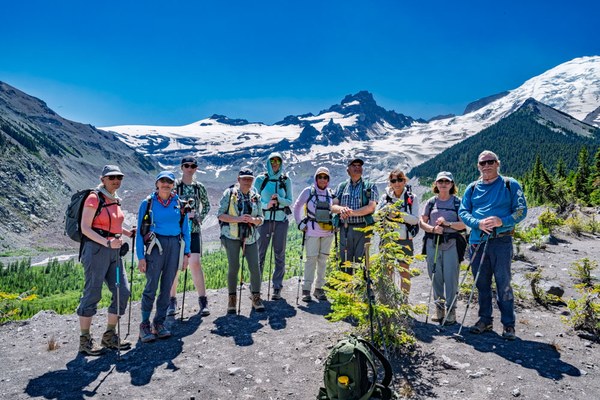
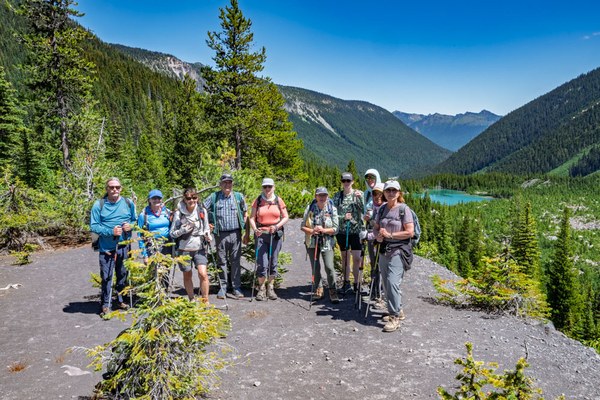
Everyone stood in silence for several minutes before we hiked to the end of the trail, where we could take a group photograph.
The Descent
For me, going down a steep slope is always scarier. The first time I came off this moraine in 2014, I remember standing at the top, thinking “No way” I would ever get home, but I did.
I said to our group, “Take it slow, use your pole to help balance, move your feet only a short distance at a time. There are two rocks and one turn that I take particularly slowly. I keep my eyes on my feet and never look at the bottom.
Maybe ten minutes later, I reached the bottom and turned to watch others coming down the slope. It was then that I began to worry that I hadn’t done a good enough job explaining this section of the trail. Everyone was taking their time, moving in careful steps, and I kept my fingers crossed that all would make it. Donna was helping folks think about pole placement and how to move around difficult places. “Thank goodness for having an excellent co-leader,” I thought.
To make matters worse, a “young” man, maybe in his thirties, arrived at the top just as the last few of our group started down.
Donna said, “We were a large group.”
He replied, “An a slow one at that.”
Donna continued, “The trail isn’t wide enough for you to pass our group.”
As Donna helped one of our members make it around a switchback, the man cut the switchback to get ahead of us. So unnecessary. To think someone couldn’t enjoy the wilds for a few minutes while our group safely descended is so sad.
Later that evening, Donna, Cristy, and I would discuss how I, the leader, needed to do a better job of explaining this traverse so people could judge their comfort level. It is a challenge at the Mountaineers to think about comfort levels and know how to describe a proposed hike adequately. This steep slope was just a small part of our trail, but it caused enough anxiety in a couple participants that I felt a better description of this challenging section in the trip posting would be a good idea. We all made it down safely, and no one complained, but it was a lesson.
The Small Things
Back on the Glacier Basin Trail, David Frey gave us a briefing on the Meadow Watch program. This citizen science endeavor has been studying the flower season at Mount Rainier for more than a decade, learning about the relationship between flowering, snow melt, and climate change. It is an outstanding program that depends on volunteers like David.
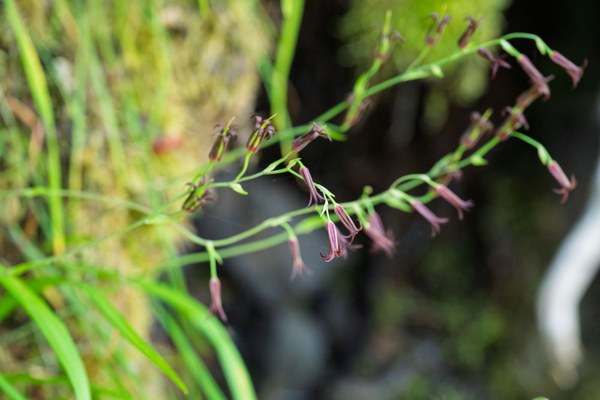
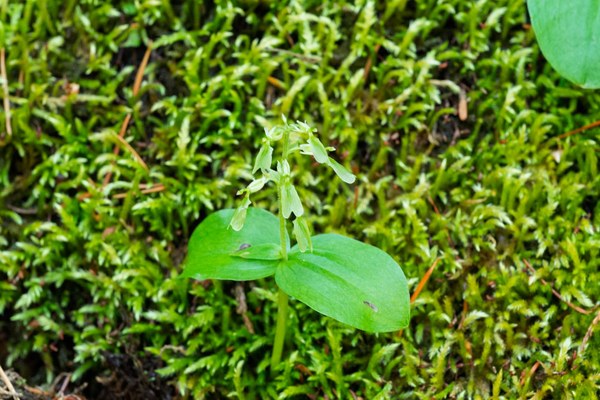
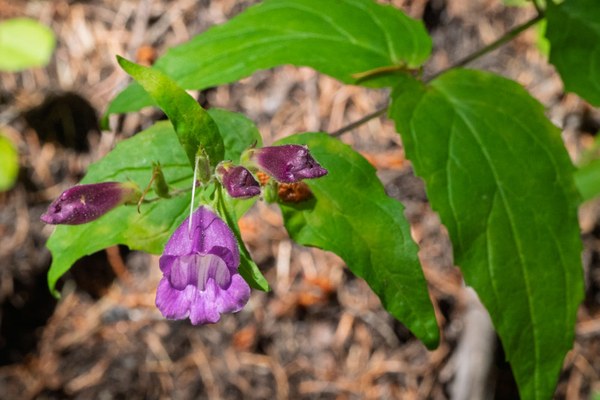
I asked Donna to take over the lead on the way down. She had found a seep with a lot of unique plants this morning, including several I’d never seen. She spotted the location, and we huddled around to examine. An umbrella liverwort was a highlight for me. It was small, and I leaned in with my phone on macro mode to get a shot. Minute green umbrellas rose on short stems and glistened in the moisture. A northwestern twayblade grew there, too. The purple flower of a woodland’s beardtongue added a touch of color. Bronze bells, also known as western feather bells, was a particular treat. It was nice to close out the trip on some small, often overlooked items when compared to volcanoes, glaciers, and lahars. Diversity is always good.
Plant List for Emmons Glacier - 24 July 2025 |
||||
| Family | Common Family | Scientific Name | Common Name | |
| Ferns | ||||
| Polypodiaceae | Ferns | Athyrium filix-femina | common ladyfern | |
| Polypodiaceae | Ferns | Blechnum spicant | deer fern | |
| Polypodiaceae | Ferns | Cryptogramma cascadensis | Cascade parsley fern | |
| Polypodiaceae | Ferns | Polystichum munitum | western swordfern | |
| Gymnosperms | ||||
| Cupressaceae | Cypress | Callitropsis nootkatensis | Nootka cypress | |
| Cupressaceae | Cypress | Thuja plicata | western red cedar | |
| Pinaceae | Pine | Abies grandis | grand fir | |
| Pinaceae | Pine | Abies lasiocarpa | subalpine fir | |
| Pinaceae | Pine | Picea engelmannii | Engelmann spruce | |
| Pinaceae | Pine | Pinus contorta | lodgepole pine | |
| Pinaceae | Pine | Pseudotsuga menziesii | Douglas-fir | |
| Pinaceae | Pine | Tsuga heterophylla | western hemlock | |
| Dicots | ||||
| Apiaceae | Parsley | Angelica arguta | Lyall's angelica | |
| Apiaceae | Parsley | Heracleum maximum | cow-parsnip | |
| Apiaceae | Parsley | Osmorhiza berteroi | mountain sweet-cicely | |
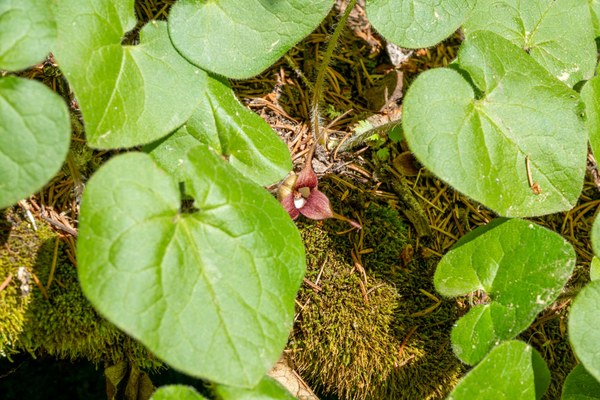
| Aristolochiaceae | Birthwort | Asarum caudatum | wild ginger | |
| Asteraceae | Sunflower | Achillea millefolium | yarrow | |
| Asteraceae | Sunflower | Anaphalis margaritacea | pearly everlasting | |
| Asteraceae | Sunflower | Arnica latifolia | broadleaf arnica | |
| Asteraceae | Sunflower | Artemisia ludoviciana | gray sagewort | |
| Asteraceae | Sunflower | Artemisia tilesii | Tilesius' wormwood | |
| Asteraceae | Sunflower | Cirsium edule | edible thistle | |
| Asteraceae | Sunflower | Eucephalus ledophyllus | Cascade aster | |
| Asteraceae | Sunflower | Senecio triangularis | arrowleaf groundsel | |
| Berberidaceae | Barberry | Achlys triphylla | vanilla leaf | |
| Berberidaceae | Barberry | Berberis nervosa | Cascade Oregon-grape | |
| Boraginaceae | Borage | Mertensia paniculata | tall bluebells | |
| Campanulaceae | Harebell | Campanula scouleri | Scouler's bluebell | |
| Caprifoliaceae | Honeysuckle | Linnaea borealis | twinflower | |
| Caprifoliaceae | Honeysuckle | Sambucus racemosa | red elderberry | |
| Caryophyllaceae | Pink | Moehringia macrophylla | largeleaf sandwort | |
| Crassulaceae | Stonecrop | Sedum divergens | Pacific stonecrop | |
| Ericaceae | Heath | Gaultheria ovatifolia | western teaberry | |
| Ericaceae | Heath | Hemitomes congestum | coneplant | |
| Ericaceae | Heath | Orthilia secunda | one-sided wintergreen | |
| Ericaceae | Heath | Pterospora andromedea | woodland pinedrops | |
| Ericaceae | Heath | Pyrola chlorantha | green-flowered wintergreen | |
| Ericaceae | Heath | Vaccinium ovalifolium | oval-leaf blueberry | |
| Ericaceae | Heath | Vaccinium scoparium | grouse whortleberry | |
| Grossulariaceae | Currant | Ribes lacustre | prickly currant | |
| Grossulariaceae | Currant | Ribes viscosissimum | sticky currant | |
| Hydrophyllaceae | Waterleaf | Phacelia hastata | silverleaf phacelia | |
| Ranunculaceae | Buttercup | Actaea rubra | baneberry | |
| Rhamnaceae | Buckthorn | Ceanothus velutinus | snowbrush ceanothus | |
| Rosaceae | Rose | Aruncus dioicus | Goatsbeard | |
| Rosaceae | Rose | Fragaria virginiana | Virginia strawberry | |
| Rosaceae | Rose | Rosa gymnocarpa | wood rose | |
| Rosaceae | Rose | Rubus parviflorus | thimbleberry | |
| Rubiaceae | Madder | Galium triflorum | three-flowered bedstraw | |
| Salicaceae | Willow | Populus trichocarpa | black cottonwood | |
| Saxifragaceae | Saxifrage | Heuchera micrantha | small-flowered alumroot | |
| Saxifragaceae | Saxifrage | Tiarella trifoliata | foamflower | |
| Scrophulariaceae | Figwort | Erythranthe guttata | common monkey-flower | |
| Scrophulariaceae | Figwort | Erythranthe lewisii | purple monkey-flower | |
| Violaceae | Violet | Viola glabella | pioneer violet | |
| Monocots | ||||
| Liliaceae | Lily | Anticlea occidentalis | western featherbells | |
| Liliaceae | Lily | Clintonia uniflora | queen's cup | |
| Liliaceae | Lily | Streptopus amplexifolius | clasping twisted-stalk | |
| Liliaceae | Lily | Trillium ovatum | Pacific trillium | |
| Orchidaceae | Orchid | Goodyera oblongifolia | western rattlesnake plantain | |
| Orchidaceae | Orchid | Listera caurina | northwestern twayblade | |
| Orchidaceae | Orchid | Platanthera stricta | slender bog orchid | |