Trip Report
Field Trip Mt Rainer - Berkeley Park
We hiked from Sunriste to Frozen Lake along Sourdough Ridge. From Frozen Lake, we dropped down into Berkeley Park and returned by way of Shadow Lake. Flowers were spectacular and we saw Mountain Goats, too.
 Thomas Bancroft
- Wed, Jul 23, 2025
- Field Trip Mt Rainer - Berkeley Park
- Mount Fremont Lookout, Berkeley Park & Skyscraper Mountain
- Naturalist
- Successful
-

- Road suitable for all vehicles
-
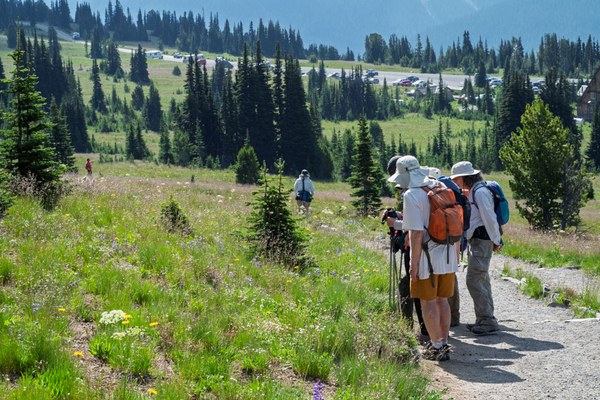
The trail is wide, well-maintained, and was dusty on our day. Make sure to bring enough water. Lots of people were on the trail and we stopped often to let groups pass.
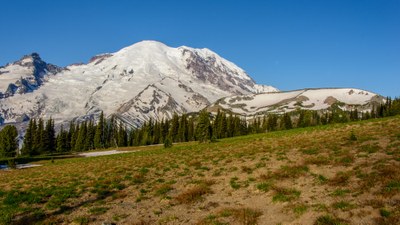
The ridge crest was dry, dusty, and a light breeze made it ideal for our July hike. We’d just climbed to the top of Sourdough Ridge from Sunrise, and I was puffing hard. To the north, Donna, my co-leader, spotted Mount Stuart and possibly Glacier Peak. Mount Baker should have been visible, but the haze was thick. To the west, Mount Rainier rose in the cloudless sky like a queen on her throne, and to the south, a hint of Mount Adams flickered through the grayish air. The word “time” ran through my mind. Could I explain all this in a way that made sense and set the stage for our day?
Time
I jumped up and down a few times, and a small cloud of dust rose around my boots. “Seems pretty solid, don’t you think?” The puzzled looks on everyone’s faces were priceless. A few heads shook back and forth. Donna smiled, suspecting what was next. “Okay, 500,000 years ago, this would have been molten rock, one of the first big andesite lava flows from the newly formed Mount Rainier. These stratovolcanoes last about a million years, so that Mount Rainier might be about halfway through its lifespan,” as I pointed toward the mountain. “The lava flowed between two massive Pleistocene Glaciers that filled the valleys for both forks of the White River,” pointing south into the valley several thousand feet below us and northwest toward the valley fed by the Winthrop Glacier. “The Emmons Glacier was thick, several thousand feet thick, and flowed way down the valley, maybe as far as Greenwater on SR 410.” I stood back, giving a chance for all that to sink in, while Donna pulled out her excellent giant map of the park produced by National Geographic.
“If you have hiked in the Glacier Peak Wilderness, that extinct volcano is older, the late Pliocene and into the Pleistocene, maybe 3 to 1 million years ago. It lasted longer than typical stratovolcanoes because it went through a rhyolite phase and then an andesite phase. Rhyolite lava has higher in silicon than andesite, is less viscous, and those volcanoes tend to be extremely explosive. Basalt volcanoes like those erupting in Hawaii and Iceland right now have even less silicon and tend to flow even better, sometimes almost like water. The Miocene lava flows from eastern Washington were basalt, and some went out the Columbia Gorge and into the Pacific.”
Donna took several minutes to look at features on the map and point to them on the landscape. She named the various glaciers on Mount Rainier and some of the peaks around it, working back along Goat Island Mountain to Cowlitz Chimneys to our south and McNeely Peak immediately to our north.
“What about these other mountains?” someone asked, “Did Mount Rainier make all of these?”
The question was perfect, just what I needed. The word “time,” again, rushed through my mind. Could I share these thoughts?
I began to explain that one could think of the formation of this part of Washington in three phases. Living in the present is always good; that is what mindfulness is all about. Understanding the past, though, helps us see the present in a new light and with added understanding. The West Cascades was the first phase of mountain building that happened from about 40 million years ago to about 17 million years ago. Then, there seemed to be a pause, or at least less activity, in the Cascades when the Columbia Basin lava flows happened from about 17 million years ago to about 6 million years ago when the High Cascade uplift began. We are in the middle of the High Cascades, and the active stratovolcanoes of Washington are part of that. More recently, the Little Ice Age, from about 1200 to the late 1800s, is visible here and then, of course, today are the flowers, birds, trees, and landscape we will experience.
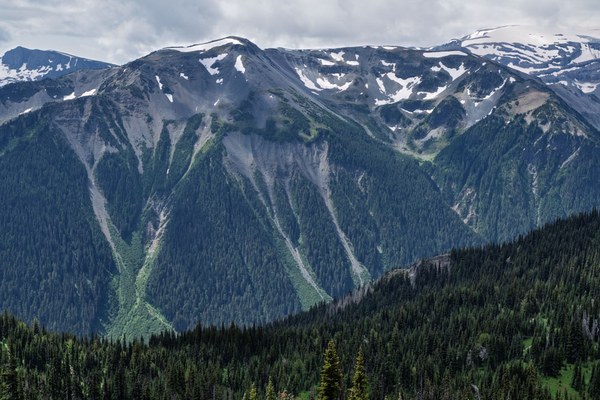
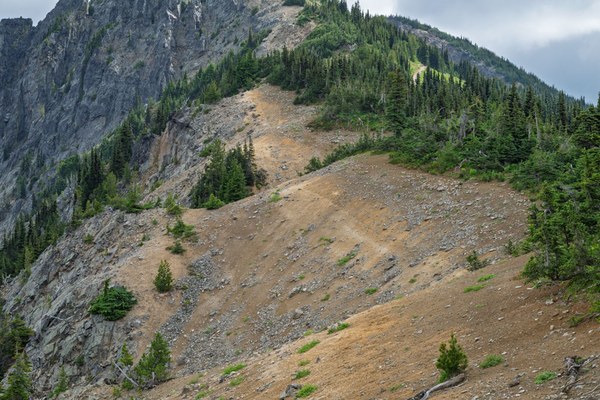
“Goat Island Mountain,” pointing south, then turning to point north, “ and McNeeley Peak and Fremont Mountain are older, from the West Cascade phase. They are in that 20-30 million age range.”
I paused while people looked back and forth.
Donna piped in, “What about Cowlitz Chimneys?” She had a grin on her face.
“Ha,” I said as I showed everyone where it was. “Yesterday,” I continued, “Donna showed me that mountain from Sunrise Point. I’d only identified it from Naches Peak, where it is a long way off. From Sunrise Point, it is so obvious. I did a ‘happy dance’ for Donna yesterday, I was so excited. I did an encore because I was still excited by my new knowledge.
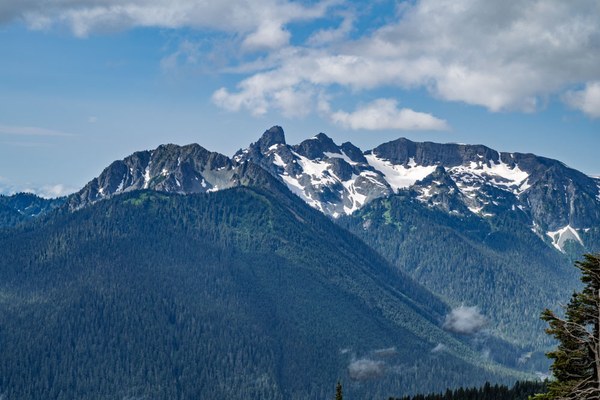
The highest Cowlitz Chimney rises to 7606 feet above sea level. Geologists think those three chimneys may have been the source of lava for the Ohanapecosh Formation. The Ohanapecosh is the base layer of Goat Island Mountain, the rocks along the road as you first enter the park, and all those headed toward Naches Peak and down toward Ohanapecosh Campground are part of that formation. They solidified approximately twenty million years ago and are the foundation of this part of the Cascades. The incredible part is that the vents were at sea level or even below sea level. Now, the plugs rise above the landscape of the park, providing a significant reference point.
Sourdough Ridge
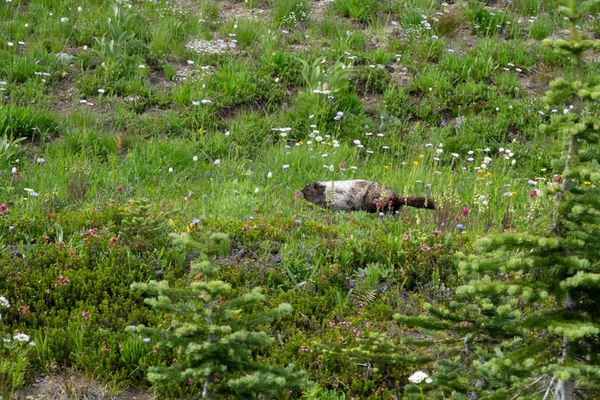
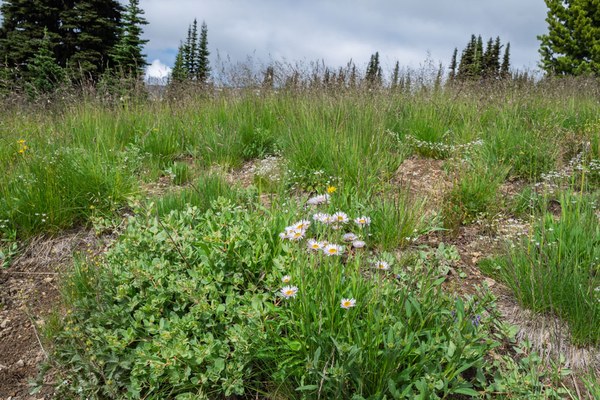
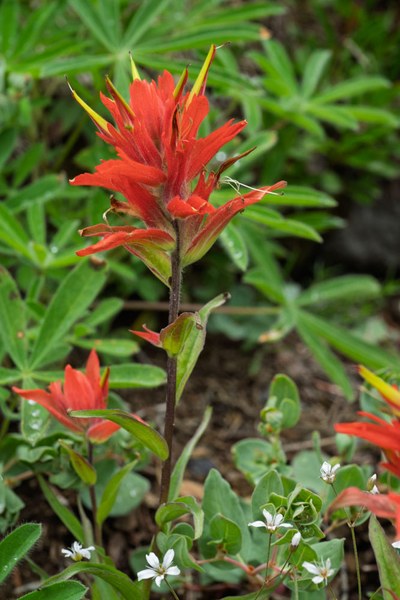
The trail along the ridge to Frozen Lake was wide, dusty, with a few rocks, and crowded with people. Most difficult, though, were the flowers, subalpine trees, and the views. It was hard to make much progress before something new would stop us. But isn’t that what staying in the moment is all about? Subalpine fleabanes in full bloom, Cascade asters just budding up, two species of paintbrush, partridge foot, rainiera, and so much more. A golden-mantled ground-squirrels scurried across the trail, and dark-eyed juncos flitted through the bushes. The deep croak of a raven rattled through the air. The metallic kraaks of several Clark’s nutcrackers gave us a chance to discuss the mutualistic relationship these birds have with whitebark pines.
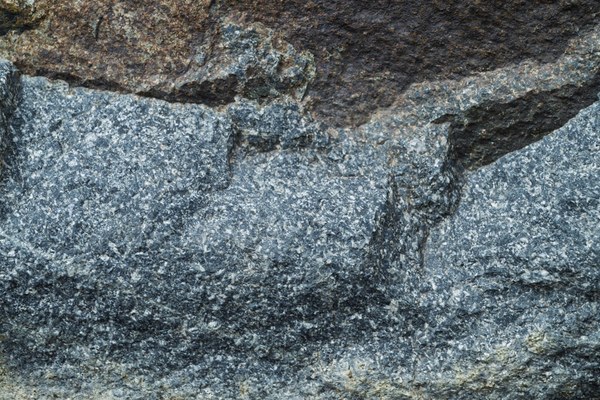
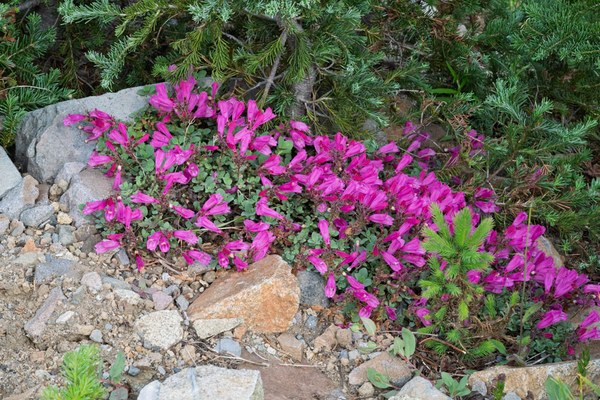
As the trail climbed toward Frozen Lake, the change in flowers began. The subalpine meadows transformed into alpine flats. The trees became stunted, showing the effects of snow, wind, and blowing ice, and the Krumholtz shapes took hold. Golden fleabane gave its yellow color to the brown of pumice chunks. Purple alpine lupine, spreading phlox, and Smelowskia dotted the flats. I tried to get everyone to get down on their knees to smell the beautiful white alpine buckwheat, but none would once it became known that this bloom smelled like boot socks that had been worn for five days straight.
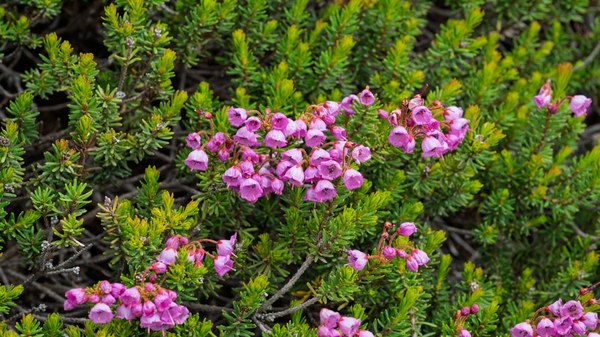
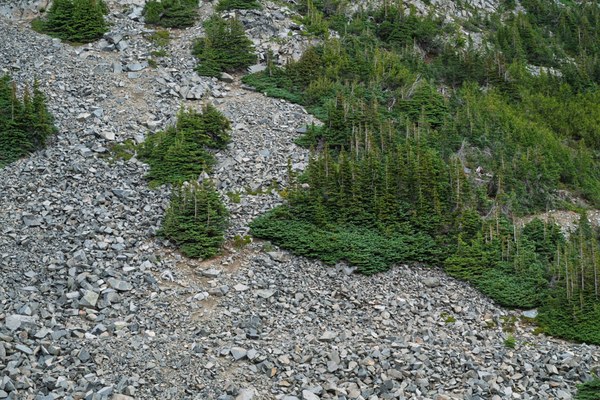 The shape of these subalpine firs is know as Krummholtz. They have been stunted by the wind and snow. The bottom curtain around each is generally below the snow while the trunk above the snow is battered by wind and flying snow.
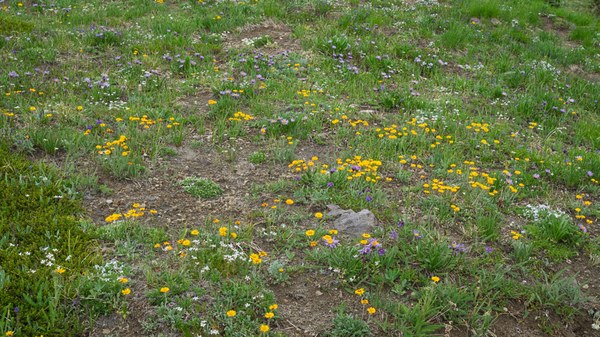
Along the southwest side of Frozen Lake, we achieved our highest elevation for the day, around 6,700 feet. Donna reviewed the landmarks in all directions, including glaciers, peaks, ridges, and valleys, and reminded folks of time. From here, it was downhill to our lunch spot.
Berkeley Park
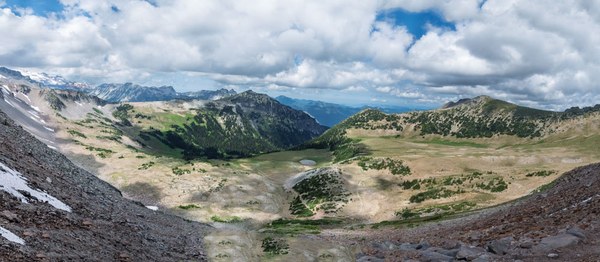
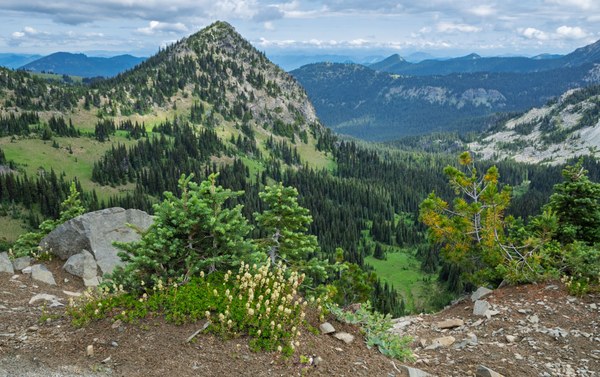
The descent into Berkeley Park is magical—Mount Rainier and its eastside glaciers tower over our path. Willis Wall rises like a giant fence, and then, Burroughs Mountain and its glacier-carved northern andesite cliffs look like a tidal wave about to break. Steep talus slopes flow down to a broad plain. Geologists call these flat, descending benches the McNeeley Drift. According to Vallance and Sisson in their USGS report, this drift was left by the Pleistocene Glaciers that filled these northside valleys until about 12,000 years ago. The one that carved out the valley with Berkeley Park seemed to have bisected the 455,000-year-old lava flow that formed Grand Park. Apparently, andesite that forms Grand Park is the longest known flow from Mount Rainier’s crest. I’ve never walked on that flow and hopefully this season it will happen.
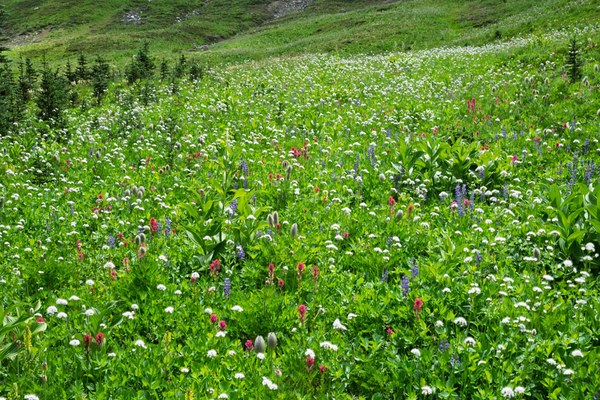
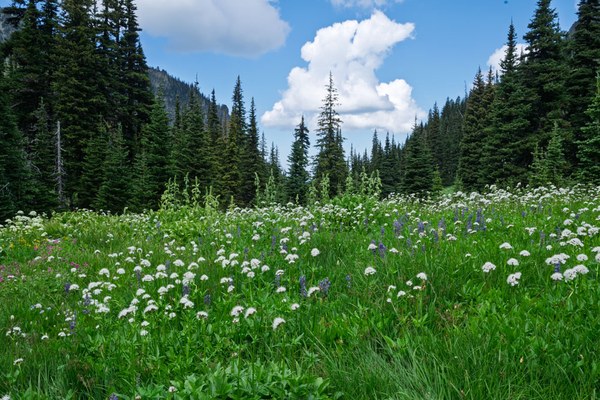
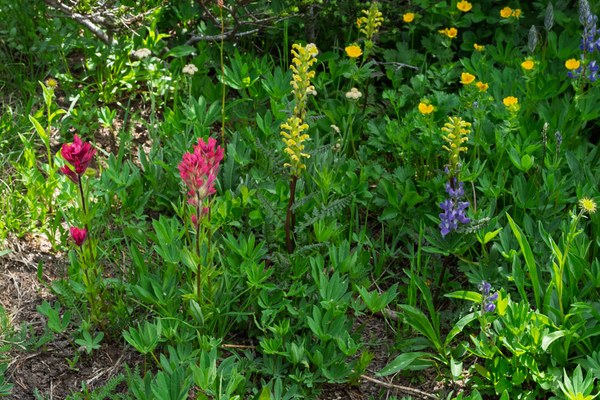
According to one of the books, the meadows will begin the switch from alpine to subalpine not far beyond where the Wonderland Trail cuts to the left and heads toward Skyscraper Ridge. The challenge to the group was simply, can we see that transition in the kinds of flowers we find, and we did. Fleabanes, lupines, asters, and others all began to switch, not all in the same place, for each species is uniquely adapted. Magenta paintbrushes reappeared, as did Sitka valerian. In one place, someone stopped us all to point, “Look, alpine lupines are up there, still pretty thick, and down there is our first subalpine lupine.”
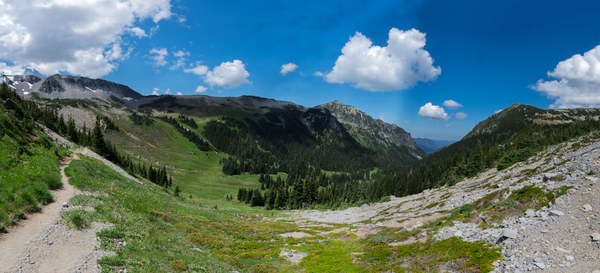
The trail makes a clockwise loop around the valley’s bowl, gradually dropping lower in elevation and weaving between clumps of subalpine firs. What I suspected was that a slight variation in aspect, soil, and moisture made differences in the meadow composition. Flowers close to the trail allowed us to study in detail, while the meadows gave us those panoramic views of beauty.
Lunch
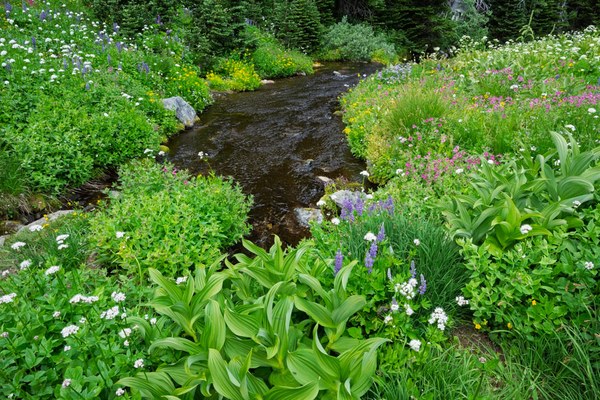
Once I asked a leader that I particularly admired what the most important things were about being a good leader. He said two things: know where “party separations” were possible and have a plan for lunch. The trail was crowded that day, and I’d hoped a small spot just ahead might be open. Lodi Creek disappears under the glacial till left by the Pleistocene ice and reappears as a beautiful flowing stream. The trail passes right by the spot, and numerous rocks provide perfect places to sit while absorbing the wilderness. Our luck was good, and no one else was there.
The water, crystal clear, bubbled out of the ground into a dozen-foot-wide stream, flowing over rocks and past banks covered in subalpine flowers. The slope behind us rose to the trail that curved down the valley. Purple lupine flowers were at eye level, a field of Sitka valerian extended across the flats to the right of the stream, and two species of monkey flowers grew close to the water. Donna jumped up to give all of us a quick overview of the species surrounding our picnic. People’s eyes sparkled in delight, and we all had an extra “wild” flavor to our sandwiches.
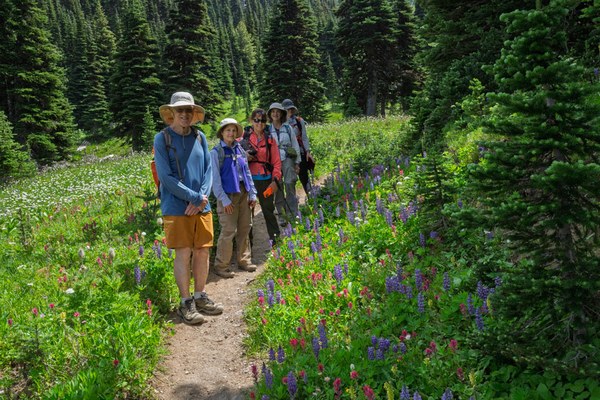 I’d hoped to continue farther down the trail to look for elephant head lousewort, but thick clouds had moved across Mount Rainier, and fear of possible thunderstorms crossed my mind. So, we started back up the trail.
Mountain Goats
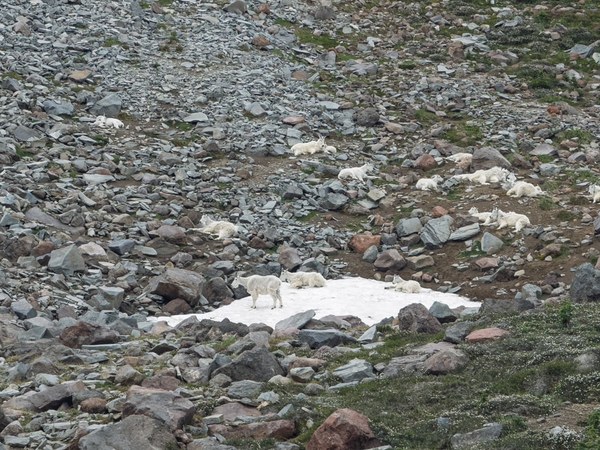
A herd of mountain goats slowed our climb back to Frozen Lake. We’d seen the group on the way down, and they had moved across the trail to be in the shade of Burroughs Mountain. Three groups spread along the talus slope—a total of forty or more goats, some with kids. Populations of goats in Washington have been decreasing over the last several decades. They are susceptible to climate change. Scientists think the summer droughts leave them in poor condition going into the winter, and then a severe winter period increases their mortality. It was a treat to see this herd and that they had young.
We made it back over the divide and down to Sunrise with no hint of rain or lightning. Safety should always be number one.
Berkeley Park Plant list at Mt Rainier - 23 July 2025 |
||||
| Family | Common Family | Scientific Name | Common Name | |
| Ferns | ||||
| Athyriaceae | Ferns | Athyrium filix-femina | common ladyfern | |
| Polypodiaceae | Ferns | Blechnum spicant | deer fern | |
| Dryopteridaceae | Ferns | Polystichum munitum | western swordfern | |
| Gymnosperms | ||||
| Cupressaceae | Cypress | Callitropsis nootkatensis | Nootka cypress | |
| Cupressaceae | Cypress | Thuja plicata | western red cedar | |
| Pinaceae | Pine | Abies amabilis | Pacific silver fir | |
| Pinaceae | Pine | Abies lasiocarpa | subalpine fir | |
| Pinaceae | Pine | Picea engelmannii | Engelmann spruce | |
| Pinaceae | Pine | Pinus contorta | lodgepole pine | |
| Pinaceae | Pine | Pseudotsuga menziesii | Douglas-fir | |
| Pinaceae | Pine | Tsuga heterophylla | western hemlock | |
| Pinaceae | Pine | Tsuga mertensiana | mountain hemlock | |
| Dicots | ||||
| Apiaceae | Parsley | Angelica arguta | Lyall's angelica | |
| Apiaceae | Parsley | Heracleum maximum | cow-parsnip | |
| Apiaceae | Parsley | Ligusticum grayi | Gray's licorice-root | |
| Apiaceae | Parsley | Osmorhiza berteroi | mountain sweet-cicely | |
| Aristolochiaceae | Birthwort | Asarum caudatum | wild ginger | |
| Asteraceae | Sunflower | Achillea millefolium | yarrow | |
| Asteraceae | Sunflower | Anaphalis margaritacea | pearly everlasting | |
| Asteraceae | Sunflower | Arnica cordifolia | heartleaf arnica | |
| Asteraceae | Sunflower | Arnica latifolia | broadleaf arnica | |
| Asteraceae | Sunflower | Cirsium edule | edible thistle | |
| Asteraceae | Sunflower | Hieracium albiflorum | white hawkweed | |
| Asteraceae | Sunflower | Senecio triangularis | arrowleaf groundsel | |
| Berberidaceae | Barberry | Achlys triphylla | vanilla leaf | |
| Betulaceae | Birch | Alnus viridis | green alder | |
| Boraginaceae | Borage | Mertensia paniculata | tall bluebells | |
| Caprifoliaceae | Honeysuckle | Linnaea borealis | twinflower | |
| Adoxaceae | Moschatel | Sambucus racemosa | red elderberry | |
| Crassulaceae | Stonecrop | Sedum divergens | Pacific stonecrop | |
| Ericaceae | Heath | Chimaphila umbellata | pipsissewa | |
| Ericaceae | Heath | Hemitomes congestum | coneplant | |
| Ericaceae | Heath | Orthilia secunda | one-sided wintergreen | |
| Ericaceae | Heath | Pyrola asarifolia | pink pyrola | |
| Ericaceae | Heath | Pyrola picta | white-veined wintergreen | |
| Hydrophyllaceae | Waterleaf | Phacelia leptosepala | narrowsepal phacelia | |
| Onagraceae | Evening-Primrose | Chamerion angustifolium | fireweed | |
| Ranunculaceae | Buttercup | Actaea rubra | baneberry | |
| Ranunculaceae | Buttercup | Thalictrum occidentale | western meadow-rue | |
| Rosaceae | Rose | Aruncus dioicus | goatsbeard | |
| Rosaceae | Rose | Rubus parviflorus | thimbleberry | |
| Rosaceae | Rose | Rubus pedatus | strawberry bramble | |
| Rosaceae | Rose | Rubus ursinus | trailing blackberry | |
| Rosaceae | Rose | Spiraea densiflora | rosy spiraea | |
| Saxifragaceae | Saxifrage | Micranthes nelsoniana | heartleaf saxifrage | |
| Saxifragaceae | Saxifrage | Micranthes odontoloma | brook saxifrage | |
| Saxifragaceae | Saxifrage | Tiarella trifoliata | foamflower | |
| Phrymaceae | Monkey Flower | Erythranthe guttata | common monkey-flower | |
| Phrymaceae | Monkey Flower | Erythranthe lewisii | purple monkey-flower | |
| Plantaginaceae | Beardstonque | Nothochelone nemorosa | woodland beardtongue | |
| Plantaginaceae | Beardstonque | Penstemon serrulatus | serrulate penstemon | |
| Monocots | ||||
| Liliaceae | Lily | Trillium ovatum | Pacific trillium | |
| Orchidaceae | Orchid | Corallorhiza maculata | spotted coralroot | |
| Orchidaceae | Orchid | Corallorhiza mertensiana | Pacific coralroot | |
| Orchidaceae | Orchid | Goodyera oblongifolia | western rattlesnake plantain | |
| Orchidaceae | Orchid | Listera caurina | northwestern twayblade | |
| Orchidaceae | Orchid | Platanthera stricta | slender bog orchid | |
| Marchantiophyta | ||||
| LIVERWORTS | Liverworts | Marchantia polymorpha | umbrella liverwort | |
| Bryophyta | ||||
| Moss | Moss | Dicranum fuscescens | dicranum moss | |
| Moss | Moss | Polytrichum juniperinum | juniper haircap moss | |
| LICHENS | ||||
| Lichens | Lichens | Alectoria | witch's hair lichen | |
| Lichens | Lichens | Peltigera sp. | dog lichen | |