Trip Report
Day Hike - William Ives Trail
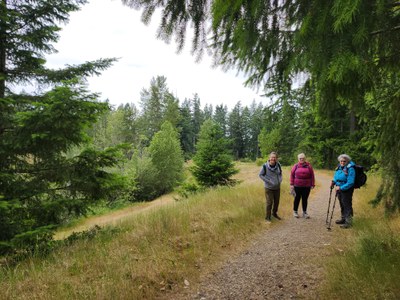
A Lacey city park in a greenbelt flanked by a golf course and suburban subdivision provides a surprisingly woodsy walk and a touch of history. 2.5 miles and 100' elevation gain according to Caltopo app on a cell phone.
 Mike Forsyth
- Thu, Jun 12, 2025
- Day Hike - William Ives Trail
- William Ives Trail
- Day Hiking
- Successful
-

- Road suitable for all vehicles
-
This trail obviously gets some maintenance, and was in good condition with no obstructions when we hiked it on June 12, 2025. It does not appear that would change much with the weather or seasons.
The William Ives Trail is in the northeast corner of the City of Lacey, and is under the jurisdiction of the Lacey Department of Parks, Culture and Recreation. It begins in the Meridian Neighborhood Park, in the Meridian Campus development, and is bounded on the east by Meridian Road NE. The meridian after which all this is named is the Williamette Meridian and base-line, a north-south line laid out by three surveyors, including William Ives, from Portland, OR to the shore of the Nisqually Reach in Puget Sound. Subsequent surveys, town, range and section divisions, deeds and titles were and are based on that line. Ives started on June 4, 1851, from Washington Park in Portland, OR, near what is now the Portland Zoo, and finished up laying his line a few feet from where this trail now bears his name. The April 13, 2017 edition of The Olympian highlighted the William Ives Trail as its "Trail of the Week", and gave a brief account of Ives's work.
This trail is more of a casual walk than a hike. We logged 2.58 miles and 104' elevation gain according to Caltopo on my cell phone. After some surgery last December, I was doing short hikes in my neighborhood and in nearby parks a few times a week for re-conditioning and rehabilitation. At the annual Hiking and Backpacking Committee meeting in February, the Chair made a request for more short, local, less strenuous hikes that didn't take all day. I was doing this anyway, so I decided to start putting some on the schedule on weekdays. The distance is usually two to three miles, and elevation gain is typically 200 to 300 feet. I have been gradually increasing my pack weight for conditioning, but have kept the pace and distance the same for members who, for whatever reason, are looking for easy to moderate exertion. The typical hikers on these walks are of retirement age, and many have the typical range of reasons for seeking easier hikes.
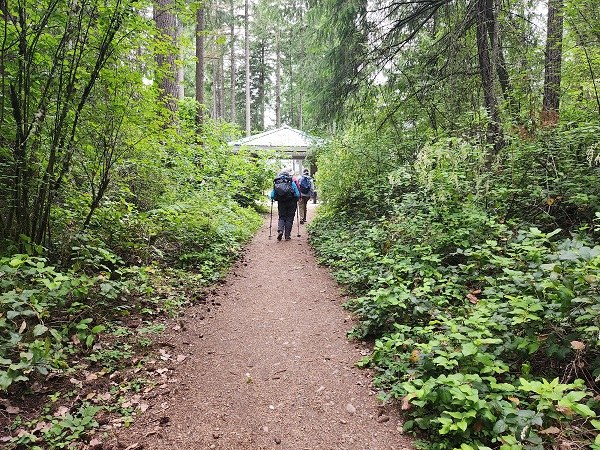
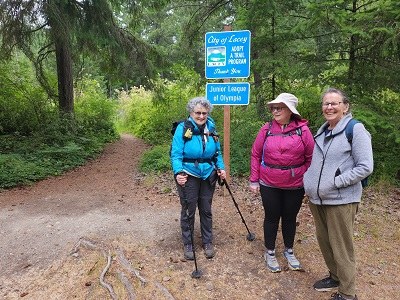
Four of us met at 9:30 a.m. at the trailhead parking lot at the Meridian Neighborhood Park. The lot has room for a dozen or so cars. A few steps to the southeast are the park restrooms. A few yards to the northeast is a covered picnic pavilion. On the other side of this, the trail begins through a wooded greenbelt. In a few hundred feet, take the first left turn. The trail then crosses Campus Drive NE, and an obvious trail enters the woods. Neither this end nor the east end has a sign identifying the trail by name. Each has a sign that makes reference to the City of Lacey Adopt a Trail Program. It was adopted by the Community Impact Committee of the Junior League of Olympia in September of 2023. They maintain it at least one day per quarter.
Once into the woods, we were soon under a high canopy of mixed species, passing through a thick understory with much decaying woody material. One of the hikers is a naturalist leader, and she identified Corallorhiza striata, the spotted coral root, a wild orchid which does not perform photosynthesis and has no leaves, but has a parasitic relationship with a fungal mycelium. It is not very common, but we found several specimens along the trail.
The Golf Club of Hawks Prairie has a series of tees, fairways and greens to the north running parallel to the trail. There is a short side trail to an overlook, with a view of a water hazard, similar to scenic lookouts on bigger trails. Similar, but not the same. On the south, mostly at a respectful distance and easy to ignore, are tract houses and suburban backyards. The trail has a surprisingly forest-like ambiance, considering that its 1.3 mile length is in a 35-acre greenbelt. The trail and the development are well laid out to make use of the space. And as small as thirty-five acres is, a lot of housing units could have been fit into that for the sake of maximizing sales and profit, or serving a narrow and sterile view of social utility. Instead those acres have greatly enhanced the quality of life for Meridian Campus residents, and offer a public good to the larger community. This green space was a condition for approving this development.
At Campus Park Drive NE, the trail spills out onto the sidewalk. This is the end of the city-owned trail. Across the street, on land belonging to a property owners association, the walking trails continue and loop around a fair-sized pond, which is a rain catchment basin. Directly across the street is an unmarked path between a madrona and a Douglas fir. Take this to an intersection of several trails, and go downhill and bear left to the higher of two paths around the pond, which goes around the pond clockwise. You may also walk the sidewalk on Campus Park Drive, then turned left onto Stevens Drive NE. We got to where my cell-phone Caltopo map showed a trail to the pond, and saw a very indistinct break in the shrubbery, which we followed down to a very distinct trail circling the pond.
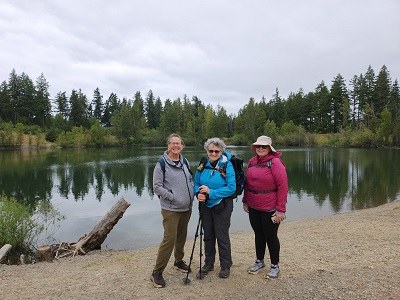
We walked around the pond and found a very short side trail, which we walked to the shoulder of Meridian Road, in acknowledgement of the namesake of the trail. We finished our circum-ambulation of the pond, found our way back to Campus Park Drive, crossed it and retraced our steps to the Meridian Neighborhood Park, coming out at the pavilion an hour and a half after we started.
This trail offers a very sylvan experience sandwiched in suburbia between the links and the backyards. After many hikes in Tolmie and Squaxin parks and a few others in the previous five months, it was a nice bit of variety. It offers unexpected treasures such as the spotted coral root orchid, and we all noted the almost complete absence of litter in the woods. It does not appear to have been listed on The Mountaineers' schedule recently and maybe not ever before. It's not a high intensity workout. But if you want to quicken your pulse at a relaxed pace, it is a nice place to do it.