Trip Report
Crag Rock Climb - Absolute Serenity Now - Quartz Mountain
The first 7 pitches of this new-ish 14-pitch climb in the Middle Fork area.
 Steve McCarthy
- Sun, Jun 29, 2025
- Crag Rock Climb - Quartz Mountain
- Exit 34
- Climbing
- Successful
-

- Road suitable for all vehicles
-
Good paved road. CCC trail in good shape. Climbers' trail up the drainage was rocky, rooty, and brushy. We did actually find some running water below the start of the climb.
Trip Report – Absolute Serenity Now
Quartz Mountain, Middle Fork Snoqualmie
Date: June 29, 2025
Team: Steve, David, Mire, Kelly
Time: 11 hours car-to-car
We set out on June 29 to climb Absolute Serenity Now, a new 14-pitch sport route on Quartz Mountain in the Middle Fork Snoqualmie area. The plan wasn’t to tackle the entire line—it’s long, and recent beta had suggested the first seven pitches were the best climbing of the route.
The day began with a rugged approach. We parked at the CCC Trail and started uphill, quickly finding ourselves deep in brush and uneven terrain. As we pushed upward through the Mailbox-esque trail, we found ourselves in an unspoken foot race with a couple of other parties, all of us eager to claim pole position at the first pitch. Even at a steady but deliberate pace, it took us about two hours and twenty minutes to reach the base of the climb.
The climbing itself was moderate and enjoyable—definitely more about movement and mileage than difficulty. Pitch 1 started on slab and led up into an open book feature. A fun little undercling/lieback sequence brought us to the anchor and gave us a taste of what was to come.
Following the party ahead of us, we chose to link pitches 2 and 3. They’re short enough to combine, but both follow arc-like lines, and even with some strategic back-cleaning, we ended up with frustrating rope drag. If you’re only carrying quickdraws, we’d recommend keeping the pitches separate—unless you’re packing a lot of alpine draws and are really diligent about extending everything.
Though it hadn’t rained in days, we still encountered wet, seepy sections on those pitches—something that seemed to be a recurring theme on this climb. Pitch 4 meandered too much to combine with anything else, but it was straightforward enough.
Pitch 5 was where things got just a little spicy. After a short climb, the line traverses right across an exposed, brushy slab that was still wet. We missed one of the bolts—tucked away somewhere in the foliage—and ended up making a sketchy, committing move to gain the next one. It was a little nerve-wracking, but we kept moving and made it safely to the anchor.
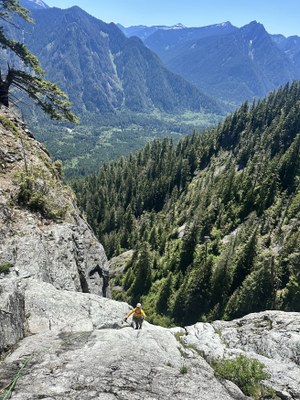
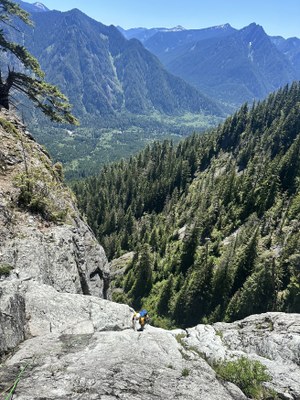
Pitches 6 and 7, which we also combined, delivered the day’s crux—not in difficulty, but in route-finding. We couldn’t spot any bolts above the pitch 5 anchor and, thinking we were on route, started climbing left. That led us into a series of committing, run-out moves up to what turned out to be the third bolt of the pitch. Only on the descent did we realize that the actual start of pitch six is up and right from the anchor, tucked inside a damp corner that still had water running down it. According to the group ahead of us, when they had started that pitch earlier in the morning, there was water flowing freely from that corner.
To manage rope drag on the combined pitch, David back-cleaned a few bolts, which helped—but even so, we weren’t entirely sure we’d combine them again. That said, pitch seven was a great way to finish our climb: a clean, high-quality slab leading up to the final anchor.
From the top of the seventh pitch, it’s possible to rappel the route in three full 70-meter rope rappels, but we ended up doing four. Our first rap was a short one down to the top of pitch six, and from there we continued down without issue.
Traffic on the wall had built up over the day. There were at least six teams on the route, and the bottleneck at the top and bottom of pitch six got a little congested as some teams were still coming up while others, like us, were heading down. One team mentioned they’d climbed the whole thing just a few weeks earlier and had the place completely to themselves. Not so for us—but it was still manageable with a bit of patience and communication.
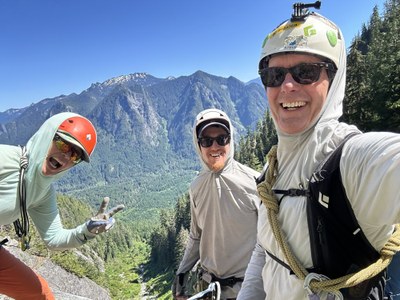
After rapping down, all that remained was the long hike back out. The descent mirrored the approach: rugged, steep, and brushy. Tired legs and fading light made the last section a bit of a slog, but we got back to the car with smiles intact.
All told, it was an 11-hour day car-to-car. Absolute Serenity Now lived up to its name in parts—peaceful climbing in a remote setting—but also served up its share of challenges. We’d recommend it for teams comfortable with route-finding, wet rock, and managing rope systems over many pitches. A great adventure, and a worthy objective for a long day out in the hills.