Trip Report
Bailey Range Traverse
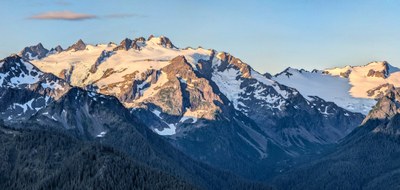
An amazing and challenging, largely off-trail, multi-day backpack/scramble/climb across the rough and rugged Bailey Range of the Olympic Mountains. It offers seclusion and beautiful panoramas of jagged peaks and glaciers deep in the Olympics, along with views of Mount Olympus at almost every turn. Once you leave the High Divide Trail, you may find a faint boot path, but it often fades to nothing and you will find glacier and snow travel, scrambling, and hiking on scree and talus slopes. The route offers options for peak bagging, scrambling, and climbing.
 Barton Place
- Mon, Jul 21, 2025 — Fri, Jul 25, 2025
- Bailey Range Traverse
- Climbing
- Successful
-

- Road suitable for all vehicles
-
The conditions were just about optimal for us. The road is paved all the way to the trail head. The established trails were all in great shape, and there is some scree traversing, but carful foot placements kept it reasonable. The cable ladder near Glacier Meadows camp was in pretty good shape with only a couple of broken rungs. The glaciers were a mix of snow cover with some melted down to ice. Fortunately for us the icy sections were low angle and we were able to navigate them without protection. We also crossed a number of snow fields and we used crampons on all of the glaciers and many of the snow fields.
The route we selected required one rappel down a scree/dirt/rock gully near Mount Olympus Middle Peak. There is a large bolder at the top for an anchor and you navigate across a snow bridge over the bergschrund at the bottom of the rappel. The week prior to our arrival, another team rappelled the gully and replaced the tat so it was in good shape.
There was water at every camp (but it was a stagnant tarn at the first camp and most of us carried water from Heart lake for that camp) and many places along the route (all marked on the map in the description below). The last toilets is at Heart Lake on one end and for us Glacier Meadows Camp on the other. We only saw one other party of two when out on the Baily Range. Fortunately for us the bugs were never much of a problem, but we did encounter one bee's nest on the last day going out on the trail heading up to Ho lake. The weather was great every day and the stars were exceptional out there.
On the third day we did have to do some bush whacking through dense forest and Slide Alder to get up from the Queets Basin up to the Humes Glacier. However it was only for a mile or two and wasn't too bad.We saw two bears (one a long ways away across a valley and one pretty much on our route). We yelled and encouraged the bear on our path to move along and eventually he/she headed up the slope and we passed below. We used bear canisters for all of our food, and did not see any around any of our camps.
The timing of our trip was good as there was just enough snow to cross some of the tricky sections on easy snow rather than loose scree gullies (e.g. getting off of the Humes Glacier) and not much exposed ice on the steeper sections of the glaciers. There was also ample water flowing along the route.
One of my friends sent out an email with some "Summer Camp" suggestions and one option that came up was the Bailey Traverse. It has long been on my list of trips to do so I jumped at the opportunity. It is more than your typical backpack so it took a bit of planning to pull it all together. It is in the Olympic National Park so we needed camping permits and bear canisters.
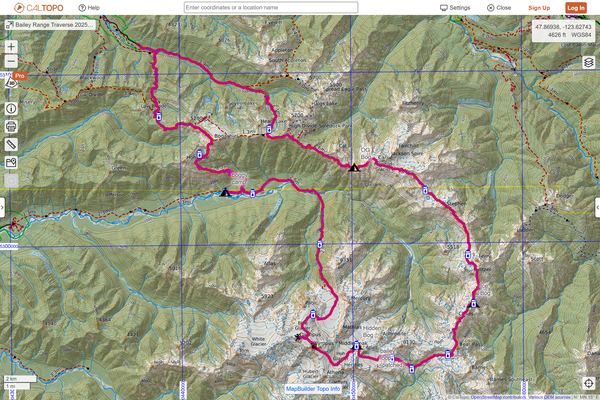
Five of us decided to join in this adventure and we started by looking at a number of routes from CalTopo.com (a great tool and highly recommended). Since portions of it are off trail and lots of people have done it, there are many options. In the end we used a gpx route from a group that had done the traverse a week earlier as a general guide for this trip. Here is our itinerary and route:
Day 1: Sol Duc to Boston Charlie (dirty bog) 17.0 miles On Trail
Day 2: Boston Charlie Camp to Bailey Ridge 5.5 miles Off Trail
Day 3: Bailey Ridge to Camp Pan 7.5 miles Off Trail
Day 4: Camp Pan to Hoh River Guard Station 16.5 miles On/Off Trail
Day 5: Hoh River Guard Station to Sol Duc 15.0 miles On Trail
Planning
One of our industrious tripmates Rebecca took on getting permits which required emailing the Olympic National Park Rangers several days prior to our trip with an itinerary and phone number so they can call you back. They will get back to you (hopefully) and if they don't you may need to follow up with them. More information on permits can be found here: https://www.nps.gov/olym/planyourvisit/wilderness-reservations.htm. Rebecca was able to secure us camping for 4 nights at the camps we were hoping to get. Most of the campsites in the Sol Duc and Seven Lakes basin area are booked well in advance so we picked our first camp out past Heart Lake making for a pretty big first day. There was less pressure on the campsites on the off trail section and there are a number of sites at Lewis Meadow and the Olympus Guard station for the last night on the way out.
For group gear, we decided on two tents (a 3 person and a 2 person), 3 stoves, 5 water filters, and individually planned meals for 5 days. All the info was collected in an online document along with a climbing gear list, general gear list, group gear list (tents, stoves, fuel, first aid kits, communications (inreach), filters, meal planning, and travel logistics that we all contributed too. Three days before the trip we had a zoom meeting to discuss the trip with all participants.
Day 1
Starting from Seattle, Ellie picked me up at 5:00. We drove around the Sound to avoid the ferry traffic to meet the rest of our team at a bakery in Poulsbo where everyone got doughnuts. We then proceeded to the coffee shop for breakfast burritos, yum. Next stop was the Sol Duc Falls trail head. We completed our last packing, and I finished the final work on my new pack, and weighed our full packs that ended up being between 33 (Barton) and 39 (David) lbs. We left the cars at 11:00.
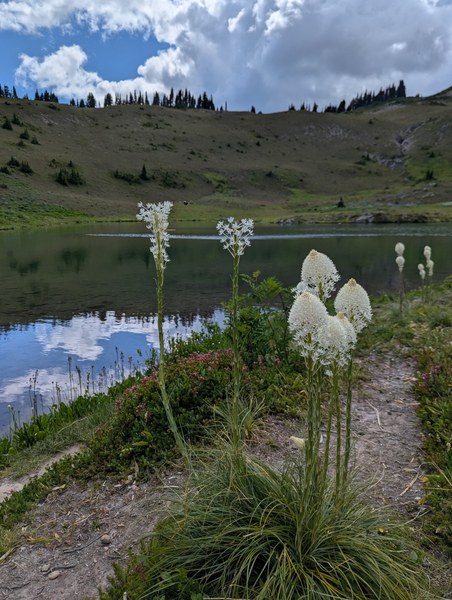
The first day was all on established trails (except across the catwalk) passing Heart Lake after 8.2 miles. We saw lots of people while hiking to Heart Lake and after that we only saw two people until we got back to Olympus (three days later). The trail ascends to the High Divide ridge from the lake and then follows it for a bit until the Bailey Range trail branches off and descends into the woods towards Cat Peak. After passing the last off ramp back to civilization (on the high divide traverse trail) the trail crosses the west flank of Cat Peak following the 4800' contour. Just before reaching the catwalk the trail turns abruptly uphill and scales the flank of Cat for a little over 150' before dropping back down onto the catwalk to avoid a cliffy section.
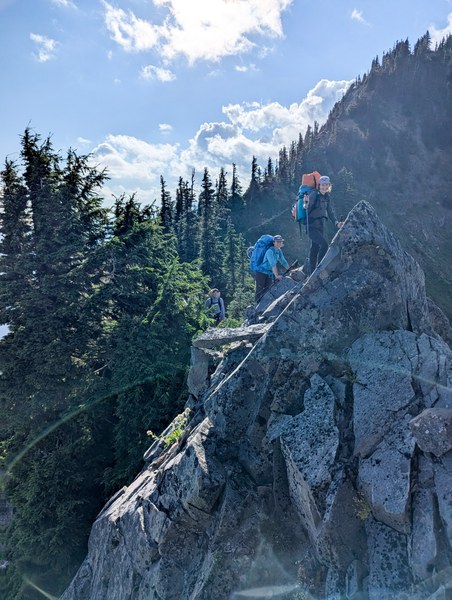
The catwalk is a jumble of boulders perched on the ridge between Cat and Carrie. At the end of the catwalk there is a small bog (some folks used for water, others didn't) with a couple of nice tent sites and this is where we stopped for the first night 17 miles from the trail head.
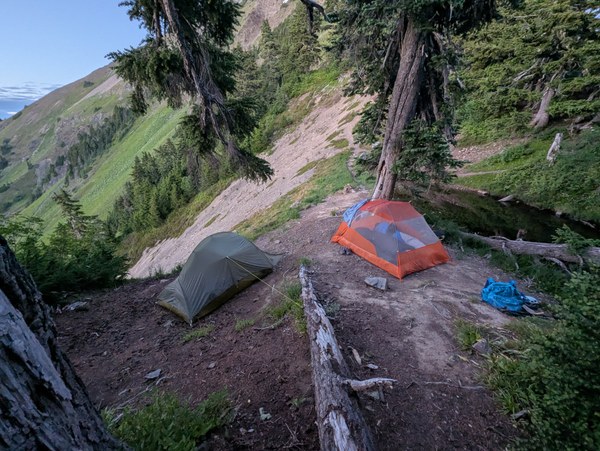
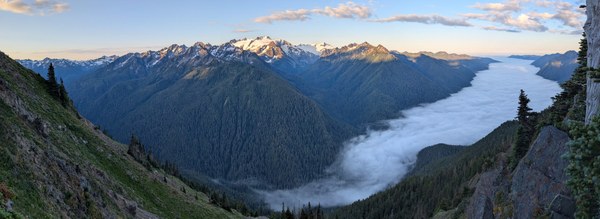
The camp is situated with a northerly view out to the straight of Juan de Fuca on one side of the ridge and out to Olympus on the other. You can also see a good portion of the rest of the route from there and we all sat in awe of how far away everything looked.
Day 2
On the second morning we woke up to an amazing sunrise and watched a bear enjoying their breakfast of blue berries and grubs across the valley. After breakfast we struck out a little after 7:00 heading up the hill and we met a young Buck deer cruising down the trail. He diverted and we continued up the trail but shortly left the trail heading up the ridge of Carrie towards the summit and the North side of Carrie to traverse the Fairchild glacier rather than following the side hilling route on the South face of Carrie. Eventually the ridge becomes too sharp to walk and the team followed an upwards traverse across the upper scree covered flanks of Carrie eventually reaching the summit.
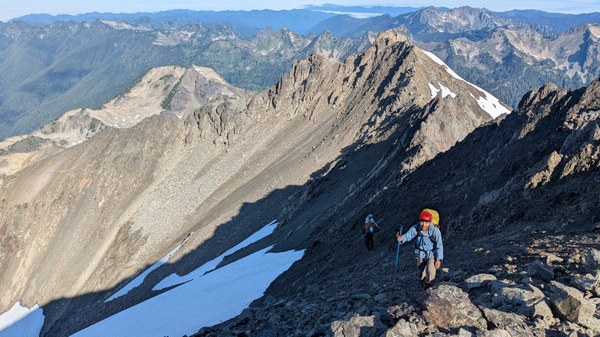
There are beautiful views of Olympus and almost all of the Bailey traverse from the top and we took a nice long break there soaking in the beauty. We also scoped our a potential route down the glacier to the end of the valley under Ruth peak and up and out through the next pass into the Stephen lake valley.
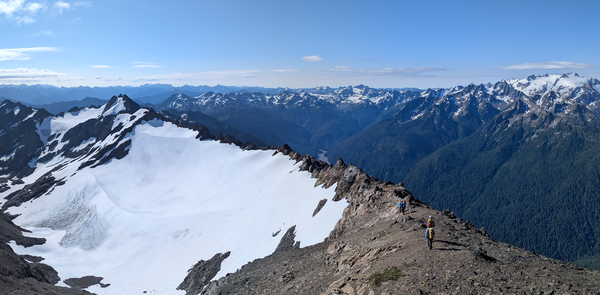
Next we made our way down the ridge to the south until we reached lower angle access to the Fairchild glacier at 6700'. We donned crampons and ice axes and set off down the glacier following a wind formed ridge running down the glacier similar to the hogs back on Mt Hood. Travel was great on the snow and we were able to follow the route we scoped out from the top of Carrie down to the exit col on the shoulder of Ruth. The exit was a little bit steeper (35-40 degrees) to get out, but went fine with good snow next to an icy patch on the glacier. We topped out in the col at about 6430'.
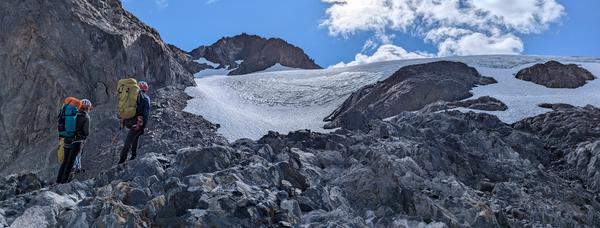
and then the route drops back down to Stephens Lake in a beautiful post glacier bowl over broken talus and a few snow patches where we stopped for a water and snack break just before reaching Stephens Lake at 5100'.
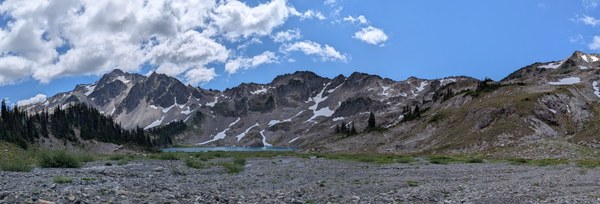
Unfortunately the mosquitoes found us here and it wasn't quite as relaxing for some of us. From here we could see the general direction of our exit out of the Stephens bowl, but didn't see much that looked good other than steep snow and talus slopes but as we learned through the trip, trust the process and like the room of requirements, the solution will present itself when needed and we continued on. There was a log part way across Stephens creek that we used to get across.
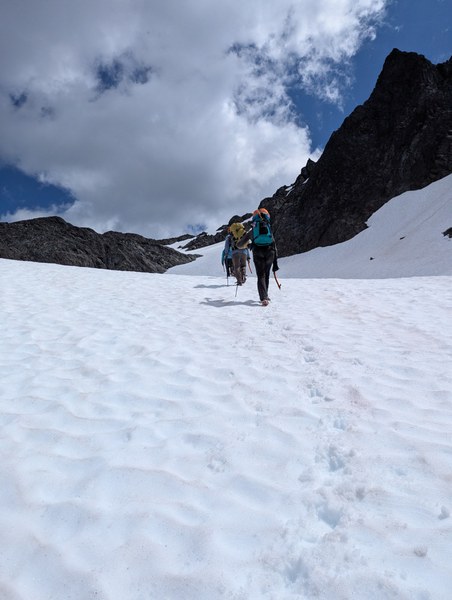
As we got closer to the slope it didn't look quite as intimidating, and we worked our way up eventually getting to snow and an easy route to the top. We caught up with and met the only people we would see on the traverse part way up the slope. Mr. and Mrs. Bailey (to us). Mr. Bailey seemed much more gung ho about the trip than Mrs. Bailey. We learned they had the same itinerary as we did. The exit gully topped out at 6250' near Mt Stephen's summit.
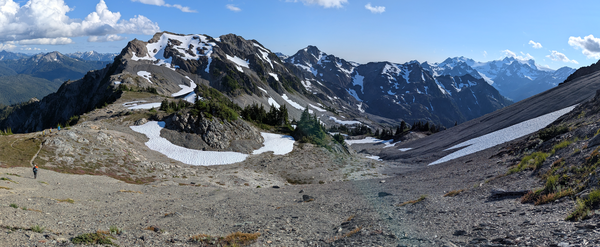
At the top the route descends across one more snow field before opening up onto a gorgeous ridge line and then traverses down the west side of the ridge to another set of beautiful lakes under Mount Ferry and Mount Pulitzer. We stopped for a break at the lake under Mt Ferry a little before 17:00 and we were about 4.5 miles from our planned camp for the night. The break conversation was about what we should do about falling behind our schedule.
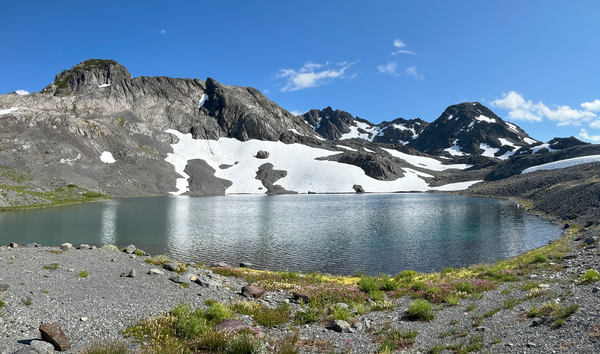
We evaluated a few options for plan B including exiting to the south, retracing our route back out, and pushing forward. In the end we decided that plan B should be plan A (harder) and that we would push forward as far as we could towards our planned camp site but would stop when it got dark (no night ops).
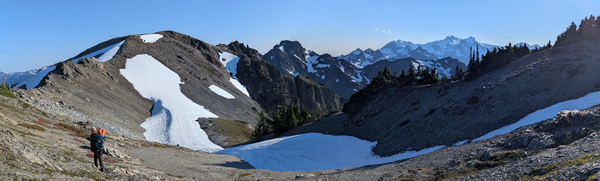
As you pass Mt. Pulitzer The route runs along a bench on top of an extremely steep cliff band guarding the eastern edge of the Bailey Range. The bench ends at the foot of Bailey Ridge with a short moderately steep snow field (at about 5750') to climb to get on the ridge at 6000'. Once gaining the ridge there is another section of ridge walking with amazing views in all directions. Fortunately there were some nice camps along the way and we found a great spot (flat, water source, beautiful views) about 1.5 miles from our planned camp site and stopped there for the night.
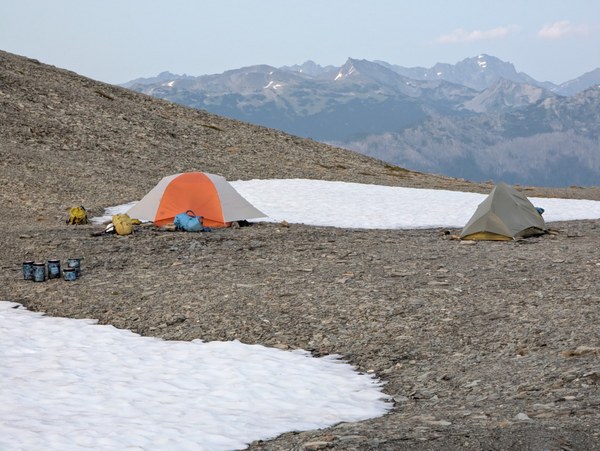
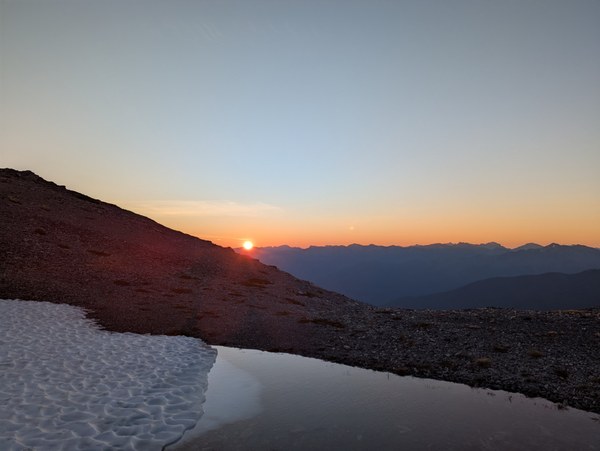
We called this site the Ice Bog as the tarn/bog that we camped by was still partially covered with ice. We all felt good about where we were and that we could make up the 1.5 miles the next day. After setting out our bear canisters on the ground away from camp we watched another beautiful sunset. We settled in for a good night's sleep.
Day 3
The next morning we got up a little earlier so we could start hiking at 6:00 and it was another spectacular day in the Olympics.
We were excited for the day that we would face the "bushwhack", glacier climbing, and reach Camp Pan (the most anticipated campsite on the trip). The route continues weaving in and along the Bailey Range highest ridge lines traversing across the southern flank of Mount Childs out to Bear Pass. We did a little scree skiing through this section. The route generally travels above the steep cliff on the Eastern side of the Bailey Range through this section.
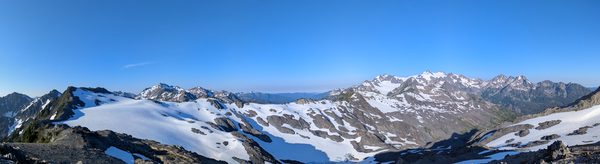
Here, there are views to the east of the Hume Glacier and we could see concerning blue ice protecting the access from the bottom, but we would deal with that when we got there. From just below Bear Peak at 5600' we dropped down into the Queets Basin and followed the Queets river down to around 3600'.
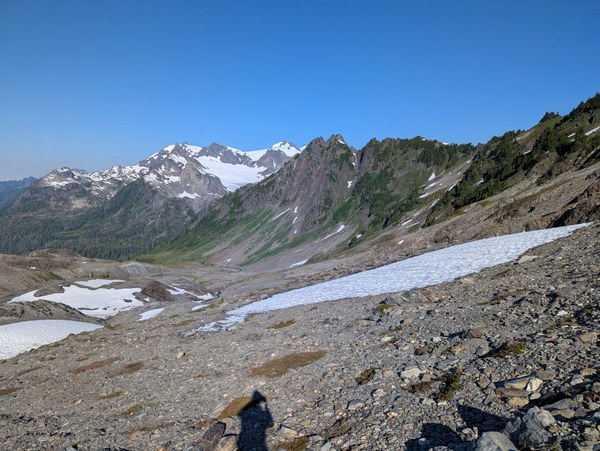
This descent generally follows the Queets down the valley traversing above the creek but below the steeper valley walls. We encountered another young bear here having this breakfast of blue berries (very plentiful) here and he wasn't too interested in moving. David started singing and calling loudly to prod him along. He eventually did move but as soon as he got around the corner and out of sight, he stopped to start eating again. When we rounded the corner and saw him David started singing and encouraging him to move along. He begrudgingly kept going, but again stopping as soon as he was out of sight. Finally on the third encounter he decided to move farther away and headed upslope out of sight for good.
Shortly after parting ways with the bear, we came to a faint path heading up a valley leading to the Humes Glacier. It was on the East side of the creek and our beta mentioned that staying on this side of the creek would lead to a challenging bushwhack and crossing some steep gullies, but you might be able to find a route across the creek in that area so we headed up it looking for a way to get down to the creek and over to the west side. It took a little searching but we were able to find a path at 3600' leading down the steep valley wall and across the creek at 3500'.
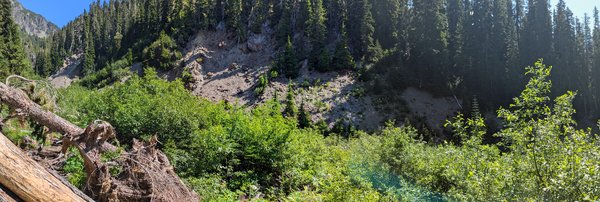
From here we started following the creek up and turned up a side tributary (mostly dry) creek and quickly arrived at a small 20' step/falls in the creek. We discussed retracing our steps or continuing on and decided to continue on which led to some bushwhacking scrambling (we set up a quick hand line for pulling over the top to get out of the creek gulley) to get up the next 100' or so, but once at the top of this we found a faint game trail and travel became a little easier. It would have probably been better to go a little farther upstream on the main creek rather than following up the side tributary, but in the end this put us on a good route up the west side of the creek. David led through this section and found several weaknesses in the terrain and vegetation allowing us to make better time than expected working up the bushwhacking section.
We stopped partway up for a short lunch break, and then continued to push up through the slide alder. About 1/2-3/4 of the way up we discovered a bunch of metal parts from a plane crash of the past that were spread across a large swath of the route. This was likely from the October 4,1956 -crash of two U.S. Air Force F-89 aircraft about four miles from Mount Olympus (additional details are available from Facebook at Airplane Crash). At this point there were a couple more short sections of slide alder
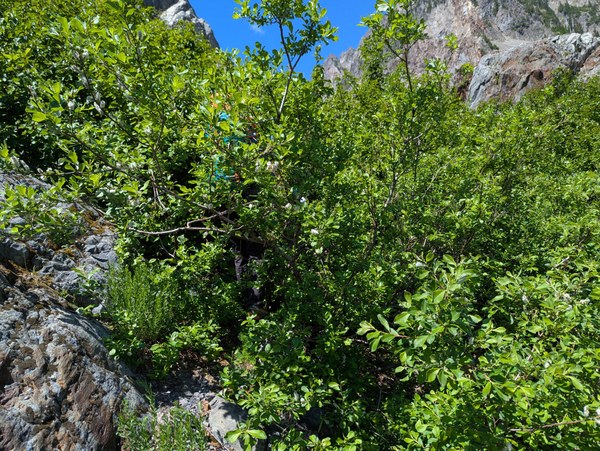
Eventually t the route began to open up as we reached tree line in the moraine gully below the glacier. Just before reaching the toe of the glacier, there is a steep cliff, but traveling climbers left (at 4500') of the face there are some rock benches that are easily scrambled up. The Hume glacier came into full view as we crested the cliffy band and the bottom was blue ice as we had seen from across the valley earlier.
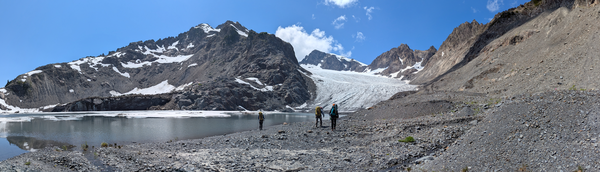
Fortunately it didn’t look too steep or crevassed. We found a nice snow fed stream and stopped for a break and filled water across from the proglacial lake.
We headed up donning our crampons as we transitioned on to the glacier but didn't rope up as all of the cracks, runnels, and moulins were exposed and easily visible. We made our way up this section rather quickly as there was evidence of fallen rock from the steep loose walls on the glacier surface. Once we reached the snow covering the glacier we roped up in two teams (one of 3 people and one of 2 people). The glacier travel was pretty straight forward here and we made good time reaching the exit gully in the mid afternoon.
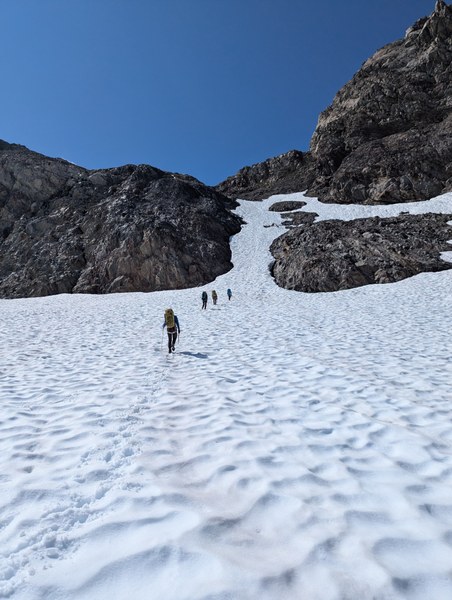
It was a steeper 35-40 degree snow finger part way up ending in a loose rocky scramble towards the top through Blizzard Pass.
The top is a nice flat snow field at 6150' that opens up with amazing views of Circe, Aries, Athena, and Aphrodite (on the ridge you are on) along with Mt Mathias and Mt Olympus (middle and east peaks) across the Hoh Glacier.
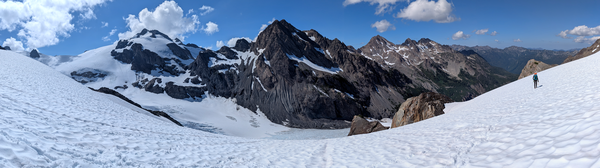
From there it is a short 1/2 mile descent 600' down to Camp Pan (the most picturesque campsite I have ever stayed at). We were roped up for this descent and did see a few crevasses on the way down to the camp.
The camp site is situated on a small peninsula in the sky surrounded by a cirque of high jagged rocky peaks, glaciers, and snow fields. We set up our tents, filled up with water from a great small snow fed drip towards the bottom of the camp and spent the late afternoon lounging and soaking up the amazing scenery in all directions. 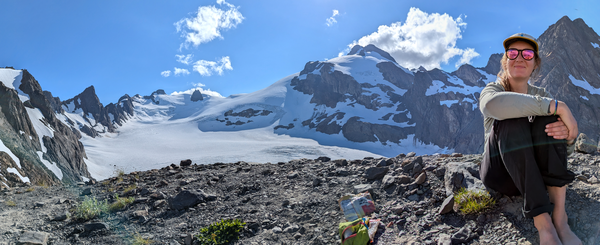 There are several good tent sites at this camp and I highly recommend any tour through this area including a night at this location.
Day 4
The next day dawned clear again and we got up and prepared for our biggest glacier day along with a short rappel as we traversed between Mt Olympus East and Middle peaks culminating in a short rock climb up Mt. Olympus. We left camp at 6:00. Getting off of Camp Pan is a little convoluted and starts by climbing back uphill through the rocks to the second gully up from the camp site and scrambling it down to the snow.
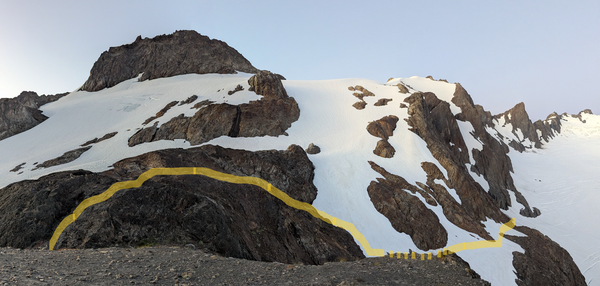
Once on snow we descended about 150' down the fall line until we could see a path going SSW traversing down towards the Ho Glacier. This was mixed snow and rock and the rock is loose through here. Once down on the Ho Glacier we roped up Rebecca took lead and continued up the Ho Glacier navigating around some of the larger crevasses. We stayed climbers left traveling up the glacier until we reached a lower angle ramp to take us up and back towards Middle and East Olympus.
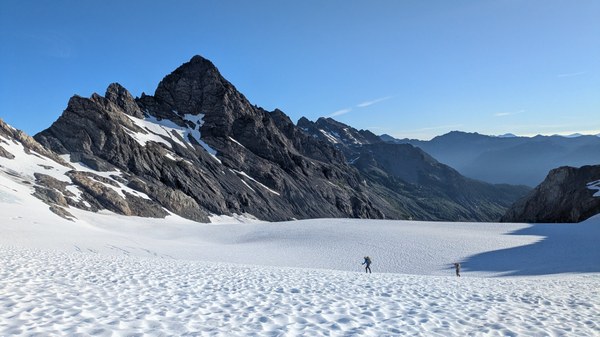
It is about two miles up to the top of the glacier and the summit blocks for Middle and East Olympus. There is a rappel station set up between the two mountains. It is closer to Middle Olympus and between Middle Olympus and a small 7600' sub peak. The rappel is down a steep dirt/mud face and the anchor is a large boulder sitting on the edge of the face. We all evaluated the rock and anchor and determined it to be safe. The anchor cord had been replaced the week before we climbed by some friends of Rebecca.
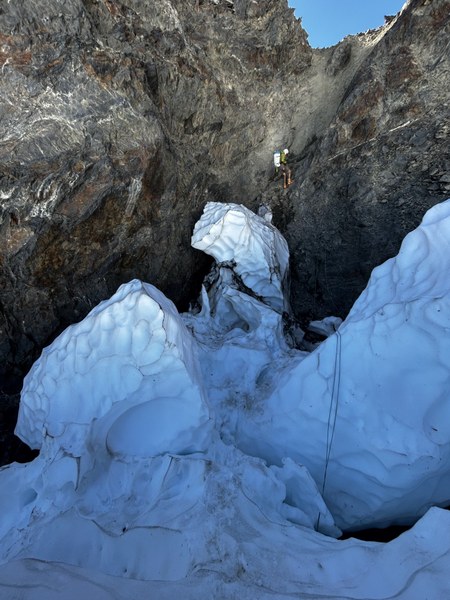
The 25m rappel is exciting and there is a moat at the bottom to negotiate to get back onto the Blue Glacier. We roped back up and negotiated a couple of large crevasses before we could head northwest towards the West peak of Mt Olympus.
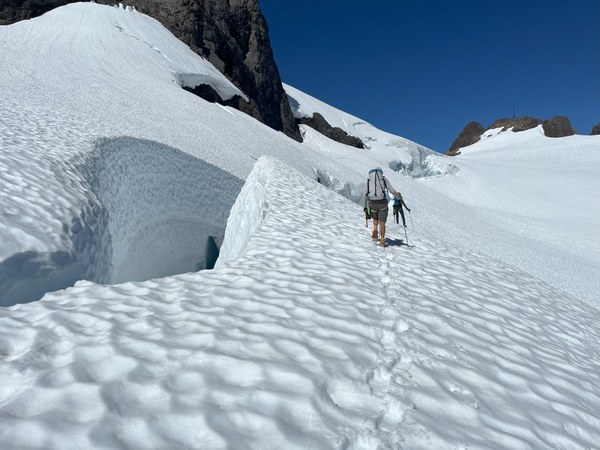
In about 1/2 a mile we joined the standard Olympus approach route and followed it up the south side of Five Fingers Ridge, then over the gully splitting the false summit and down to a col between the false and true summits where we stashed our packs and un-roped for the climb up the summit block. Ascending the summit block includes a short climb up a snow mound followed by a short rock climb up the summit block of the West Peak of Olympus.
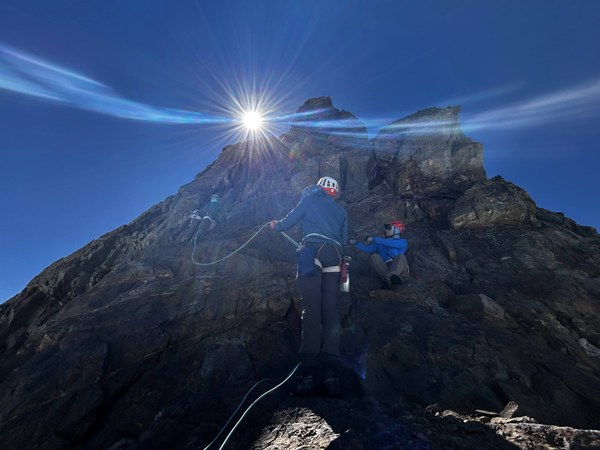
The summit block rock climb is rated 5.4 YSD and Rebecca led it with two twin 30m ropes (that were just a little short requiring everyone to scramble up about 5 meters to get to the ends of the rope to tie in/attach to). We carried 6 tricams and a set of offset nuts but only used 3-4 pieces on the route. There is a rappel anchor on top that we utilized to belay from on top.

It was a beautiful day and we were all on the large summit by 13:00 where we sat and enjoyed the view while we ate our lunch. Almost the entire Bailey Traverse route is visible from the summit and it was great to recount our adventure from there. We also noticed one other group of climbers that had come up the standard route, but they stopped at the top of the false summit.
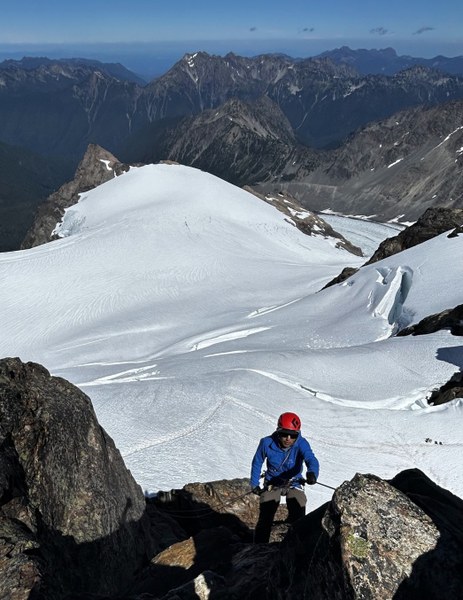
We descended rappelling the climbing route and then back down to our packs at the col between the false and true summits. We then retraced our route back up and over the false summit, back down along the south side of the 5 fingers ridge. We continued down the ridge to Crystal Pass, ascended and passed through it and onto the Snow Dome. We pushed on down the Snow Dome and as the slope steepened towards the bottom,
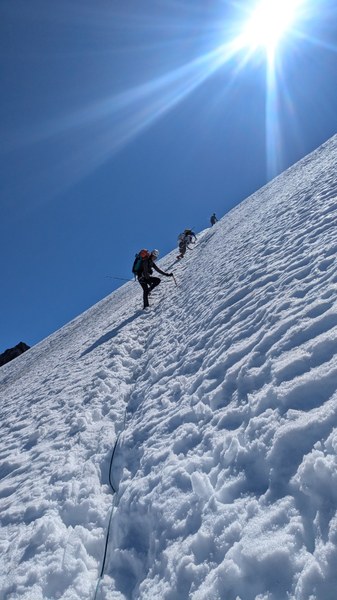
the route crossed an exposed section of blue ice where the snow had melted down to the glacier. We caught up with the other climbing group that we had seen earlier right here. This slowed us down a bit as everyone switched from walking to front pointing down climbing for 20m. Once through that, we reached a section of polished rock and a good spot for a break and refilling water from snow melt running across the rock.
The route continued down through mixed rock and snow patches down to the huge Blue Glacier that was melted down to blue ice.
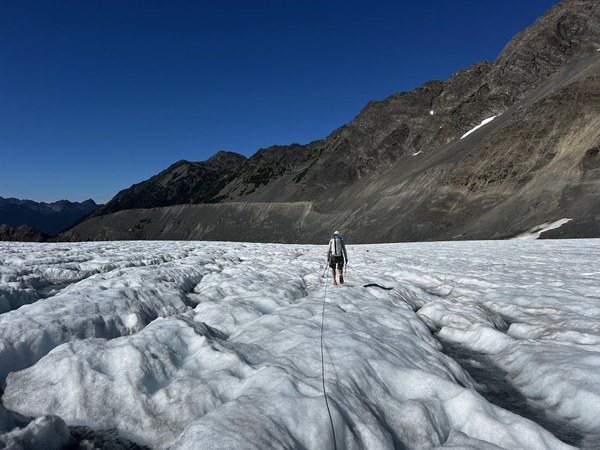
Barton led our way across it avoiding runnels, holes, and moulins crossing it to reach the "trail" leading up the lateral moraine. It's not a very distinct trail and gains about 200' up the moraine to the actual trail along the top edge of the moraine.
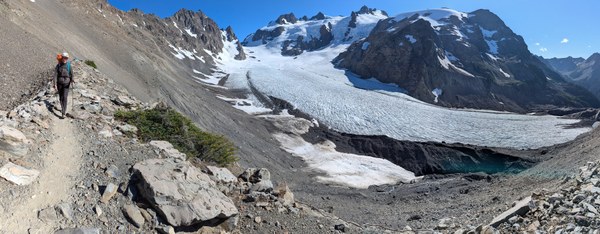
We continued down to the Glacier Camp and took a break at the shelter there, using the out houses (the first that we had seen since leaving Heart Lake 3 days before). It was 18:00 and we had just under 8 miles to go, but we were back on trail now. Everyone packed up and we headed out.
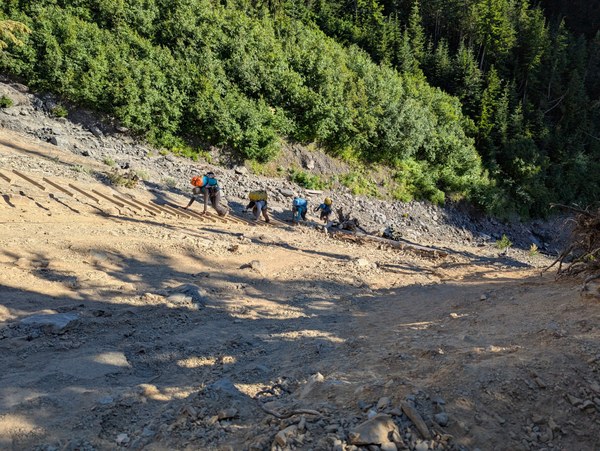
The cable ladder was in pretty good shape with just a few rungs broken, and we made good time down to a nice creek to stop and refill water. After a short break, we got back on the trail.
We made good time chugging down the trail reaching the high bridge over the Ho river around 20:30. One of our objectives of the trip was to avoid night ops, but it looked like we were in for a short night op this evening.
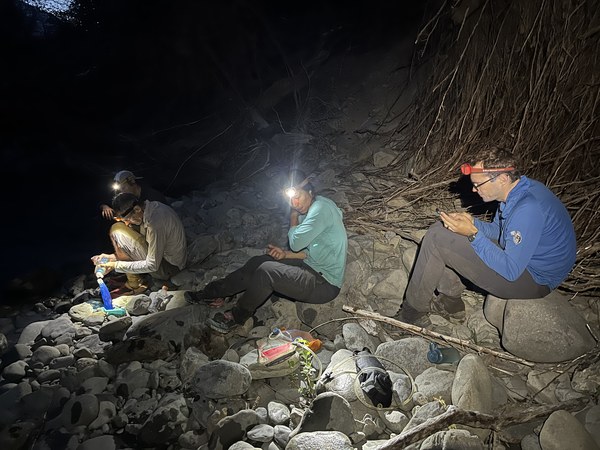
The light faded as we continued on, and eventually we did get our headlamps out to illuminate the trail. We met up with Mr. and Mrs. Bailey again and chatted with them to learn more about their adventure. Mrs. Bailey seemed happier now and it was stated that they were still married "for now" ;-).
We passed Lewis Meadow Camp about 1.5 miles before the Olympic Guard Station and Mr. and Mrs. Bailey stopped there. As it turns out, this would have been a good spot for us to stop for the night too, as the Olympic Guard Station is actually past the turn off (the Ho Lake trail) to go up hill and back into the Sol Duc drainage so we had to back track a half mile in the morning to get back to the Ho Lake trail.
We heard from the team that hiked the route a week prior that there wasn't a water source near the Olympic Guard station campsites, so we started looking for access to the Ho river as we got closer to camp and found a nice spot close to the trail. The water was a little silty, but we stopped and filtered enough for dinner (it turned out that there was a water source by our camp but we didn't find it until the next morning).
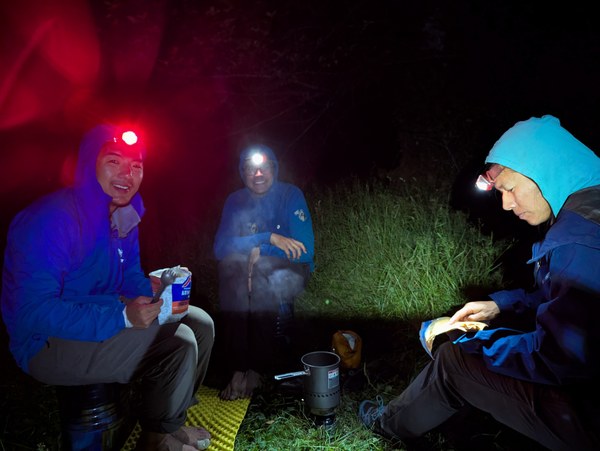
It was 22:15 when we arrived at the Olympic Guard Station Camp concluding a 13 mile day. We looked for camp sites down the main camping section, but one of the campers let us know that all the sites were taken, but they thought there was space in the group area. We headed over to the group area and found open sites there. Tents were erected quickly and water boiled for dinner. Everyone was hungry so there wasn't as much dinner conversation as usual. We all scarfed down our food and fell asleep quickly after another great day on the Bailey Traverse.
Day 5
The next morning dawned cloudy and moist. I noticed that there was a slug crawling over my water flask as we were packing up camp for the last time on this trip. There was a good water source about 200' from our campsite and we all filled up for the hike out.
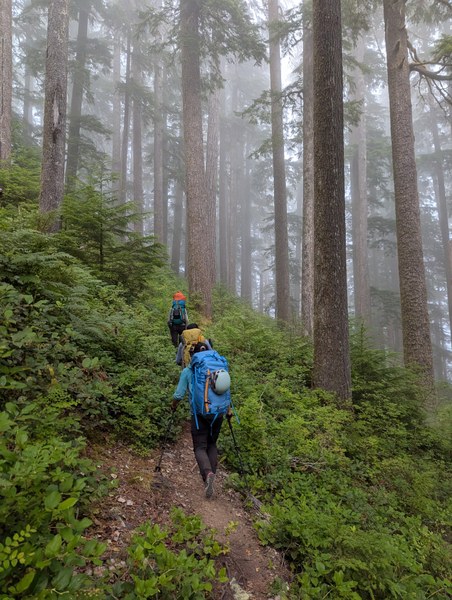
We were all anxious to get home and were hiking by 6:00 and started our last day at a good pace to get up the last 5000' to get out of the Ho valley and back into the Sol Duc drainage and back to the cars at the trailhead. Unfortunately there was a bees nest near the trail part way up and 3 of us got stung 2-3 times (our only injuries of the trip). On the good side there were tons of ripe blue berries along the trail as we pushed up the hill. We noticed some interesting spiderwebs from the Sierra Dome Spiders, Neriene litigiosa.
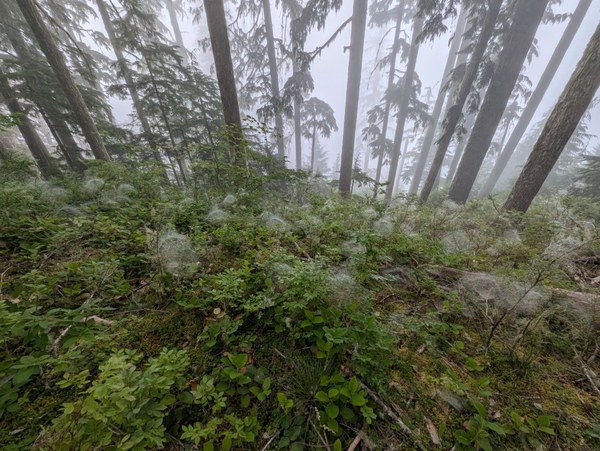
The sun broke through the clouds before we reached Ho Lake at 10:30 where we took a break for a second breakfast. One of our party took a swim with the tadpoles, minnows, and a beaver we saw out in the middle of the lake. Jason performed some surgery on his blisters (draining and rebandaging them).
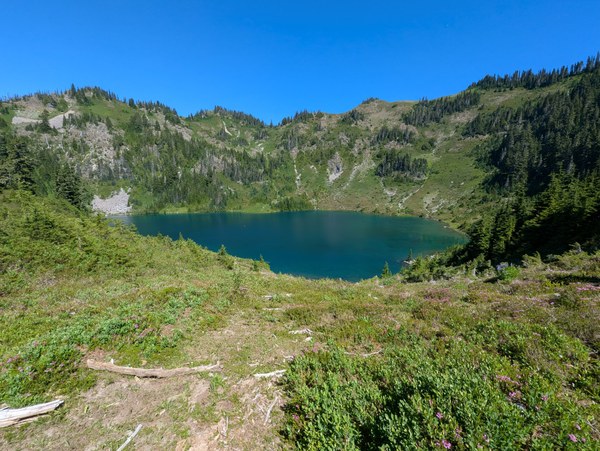
The lake is near the top of the ridge so we quickly reached our high point at 5330' for the day just under Bogachiel peak. This is also where the trail passes above Seven Lakes Basin (it looks like there are way more than seven lakes down there).
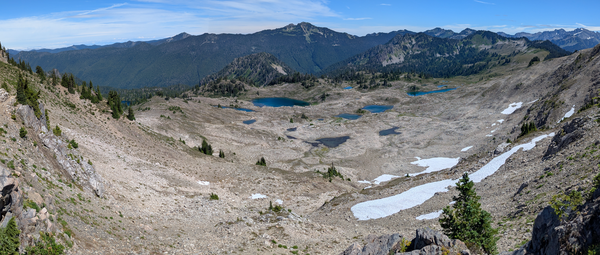
The trail runs on or near the ridge crest for a couple of miles before dropping down into the Sol Duc drainage. We stopped for one last water/break stop at a small group of lakes at 4100' elevation. There was a nice little frog swimming in the lake there.
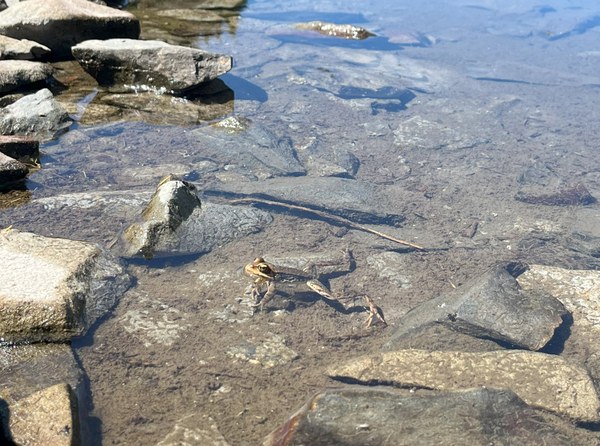
The last few miles went quickly with Jason leading us out. We passed Deer Lake, and eventually closed the loop rejoining our original trail at Sol Duc falls for the last 0.75 miles reaching the cars a little after 15:00 and finishing our tour of the Bailey Range and Mt Olympus.
We hiked 61.5 miles in 5 days, 36 hrs of actual hiking (moving time), for an average moving pace of 35 min/mile with 21,800' of elevation gain, tagging Mount Carrie, Bailey Ridge, and West Mt. Olympus along the way.
On the way home we stopped at Yodelin for dinner and while ordering, our waiter asked us if we were sure we wanted to order all of the food that we did as it was a lot. We assured him that we were sure and we did indeed finish it all. Then our next stop was at Fat Smitty's for milk shakes and French fries for dessert.
It was a great trip, our team was amazing, the travel was fun, the views phenomenal, and the bushwhacking was easier than expected. We experienced off trail travel on snow, rock, and forest, lots of scrambling, glacier travel, one steep dirt/rock rappel, rock climbing (5.4 YDS), and even a little ice climbing on the trip and I would do it again in a heart beat.
Gear
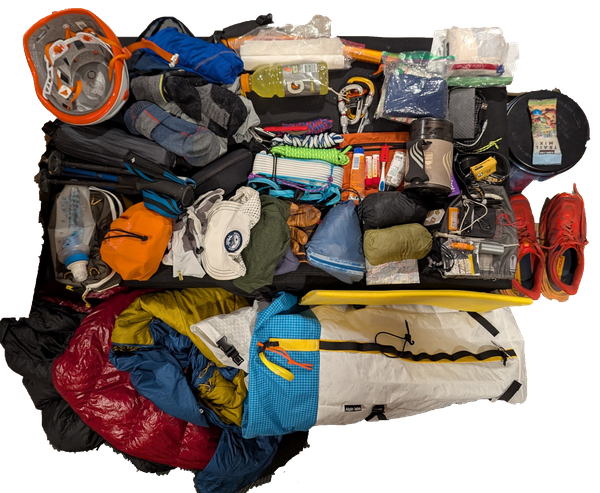
Communications and Navigation:
- We had two In-Reaches used to communicate daily status to folks at home and in case of emergencies that were used for communicating trip status to friends family along the way.
- We primarily used CalTopo (the app) - make sure you download the maps before you are out of phone service. I also printed one paper map that I used often to track our progress. I used the map rather than my phone for all non-consequential navigation to save battery.
- Everyone used their phones for navigation and photography and carried a battery pack for recharging (typically 10k mAmp). They batteries were more than enough and no one ran out of power.
Climbing:
- Our personal climbing gear (glacier and rock) consisted of 3 lockers, 1 non locker, 1 micro traction, 1 double sling, 2 prusik cords, 1 ATC (optional), harness, helmet, and gloves. Petzl Leopard and Katoola KTS crampons and ice axes.
- The group climbing gear included 2x 30m Rap Line ropes, and 4-6 tricams, 1/2 set nuts, and draws.
- The 5.4 rock pitch on Olympus was led on two strands of the RAP line placing a few nuts and tri cams. We rappelled on dual strands. The ATC's (guide and standard) worked well on the rappels with well secured third hands, and I used a super munter on the rappels that worked fine.
Glacier:
We roped up for all of the large glaciers as two teams (one of 2 and one of 3), negotiated around several crevasses, and fortunately no one fell into any crevasses. For the most part the glaciers were either snow covered or the angle was low enough that walking on the exposed ice surface was secure. There was one small section of ice on a bit more of a slope but everyone negotiated it well downclimbing face in. This is the one spot we might have used a couple of ice screws or pickets if we had carried them to belay folks across this section.
Footwear:
- Folks wore trail runners (Hoka Speed Goats, La Sportiva Bushidos) or La Sportiva TX4 approach shoes. The trail runners worked fine, but the La Sportiva shoes were a little better (stickier) on slabby rock. Both types of crampons worked well, but the Petzl took longer to put on as we threaded the straps under and through the spectra cords on the bottom of the crampons to make them secure on softer shoes.
- David taught us a new technique of filling a Nalgene with boiling water and then using it as an roller iron to dry out wet shoes.
Camp:
- We carried two tents, a Big Agnes Cooper Spur 3 person and Big Agnes Fly Creek two person, two canister stoves (Jet Boil Flash & MSR Reactor) and two medium gas canisters and still had gas left at the end of the trip.
- Everyone had a water filter or treatment (b-free, platypus, or aquamira drops, and capacity for 2-3 liters of water and all worked fine and there were sufficient water sources along the route.
- The weather was warm and our lightweight gear worked fine. It was nice enough that we didn't need to use the rain flys on the tents for one or two nights. I didn’t ever get my hard shell out of my pack.
- The bugs were practically non-existent and we didn't ever break out our bug head nets or use much mosquito repellant.
- Two multiday first aid kits that saw very little use other than for some blister treatment, some aspirin and ibuprofen.
- A repair kit with sewing materials, safety pins, duct tape, zip ties, thin cord, and nylon patch kit.
- Everybody used sun glasses, sun hats, lots of sun screen, and lip balm every day!
- We carried smaller rechargeable headlamps (e.g. Nitecore NU25) as we didn't plan on much in the way of night ops and that worked out fine.
Food:
- Barton and Ellie had two freeze dried entrees and a dessert for every night and that turned out to be too much food and it would have been fine to share an entrée and a dessert every night. Folks got tired of eating the same thing for snacks and lunch every day so will bring more variety on the next multiday trip. I brought tooth paste tablets that worked well except that one disintegrated in the bag along the way.
- Lots of ramen in a .5l Nalgene and several sporks used at dinner time.
Additional Gear to Consider for next time:
- Ice screws (anchors and crevasse escape 1-3 per rope team)
- Pickets (so you can keep your ice axe and bury a picket as an anchor, 1-2 per rope team)
- Multiple folks wished for camp shoes at one point or another during the traverse.