Trip Report
Alpine Scramble - Pinnacle & Plummer Peaks
The trip was successful for Plummer Peak only. We did not attempt Pinnacle Peak. Only one scramble student showed up for the trip, and one student was a no-show. To help mitigate the situation and limit risk, we only climbed Plummer Peak, which has less risk than Pinnacle Peak.
 Steve Thompson
- Sat, Jul 12, 2025
- Alpine Scramble - Pinnacle & Plummer Peaks
- Pinnacle, Plummer, Denman, Lane & The Castle
- Scrambling
- Successful
-

- Road suitable for all vehicles
-
The weather was clear, hot, and sunny. Wildflowers were out. Trail conditions were good. There were still some patches of snow on the trail to Pinnacle - Plummer saddle, but it was easily managed without need for microspikes or traction gear.
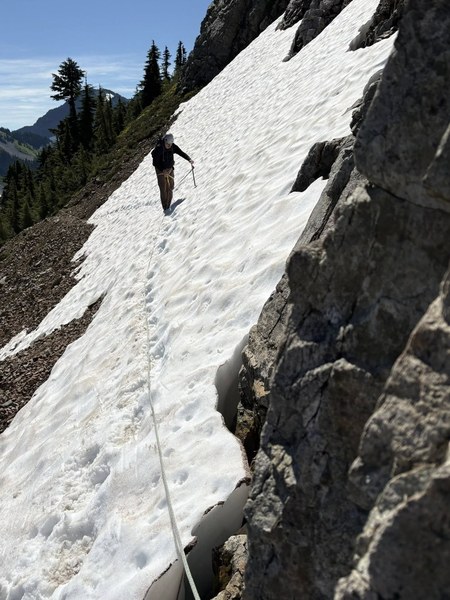
From the saddle to the base of Plummer Peak was a 30+ meter long section of steep, hard snow, with poor runout, that we traversed. I protected the snow slope with a fixed line. (A 40 meter half rope worked well.)
The upper section of the scramble was straight forward with no problems. There were some biting flies on the summit.
The trip was scheduled for Pinnacle and Plummer Peaks in the Tatoosh Range with myself (trip leader) and two scramble students. We met at Longmire at 7:30am, but only one student, Brandon Beams, arrived. The other was a no-show and did not send a message.
It was a beautiful day, and I decided to drive to the trailhead, pack our gear, and start up the trail with just the two of us. I knew other people would be climbing the same peaks today and was hoping, as a long shot, that I might meet other Mountaineers to climb with. We did not meet other Mountaineers, but we did meet another group from Portland who were also climbing Plummer Peak.
When doing this trip in the past, I would start with Pinnacle Peak first and finish with Plummer Peak. Brandon did not have a lot of experience scrambling anything as steep and exposed as Pinnacle Peak, so I decided to start with Plummer Peak first. Plus, we could stay in contact with the other group for safety in numbers.
There was a section of steep snow that covered the boot track that led to the base of Plummer Peak, and the slope had poor runout. I considered it a no-fall zone. My student was not comfortable traversing the snow slope without a fixed line, but I knew it was within his abilities. I used a 40 meter half-rope to setup a fixed line to traverse the snow slope and I kicked large steps into the snow with my crampons. Brandon made it across the snow traverse with no problems. Once I had setup the fixed line then other people started using it. After a dozen or so trips, my steps had become a good boot track across.
The remainder of the scramble was straightforward. We also shared in some watermelon that the group from Portland had packed up to the summit.
Plummer Peak seemed to be a good fit for this student. The day's trip offered some travel across hard snow, using a fixed line from a diaper harness, and included some blocky sections of rock scrambling with occasional exposure. It pushed him beyond his comfort level yet was completely within his abilities.
Regarding a Mountaineers trip with only two climbers:
The trip was scheduled to have three climbers, but one climber was a no-show. This created the condition that was out of the leader’s control. To mitigate this condition, we scaled back the trip to only climb Plummer Peak, which has less risk than Pinnacle Peak, and we did not attempt Pinnacle Peak. Plummer Peak is also a popular route and other climbing parties were always close.
Prior to Freedom of the Hills 10, the Mountaineer’s climbing code required 3 climbers. This requirement was for safety reasons, so in the event of an injury one person could stay with the injured climber and one person could go for help. That theory is mostly obsolete with modern communication devices. Freedom of the Hills 10 no longer specifies a minimum of 3 climbers in the climbing code.
The trip turned out to be a big success for Brandon. I was able to work with him one-on-one on his rock and snow scrambling skills. I am requesting that the Brandon, the student who showed up and put in the effort, get credit for the climb and count that towards completing his course graduation requirements. Thanks