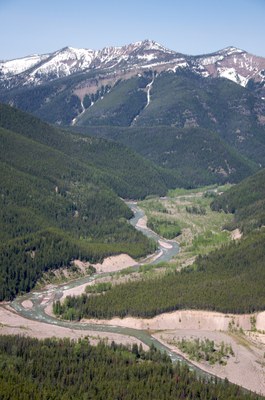
Three Forks of the Flathead River
The three forks of the Flathead River are the centerpiece of the Bob Marshall and Great Bear Wildernesses and offer remote and wild boating with several options for technical difficulty.
The three forks of the Flathead River are the centerpiece of the Bob Marshall and Great Bear Wildernesses. With remote rivers that generally require hiking in, options for many difficulties of whitewater, and scenic Northern Rockies wilderness, the area offers some of the best packrafting in the contiguous US. The hiking is generally quite good too, with the option to include famously scenic destinations like the Chinese Wall.
Informational resources: American Whitewater has a good amount of information on the three main forks of the Flathead and much less or zero information on side creeks and other rivers in the area. The Flathead Rivers Alliance sells a “Three Forks of the Flathead” float guide. The most comprehensive guidebook to the area is “Packrafting the Crown of the Continent”, written by Montana packrafter Dave Chenault.
Season: Most Flathead River trips occur in late June, July, and August, with flows decreasing dramatically over the course of summer. Different stretches of river are ideal at different times. The technically easier stretches like the North Fork and South Fork are generally done earlier, while more difficult sections like the Middle Fork below Schafer Meadows are typically done later. Like other undammed river systems, flows can vary heavily based on snowpack and melt, and the gauges are often downriver below the wilderness sections so they do not always accurately reflect wilderness river conditions.
Getting there
Whitefish, Kalispell, and Missoula are (north to south) the nearest sizeable towns near the Flathead River system. Different trips will warrant different starting points, and nearly all of them will involve hiking to access the river. There are a handful of shuttle services that will help facilitate point-to-point trips.
Land manager
Most of the river system is in the Flathead National Forest. As of 2025, there is no river permit required for the Flathead, but this may change in the future.
on the water
South Fork of the Flathead
- Overview: The South Fork is the iconic paddle of the Bob Marshall Wilderness, with remote hike-in access, big and untouched views, outstanding camping, and diverse water. It begins at the confluence of Youngs Creek and Danaher Creek and flows to the Hungry Horse Reservoir. For about 38 miles from the confluence to Mid Creek (AW link), the river is generally class II or II+, reaching III- at higher flows, with some chance of wood. There are several landmarks along the way and opportunities for hiking and side trips. Below Mid Creek, the river enters the class V Meadow Creek Gorge (AW link) which can be portaged on river right via a 4.5 mile trail walk. The gorge might be class IV at very low flows that packrafts can run and other craft would struggle in, but would be very rocky and narrow. Below the gorge, there are 15 miles of easy boating to Twin Creek and the reservoir (AW link).
- Difficulty: Class II-III- above Mid Creek, class IV-V in the Meadow Creek Gorge, class I-II below Meadow Creek.
- Gauge & Flows: South Fork Flathead River above Twin Creek near Hungry Horse, NOAA and USGS. Most of the river is at its best between 2000 and 5000 CFS. Meadow Creek Gorge is likely only runnable in packrafts at lower flows than that, except for expert boaters.
- Access: There are many trails in or out of the South Fork’s drainage. Lodgepole Creek to Youngs Creek is the shortest way in, but you can look at the map and get creative. You can take out just below the Spotted Bear River and ranger station or at Twin Creek where it enters the reservoir, or just hike out on one of many trails. Most South Fork trips are point to point, but a loop could be made with a long hike on the Continental Divide Trail past the very scenic Chinese Wall, or using one of the forks of the Sun River with two hikes over the continental divide.
Middle Fork of the Flathead
- Overview: The Middle Fork can be divided into three general sections - the upper wilderness run above Schafer Meadows, the 28 mile class IV wilderness run from Schafer Meadows to Bear Creek (the highlight of the river), and the 45 mile roadside run from Bear Creek to the small town of West Glacier and the confluence with the North Fork below it. The upper wilderness run is class II- and extremely remote with a long hike to access, but you’re assured of solitude and scenery. From Schafer Meadows to Bear Creek (AW link) there are three class IV rapid sections - Three Forks, 25 Mile, and Spruce Park, with Spruce Park being the most difficult. The entire Spruce Park section can be portaged, but it’s long - 3 miles. Within Spruce Park there are gorge walls, so shorter portages around individual cruxes may or may not be possible. Below where the Middle Fork meets the road at Bear Creek, there are 45 miles to the confluence with the North Fork - Bear Creek to Paola class II-III, Paola to Moccasin Creek class II-III, Moccasin Creek to West Glacier class III+ which sees the most traffic included many guided raft parties, and West Glacier to Blankenship Bridge class I-II.
- Difficulty: Class IV rapids below Schafer Meadows, class II and class III/III+ elsewhere.
- Gauge & Flows: Middle Fork Flathead River near West Glacier, NOAA and USGS. This gauge is far below the wilderness run with several tributaries in between, so it is not necessarily reliable but still the best information available. It can be difficult to find flows that are ideal for the entire wilderness section of the Middle Fork, with the upper above Schafer Meadows better at 5000+ CFS and the section below Schafer better below, with packrafts floating below Schafer preferring as low as 1000-2500 CFS.
Access: Schafer Meadows is an airstrip that was grandfathered into the wilderness, or you can hike about 14 miles via the Morrison Creek trail. For a shorter hike of about 6 miles, you can hike along Granite Creek and put in below the Three Forks rapid and above 25 Mile. The lower roadside sections have many access points described on American Whitewater - camping is possible in this section but may be limited in some areas. For the upper wilderness section, plan your own adventure on the map.
North Fork of the Flathead
- Overview: The North Fork below the Canadian border runs near roads, with road access to both the put-in and take-out, going 58 miles from the border to Blankenship Bridge where it joins the Middle Fork (AW link). It forms the western boundary of the northern section of Glacier National Park. It is the technically easiest of the three forks, but still has rapids and wood.
- Difficulty: I-II+, III- at high flows.
- Gauge & Flows: North Fork Flathead River near Columbia Falls, NOAA and USGS. Fairly tame at 2000 CFS, bigger waves at 7000 CFS, AW calls it “medium runnable” up to 9000 CFS.
- Access: There is a put-in immediately south of the Canadian border, access north of Polebridge, and the take-out just below the confluence with the Middle Fork. River left is part of the national park and camping requires a permit. Camping on gravel bars or beaches river right is legal if you are below the ordinary high water mark and more than 500 yards from any house or cabin.
Sun River
- Overview: The North, West, and South Forks of the Sun River aren’t headline rivers on their own but can offer quality remote floating despite being woodier than the Flathead forks. They can be used to make exciting and interesting loops with the South Fork of the Flathead - balancing the desired amount of water between both the South Fork and the Sun Rivers is often the crux of planning such a trip. The North Fork is extremely woody above Wrong Creek, but is boatable below. It becomes a class V gorge in the last ~1-2 miles as it enters the Gibson Reservoir but you can get on a trail to portage. The West Fork is too shallow and woody above Ahorn Creek but boatable below, described by Chenault as “spicy” class III. The South Fork is shallow and woody upstream of the Benchmark trailhead, challenging between Benchmark and the confluence with the West Fork, and calmer below the West Fork, and like the North Fork there is a short class V gorge as it enters the Gibson Reservoir.
- Difficulty: North Fork class III (V), South Fork class II-III (V), West Fork class III. Portages for wood are certain on all three.
- Gauge & Flows: North Fork Sun gauge and South Fork Sun gauge. Both are ideal around 400-500 CFS.
- Access: Various hiking trails from the Gibson Reservoir and the trailheads at the end of the Benchmark Road, or walk further from elsewhere.
Other Creeks
- Overview: There are other creeks that can be combined with a Flathead trip, especially the South Fork, but they depend heavily on flows and can be woody. Two in particular that are reputed to be excellent are the last few miles of Youngs Creek before the confluence with the Danaher while approaching the South Fork from Lodgepole Pass, and the White River when approaching the South Fork from the east or as a side day trip, both at class III, but there are many others described in the Chenault guidebook.
Photo credit: “Flathead River, Montana” by Sam Beebe, CC BY 2.0
- Suitable Activities: Packrafting
- Seasons: Year-round, June, July, August
- Weather: View weather forecast
- Land Manager: Flathead National Forest
- Parking Permit Required: America the Beautiful Pass
- Recommended Party Size: 6
- Maximum Party Size: 12
- Maximum Route/Place Capacity: 12
This is a list of titles that represent the variations of trips you can take at this route/place. This includes side trips, extensions and peak combinations. Not seeing a title that fits your trip? Log in and send us updates, images, or resources.
- South Fork of the Flathead River
- Middle Fork of the Flathead River
- North Fork of the Flathead River
There are no resources for this route/place. Log in and send us updates, images, or resources.