Elwha River
After a century of inundation, the Elwha's canyons have finally come to life again after removal of two dams. Paddle up to 15 river miles of class II-IV whitewater to the Salish Sea.
FLOW
- USGS Gauge: Elwha River at Mcdonald BR Near Port Angeles
- 1,000 - 1,200 CFS: low runnable
- 1,200 - 1,600 CFS: prime runnable
- 1,600 - 2,000 CFS: pushy runnable
PUT-INS & TAKE-OUTS
- Glines Canyon Class IV Put In: From Altair, continue hiking up the road 0.8 miles to an overgrown road that leads down to an open glen with river access on the right. There is one class IV drop 0.4 miles down river. You can scout this rapid from the Class III Put In below. You can also continue on up the road to the Glines Canyon Dam and look into the extreme whitewater in Glines Canyon and at the former lake bed from an overlook.
- Gline Canyon Class III Put In: From Altair continue hiking up the road 0.3 miles. At 48.0079, -123.5944 find a faint use trail on the left that leads down to the bottom of the Class IV rapid. The faint use trail drops 50 feet over a distance of 250 feet. Long pants are recommended.
- Altair Put In: At mile 239.5 on Highway 101 take Olympic Hotsprings Road south to the National Park entrance at Madison Falls Trailhead. From here hike up Olympic Hotsprings Road. Take the Bypass Trail where the road was washed away by the river and continue until you reach the bridge at the old Altair Campground. Access is on river left at a small beach.
- Madison Falls Trailhead: For an 11 mile run with no hiking, put in at Madison Falls Trailhead and take the river to the Salish Sea. Madison Falls Trailhead is 1.8 miles south of highway 101 on Olympic Hot Springs Road. This reach only has one typical portage, for That Dam Rapid, but could have portages for natural wood hazards as wood shifts.
- Highway 101: This is typically the take out for the upper reach, or the put in for the lower reach. Parking is on river right in a large parking lot in between the new and the old Highway 101 bridges, at highway mile 239.5. The best river access in on river left just upstream of the old bridge in a nice eddy with a gradual road bed to walk up to the highway. This can be used as a staging area and the old bridge used to walk to and from the parking lot on the other side of the bridge.
- Mouth of the Elwha: From Highway 101 mile 242.5 turn onto Highway 112. Head 2.1 miles west (crossing the river) to Place Road. Turn right (north) and follow this road 1.9 miles to the T junction and then turn right (east) continuing on the short lane to the Elwha Dike access point. Day-use parking is available along the road. Hike a couple hundred yards along the trail towards the ocean for the take-out. From the river, take out on river left on the dike at the mouth of the river.
ON THE RIVER
glines canyon to highway 101
This is a 6.0 mile reach with an average gradient of 34 feet per mile, characterized by predominantly class II+ whitewater, some natural wood hazards, and a handful of man made logjams. There is one Class IV rapid at the beginning that can be portaged on river left, or avoided altogether by putting in just just below it. Below Altair, the river opens up into a broader valley with plenty of class II whitewater and a couple class III- rapids. With Glines Canyon Dam no longer holding back wood and gravel the river channel has become much more dynamic with changes occurring year to year and shifting wood hazards.
In the middle of this section, the river is extensively braided. Where the Bypass Trail rejoins the road the river is braided and has several islands for a span of 1/2 mile. At the top of a large island here the river left channel makes for a 0.5 mile portage on a mostly dry riverbed. The river right channel may have several riverwide logs that make for difficult and high risk portages. Scout carefully on the hike up if opting to do the right channel.
highway 101 to the salish sea
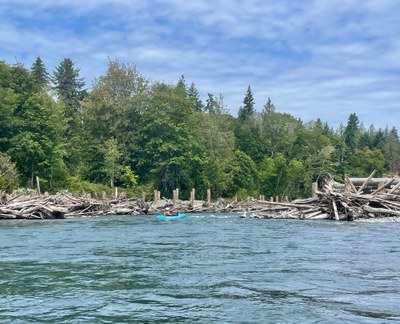
This is a 9.0 mile reach marked by extensive man made logjams, one high consequence Class IV rapid that can be portaged, a weir that can be paddled over, a fish contraption with a decapitator cable, and class II whitewater. The average gradient is 22 feet per mile. If portaging That Dam Rapid, the gradient is even less. With the Elwha Dam gone, the Elwha River is still developing a new river channel through the reservoir sediments of the historic Aldwell Reservoir that begins at the put-in from the Highway 101 bridge. Use caution through this section as fish habitat structures have been constructed in this reach and wood hazards are constantly shifting as the channel is in a state of flux. This section is a fascinating landscape of old tree stumps from when the forest was cleared a century ago prior to construction of the Elwha Dam to the young 15 year old forest of today. While the whitewater is not difficult, the wood hazards demand attention. This section is no place for inexperienced paddlers. There are reportedly over 80 man made logjams to encourage salmon habitat, most of which are in the first mile below the hwy 101 bridge and the first mile below the Elwha River Road bridge.
At 3 miles from the Hwy 101 put in you encounter That Dam Rapid (IV), the rapid that was inundated by the dam for a century. Here the river makes a 90 degree right turn after passing by a couple massive boulders on river left. You can portage on river left onto a gravel bar at 48.0943, -123.5590 by climbing up the left bank to the ridge. Once on the ridge, head 50 feet left to the main trail, go right 20 feet to a split in the trail and descend the right fork down to the river. A good view of the rapid is available from several look out points on river right, accessible by car and a short hike. To do so, park at the Elwha Dam Trailhead off Highway 112 and hike down the dirt road 0.5 miles. A rock staircase leads you down to the bottom of the rapid. Further down the road a steep overgrown road leads to the old dam itself and a good view of the lead in rapid and the top of the rapid. That Dam Rapid starts with a long entry rapid that slams into a big green wall on river right and then makes a 90 degree left hand turn before exploding below through a class IV cascade of boulders and holes. At moderate flows the standard move through the main drop is to set up in a nice eddy on river right, start right through the rapid, after clearing the first hole on river left, work quickly to the tongue on river left to avoid more rocks and holes on river right. It may be possible to eddy out left by making an aggressive left move after hitting the big green wall, and then take the left tongue on the far left all the way down.
About 1 mile below the Highway 112 bridge you reach a water intake weir. The water intake is on river right but you can paddle past it to the old weir, which has been reconfigured to allow passage downriver. Shortly after the weir you pass under the Elwha River Road and Discovery Trail bridge. Just below this bridge is a fish collection barge attached to a cable that runs the width of the river. This decapitator cable can be held up and ducked under if the water is low enough. Next the river changes character and becomes braided as it reaches its mouth at the Salish Sea, where wave surfing may be possible on a good day. Keep an eye out for mink and deer.
NOTES
- Avg. Gradient: Above the 101: 34 feet/mile. Below Hwy 101: 23 feet/mile.
- Nearest services: Port Angeles is a big town with all amenities.
- Area Rivers: Can be combined with Dungeness, Dosewallips, or Sol Duc rivers for a multiday adventure.
- Suitable Activities: Packrafting
- Seasons: Year-round
- Weather: View weather forecast
- Difficulty: Class III River, Class IV River, Class II+ River
- Length: 15.0 mi
- Land Manager: Olympic National Park
- Parking Permit Required: National Park Entrance Fee
- Recommended Party Size: 6
- Maximum Party Size: 12
- Maximum Route/Place Capacity: 12
There are no resources for this route/place. Log in and send us updates, images, or resources.