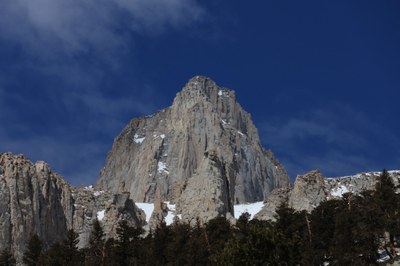
Trip Report
Basic Alpine Climb - High Sierra - Mount Whitney
Three nights in the Sierras with a successful summit on Mt. Whitney and multi-station rappel back down to the notch. Great conditions and a great team effort.
 Joshua Walther
- Tue, May 13, 2025 — Fri, May 16, 2025
- Basic Alpine Climb - High Sierra - Mount Russell and Mount Whitney
- High Sierra - Mount Russell and Mount Whitney
- Climbing
- Successful
-

- Road suitable for all vehicles
-
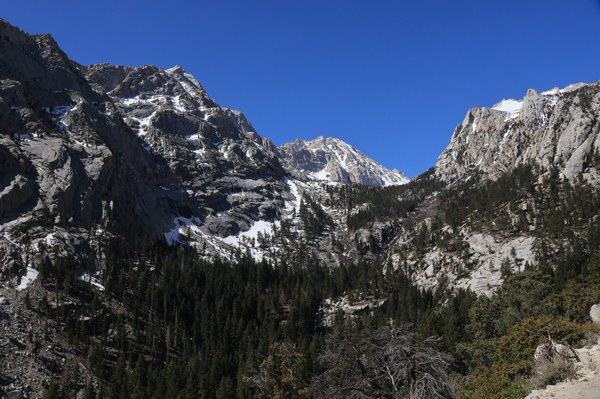
The route is straight forward from the Whitney Trail split. Ascend quickly and there are a few river crossings that require careful footwork to avoid wet feet. Next tricky parts are some ledges that can pretty easily be zigged and zagged with one climbing move to get past them. The down climb on them later may require a butt scoot or a little confident down climbing. Snow is consistent on the far side of Lower Boy Scout lake and up. It's probably best to put crampons on here and get an ice axe out. Next you will come up on Upper Boy Scout Lake. There are several solid dry camping spots, and some running water for filtering. Up to Iceberg Lake you can stay low or traverse high, it doesn't matter. Once you are there you ascend the couloir to reach The Notch. The snow is good until about 1 pm, and you will need two ice axes for several steep sections. Expect a lot of post-holing on your descent after 1pm. At The Notch, you'll decide between a long traverse, or the direct ascent. We chose the direct ascent. There is a rock step that is exposed and requires commitment. Top out the last 400' and claim the summit by the shack. It is filled with snow, so you can't sleep in it. On the descent, you can choose to down climb or rappel.
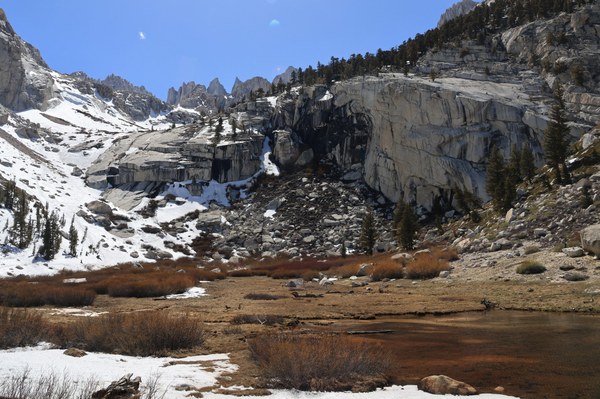
Lower Boy Scout Lake where the snow starts
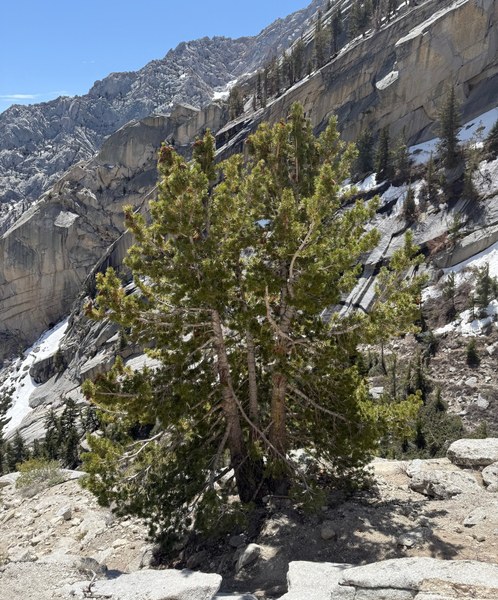
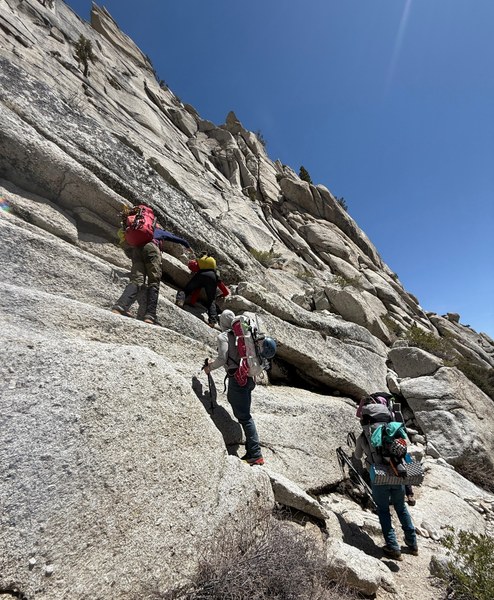
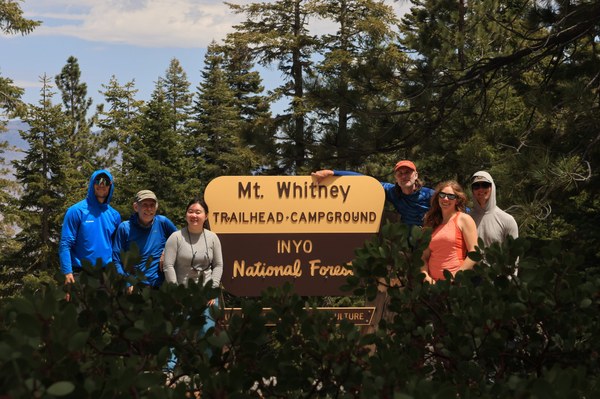
Overall, we had a great climb on the Mount Whitney Mountaineer’s Route and made a ccohesive team. Our weather window lined up perfectly, and we had two beautiful blue bird days of sunshine and blue skies for the hike in and summit send. We started by camping overnight at the Whitney Trail TH at 8400’ and took off around 9:30 the next morning. After the trail splits, there are a couple river crossings (~1.8mi, ~3.0mi) that require some careful footwork to avoid a slip or wet feet. Navigation was a little tricky deciding where to climb up the granite ledges (3.7mi) towards the beginning, so I recommend using the pictured tree as a good marker for where to start moving up and stay on trail (the trail 180s here back towards Whitney).
It was pretty straightforward from here up to Lower Boy Scout. There is a high and low route through the willows, we choose the high route on the rocks. Upon arriving to Lower Boy Scout, you will see where the snowpack ends at the lake. This is a great spot to camp if you are not summiting the next day. Most of the spots are dry on the east side. We took a nice break and put our crampons on. We ascended quickly on the other side through the snow and used an ice axe as well. Our original plan was to get up to Iceberg Lake for a short summit day. With a member of the team struggling with altitude, we decided to make camp at Upper Boy Scout instead before it got too late and cold in the evening. There was abundant freshwater melted out for filtering at Upper Boy Scout - make sure you bring a waterproof glove like the showa temres to dip your hand in the water. The lake itself is frozen. Arrive sooner than later to claim your camping spots. Expect some clouds to roll in and hang around for the early evening. This was consistent every night, but they dissipated after sunset for clear starry night skies.
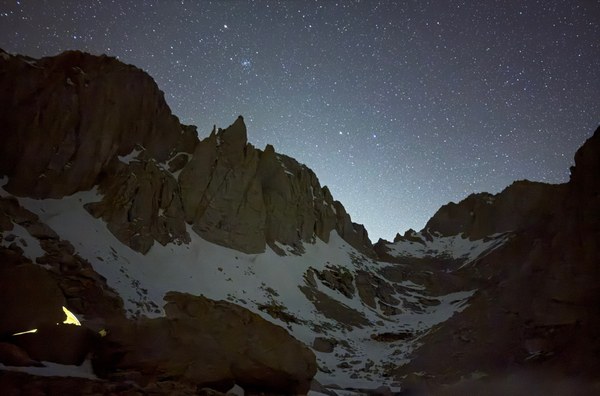
We left for summit the next morning at 7:00am. This gave the team ample time to rest and acclimatize more from the previous day. The moment the sun rises, it is a major heatwave on a clear day. I’d recommend one hour earlier or more start to give yourself better snow conditions on your return. We stayed on the higher trail on the way in between Upper Boy Scout and Iceberg Lakes, but we took the low route on the way out. Either way will get you there, but low is better for the descent. From Iceberg Lake, we started up the couloir up to the notch.
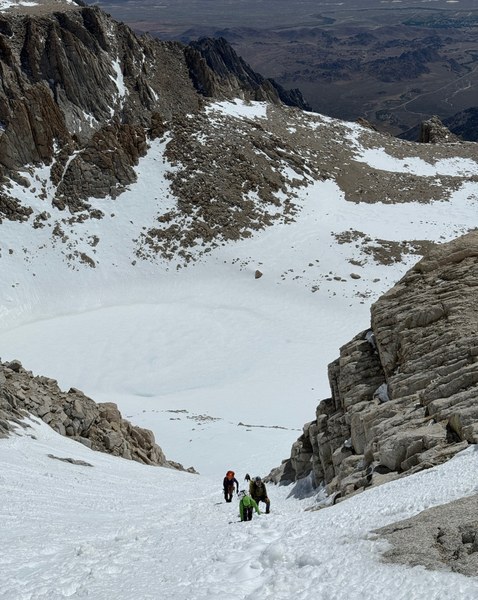
/Iceberg Lake frozen over in the distance
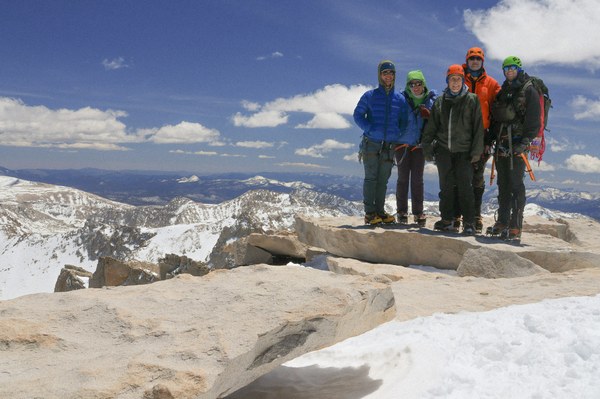
The climb up the couloir is intimidating from afar, but appears very doable when right in front of it. Several sections required two ice axes for quick, secure climbing. It is around 45 degrees steep in some sections, so be prepared to climb. Towards the notch, there are some exposed rocky sections that are easy to navigate and not exposed. The notch opens up into some of the best views you’ll have for the day of the Sierras. It’s incredible. Take a picture. From the notch, we chose our adventure between the long, exposed traverse or the direct ascent for the final 400 ft. We took a nice rest as all members of the team completed their ascent of the couloir and had a group discussion on ascent, descent and turnaround time. We were right on schedule for a 1 pm turnaround time, and everyone unanimously agreed on the direct ascent. The direct ascent has a melted-out rock step that is slabby and exposed above very steep snow. A fall would be consequential and required commitment. All members of the team moved smoothly through this crux, and the last 300 ft was all two ice-axe climbing to top out on the summit. We took lots of pictures and videos, and then discussed as a group our next move, whether it was to take the traverse down, down climb the direct ascent, or rappel the direct ascent (We brought along a 60m rope from Upper Boy Scout).
We found the purple sling anchor at the top on climber’s right, tested it, and decided to move forward with the rappel as a team. I went down first and scouted out our second anchor, which was a red sling and cordellette wrapped around two protruding boulders on climber’s right. It was secure and the team opted to use it as our next rapp station. This unfortunately would not get us past the rock step, so the team started considering our plan to get back down that problem. I down climbed to avoid overloading the second rapp station, and scouted out a third rapp station. By dumb luck, I happened upon a groovy horn on climber’s right. It was bomber and we used Alisha’s rapp kit to set up a third station. It is a black sling double wrapped around a horn and tied off with an additional catastrophe knot and it has a rapp ring. No telling if it will still be there after gusts and weather this weekend, so still be prepared to make your own. The team was prepared with pickets to set up a belay station and belay each other down past the crux if necessary, but rappelling off the horn was a welcome alternative solution.
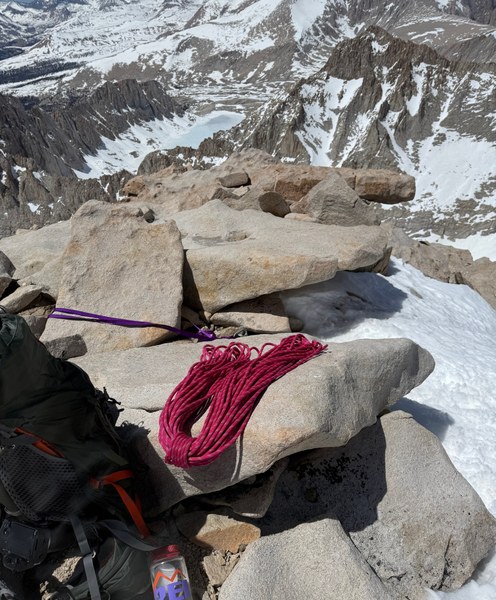
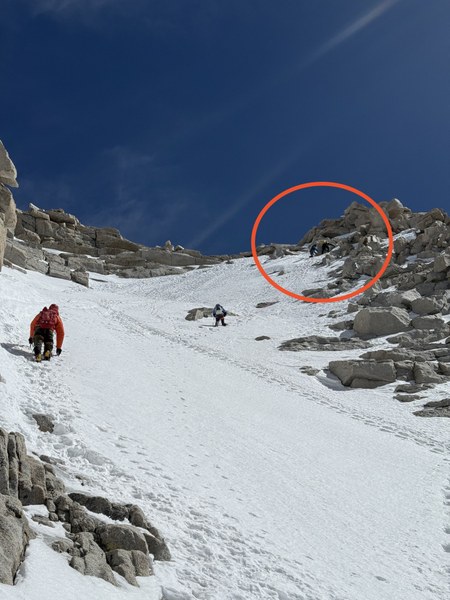
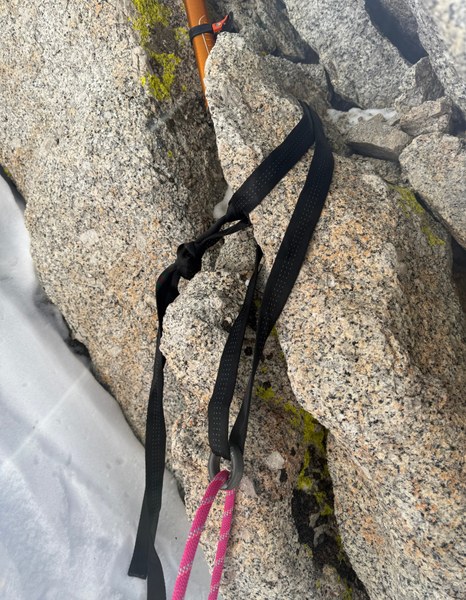
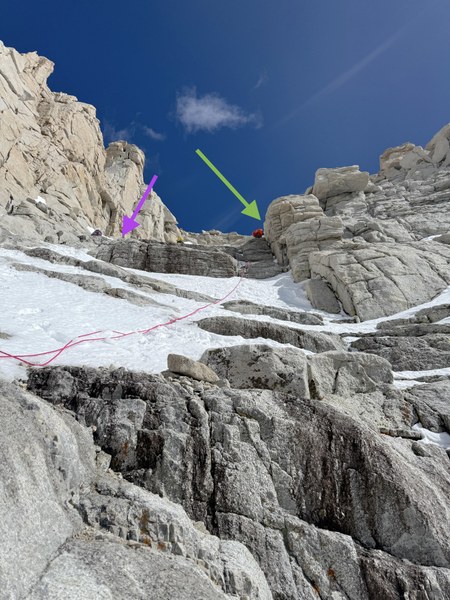
Purple: rock/ice step on ascent
Green: Nelson preparing to rappel the newly installed 3rd station
From here it was a chill descent down the couloir. There is ample opportunity for lots of high- adrenaline glissading down the couloir, which almost all of the earlier climbers opted for, at least on the lower half. The High Sierra’s shadows were looming and growing fast, and there was no way we could out pace them. We decided not to glissade to avoid being cold and wet all night in our sleeping bags at Upper Boy Scout. We post-holed a lot, which zapped most of my remaining energy for the day.
The team did a great job back at camp dividing and conquering with shoveling/boiling snow, filtering water, and making dinners. The temperature dropped quickly, our friendly overcast blew in for a short hour or so, and we called it a night. We hiked out the next morning and made great time on the descent. The ledges from earlier on were our main concern, but you can mitigate risk by doing an easy butt scoot. If you’re feeling froggy, there are some great holds to down climb it too. It may help to remove packs and lower them if you’re feeling cautious. We made it back to the trailhead in a few hours, and celebrated in Lone Pine with burgers and beer.
It was great climbing with this team. Communication was fantastic - all had a voice and a vote. Decision making was quick and informed – we thought out all the options, weighed them, and took decisive action. Strong climbers – folks on this team brought the appropriate experience and fitness level to drive success. Thanks all for an amazing trip, and looking forward to the next one.
**At the time of writing this, I am trying to get the beta out as quickly as possible for our next groups of Mounties headed to the Sierras. If there aren’t pictures yet, please check back frequently and they will start showing up asap. I’ll continue to update as I have more/better beta pics from others on the shared album.