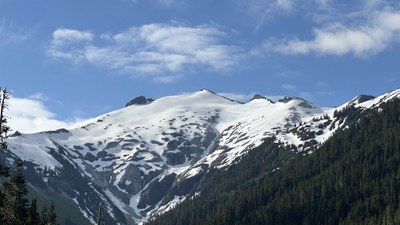
Trip Report
Basic Glacier Climb - Ruth Mountain & Icy Peak Traverse
Terrific two-day first mentored lead of Ruth Mountain and Icy Peak; under the clouds on Day 1 with clear skies giving us gorgeous views all around for Day 2. Congrats to IB students Jazmin, Christina, Kali, Devin, and Luke and honorary IB member Nick from Foothills on their first Mounties Glacier Climb!
 Nathan Rutz
- Sat, Jul 5, 2025 — Sun, Jul 6, 2025
- Basic Glacier Climb - Ruth Mountain & Icy Peak Traverse
- Ruth Mountain & Icy Peak Traverse
- Climbing
- Successful
-

- Road suitable for all vehicles
-
- As mentioned in a prior TR, the road to Hannegan Trailhead has been rebuilt (cuts around to the side) so there’s access to the parking lot. Bathroom was open.
- Hannegan Trail from trailhead to pass was clear with running water at various points along the way to refill BeFrees/filtered soft flasks. Crossings were all straightforward, thanks to some great trail
- The first gully (from Hannegan Pass towards Point 5930) was essentially snow-free and plenty wet/muddy.
- No crevasses were observed on Ruth Glacier
- The gully below Icy camp was mostly snow-covered, with a stretch of bare, loose rock in the middle. Be extremely careful with loose rock and risk of rockfall, especially as the gully continues to melt out and soften (making for more challenging transfers to/from snow and rock). Traveling up was fairly soft, but we were able to kick solid steps.
- The glacier on Icy's NW aspect had a few crevasses opening west of our route, which itself was clear of obvious crevasse hazards.
- Gully #3, the final summit gully to Icy Peak, was snow-free with loose rocks.
For another detailed Trip Report of the route, check out Basic Glacier Climb - Ruth Mountain & Icy Peak Traverse — The Mountaineers from Liz Louis the weekend before ours.
Day 0 – July 4
Arrived at Glacier Public Service Center at 7:30 and was first in line for permits, which was fairly straightforward and quick.
Stopped at Wake ‘N Bakery as one does. (Not relevant but a necessary shout out for an essential small business).
Day 1 – July 5
Met at the trailhead a little before 7am for introductions, pack checks, and group gear distribution.
The hike up to Hannegan Pass was straightforward and uneventful with cool weather thanks to cloudy skies. We mostly went light on water for the first stretch, knowing we were stopping at Hannegan Camp to filter and fill the water everyone needed for the rest of the day until camp. The trail was snow-free to the pass, where we dumped packs while most of the team did a quick side-trip to Hannegan Peak (class 2 all the way with some snow patches). Once back, some of us ditched our trail-runners and we headed for Ruth.
Leaving Hannegan Pass (~12:30PM), we crossed a patch of snow to reach the base of the gully, which had mostly melted out and was in its normal muddy state. Travel up was slow but straightforward, and the snow travel from there to the Ruth Glacier was easy following well established tracks.
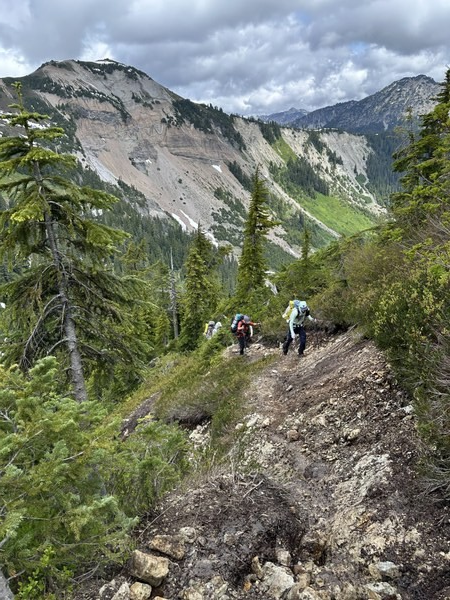
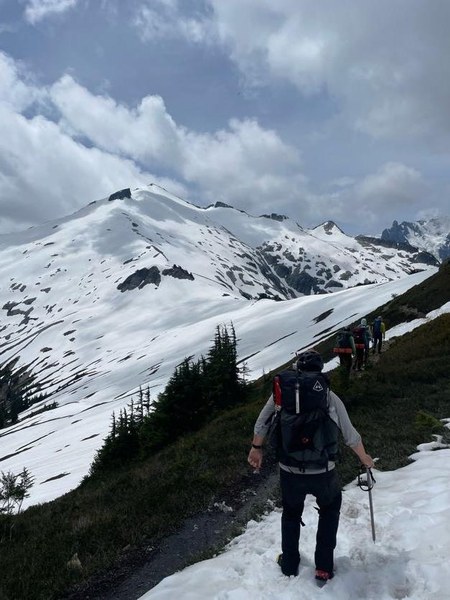
At the glacier, we roped up at a rocky outcropping at ~5750ft. Travel to the Ruth summit was straightforward as the route was entirely snow covered and there were tracks to follow.
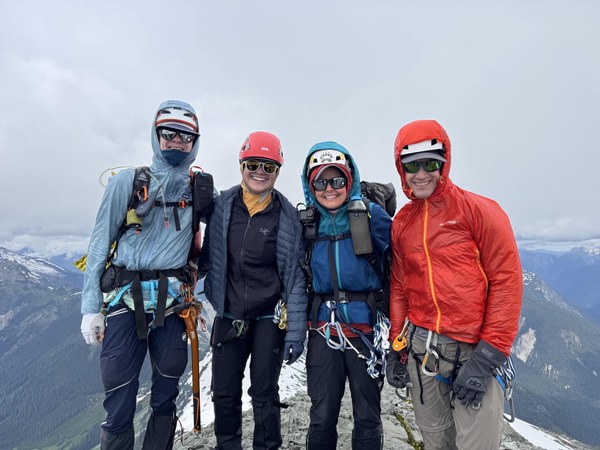
Once on the summit of Ruth, we evaluated a few options: 1) down the SW ridge towards camp, 2) down the scree/talus-covered NW ridge then over to camp, or 3) backtrack to the glacier, rope up, and circumnavigate the summit counter-clockwise to the notch we would use on our return journey.
- Option #1 looked okay with solid rock, but we could not see a continuous line and there was a snow finger that we couldn’t quite tell how the travel would be.
- Option #3 was very comfortable, if requiring a little more back-tracking, though we could not evaluate the condition of the crossing back onto the ridge line.
- Option #2 (which is what we decided on) looked like crossing a lot of choss, but none of it would be overhead of our team as we traversed. Marshall (rope lead) went down to scout it out and confirmed the route went fine all the way to/down the ridge. Then Michael (mentor on the climb) followed and spotted a climber’s path a little lower than his traverse route, giving the team an easier path to follow.
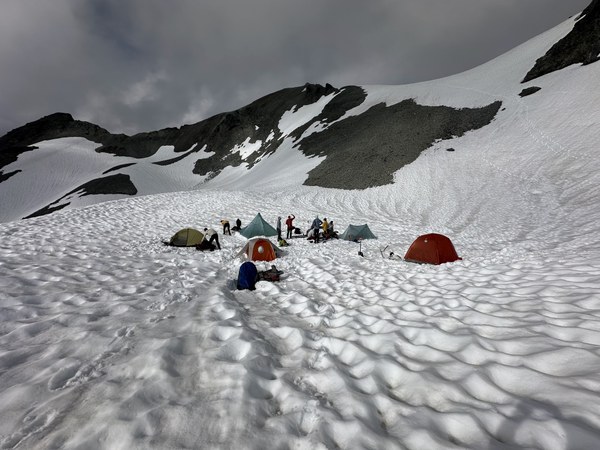
The team then packed up and followed that route down the NW ridge before descending south off the chossy ridge and across the snowfield. With another climbing party camped out above the gully, we camped in the snow-filled depression just north of the gully, which provided our camp with some protection from the wind.
Day 2 – July 6
We departed camp at 4AM for Icy, taking the gully route down (two long, steep snow patches with talus and some short rock steps with lots of loose rock in between). This involved ~30 ft of travel down very loose rock to reach the snow; a couple medium-sized rolled on us despite taking great care. At the snow, there was a small amount of room in the moat between the rock and snow which was used for putting on crampons in small groups. Groups of ~4-5 put on crampons before heading down the gully, with the rest of the team pausing to avoid kicking anything down on the staging area. The snow itself was good for travel being hard enough for the crampons, but soft enough that steps could be kicked. The team employed a variety of techniques (face-out, face-in, high dagger, etc.) as the steepness and their comfort dictated. There is an exposed section of loose rock about halfway down the gully. The transition to/from rock was tricky with the melting out snowpack causing many of us to punch through certain sections and having to step onto choss.
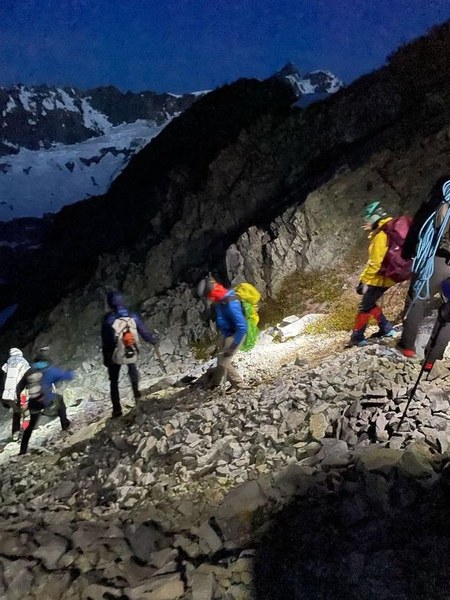
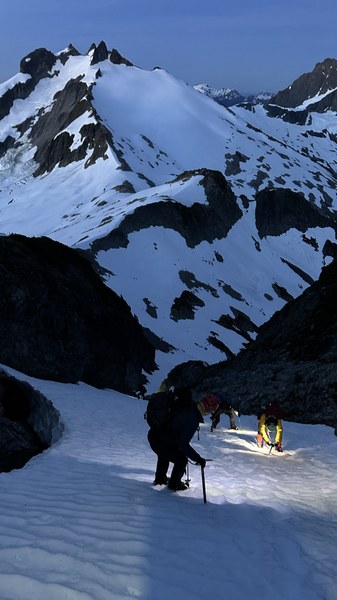
It should be noted that the gully descent was quite steep. Our party handled it great however subsequent parties may want to evaluate methods for protecting the gully or, as the season progresses, alternative routes for descending to the Icy Glacier.
Once down the gully, the team moved south out of the line of rockfall before heading up to the should above the bottom of the gully to take a break and rope up. In all, the gully took our group of 11 people 1h15 to descend the gully.
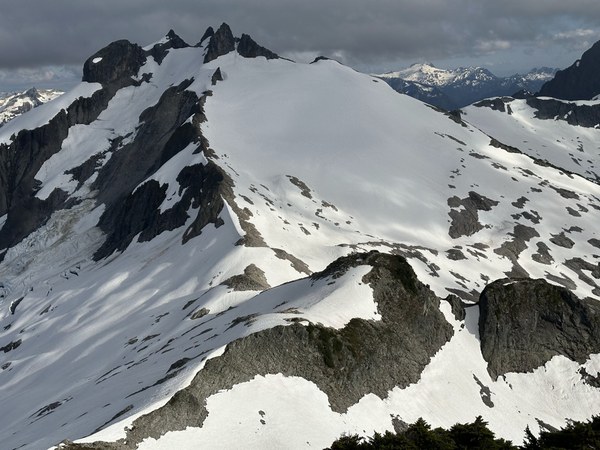
Traveling to and across the glacier on Icy’s NW aspect, and then over the ridge and up the snow to the base of the summit gully was straightforward with good tracks to follow and no obvious hazards in the route. The gully to the summit is the climber’s left gully of several options. On Icy, co-leaders and mentors extraordinaire Paul and Michael (and myself) scrambled up the summit gully to just below the obvious crux (~30m below summit). Paul slung a bomber horn/flake as an anchor and belayed Michael up from there; Michael placed a single cam (.4) on the right and found good hands on the right-hand side to get past the (short) crux. Michael set a redirect off the anchor at the notch (plenty of tat and two rap rings; worth inspecting some of the older strands) and used a second cam and a slung horn to anchor a handline at the summit. I and another rope lead (Richard) scrambled the gully un-roped; it was comfortable with dry rock but would have used the fixed line if otherwise. The larger group followed using prusiks on the fixed line before we somehow fit our party on the summit safely (if not comfortably).
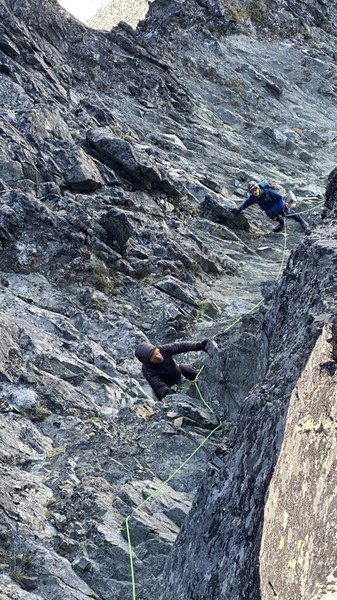
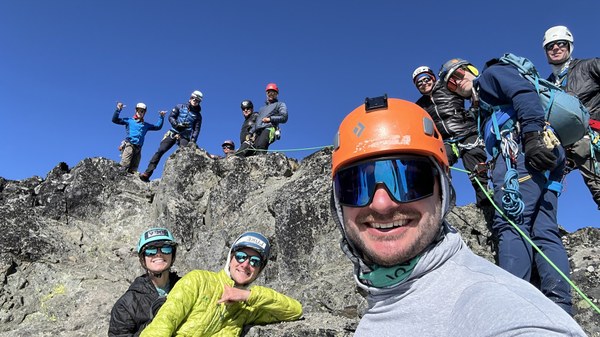
For the decent, the fixed line was tied off at the rappel anchor with a clove and most of the group descended on a single rope rappel allowing the handline to the summit to remain, with Paul inspecting rappel setups with it being many people’s first trip in the alpine, before the last few cleaned and converted the rappel into a 2x60m rope double rappel (with saddlebag for the second 60m). A 30m rap is adequate to get back down to scramble terrain, but we purposefully brought two 60m ropes to have a longer rap (down to the climbers’ trail). It is important to be conscious of loose rocks in this section and exit skier’s left out of the gully after the rappel to avoid rockfall.
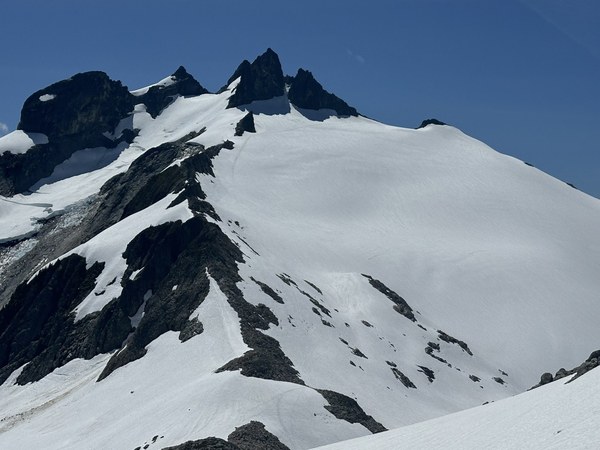
The return to the gully was similarly straightforward travel. The gully itself was much softer by the time we reached it (11AM) and the first rope team (shout out Luke and Devin) kicked some terrific steps that the following rope teams were able to utilize. While the snow travel up was easier than the travel down in the morning, the chossy section in the middle was much more hazardous.
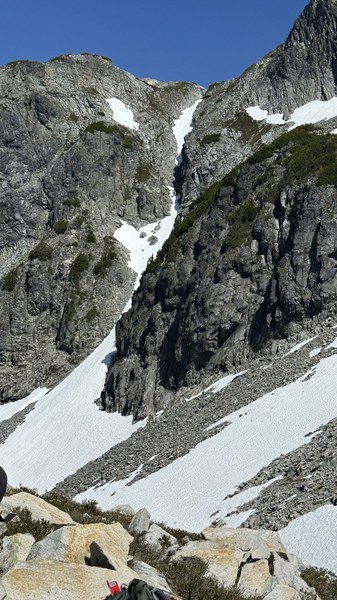
The first rope team ditched the crampons for the rock section, which seemed to help with traveling carefully over the loose rock (though it added time taking them off and putting them back on). Between the sun, fatigue, soft snow, and lack of a clear “best” route, this section was definitely more hair-raising on the way up. The team successfully worked through it and made it back to break down camp around 1PM.
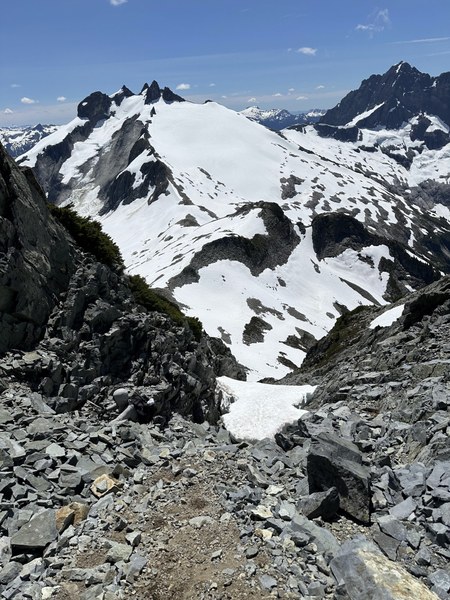
For the return journey past Ruth, we followed a trail up through the choss and crossed the ridge at a notch that was fairly easy to get across back to the snow on the north side of Ruth. After evaluating our position and the snowpack, we determined we likely had crossed below the glacier itself and would not need to rope up again to traverse down across the face of Ruth, as long as we paid careful attention to our route (and, obviously, without glissading). There were no visible open/opening crevasses or even thin cracks on our traverse.
Snow travel back to Hannegan Pass was straightforward, and the group was careful through the muddy gully (which was still muddy) back to the pass. We retrieved our trailrunners and the group de-briefed there, so people could move at their own pace on the way out knowing that holiday traffic was in store.
Water was filtered along the way, and we all made it back to the trailhead by 7pm.
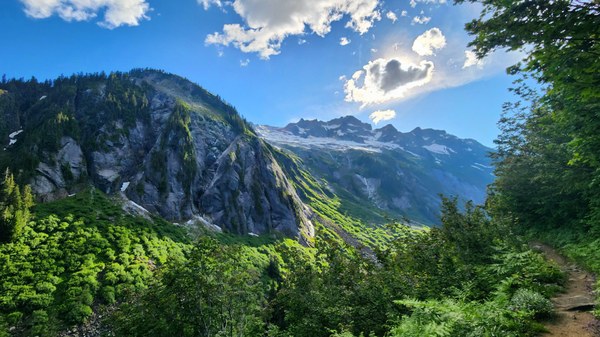
Overall, an awesome trip getting a terrific group of students their glacier climb. I definitely can understand the appeal of only doing Ruth Mountain, but Icy Peak is definitely an added challenge and worthwhile reward!